

ENCOURAGING STUDENTS TO SOLVE REAL-WORLD PROBLEMS
Mr. Tran Van Toan, former head of the mathematics department at Marie Curie High School (District 3, Ho Chi Minh City), compared the high school graduation exam under the 2006 General Education Program with the sample exam for the new graduation exam.
According to Master Toan, previously, the exam was assessed entirely through multiple-choice questions with four options, categorized into four levels of cognitive ability: recognition, comprehension, low-level application, and high-level application. However, the sample exam recently released by the Ministry of Education and Training is structured into three multiple-choice formats, each targeting three levels of candidate competency assessment: recognition, comprehension, and application.
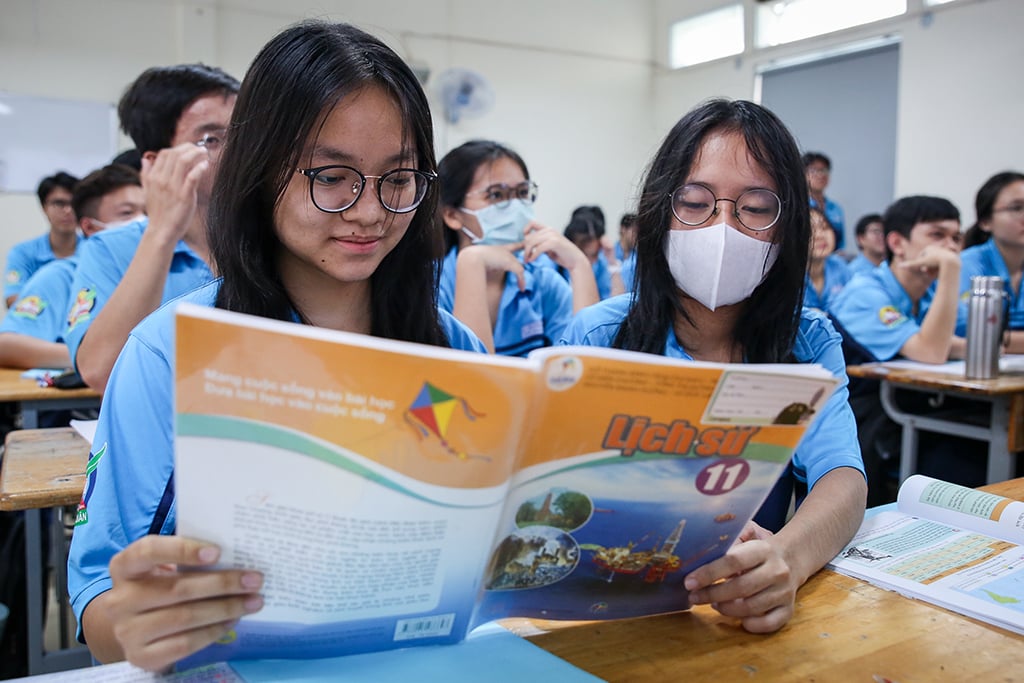
Schools have made changes in their teaching methods to help students following the 2018 General Education Program adapt to the changes in the high school graduation exam from 2025 onwards.
Most teachers affirmed that with the innovative approach demonstrated in this sample exam, teaching and learning methods, as well as assessment methods in schools, must certainly undergo timely changes. Mr. Tran Van Toan stated that while previously the teaching approach focused on content and the required level of knowledge, now we must emphasize developing the competencies of each student. This is concretized through ways to encourage students to solve real-world problems. Simultaneously, assessment methods must also change to a structure of three multiple-choice formats to better evaluate students' abilities.
Specifically for this year's 11th-grade students, the former head of the mathematics department at Marie Curie High School noted: "Students should focus on studying the content of definitions, theorems, and properties, and take notes on things that might lead to misunderstandings about a property or cause errors in the results."
In addition, students need to be able to apply general knowledge to solve real-world problems.
Similarly, Master Pham Le Thanh from Nguyen Hien High School (District 11, Ho Chi Minh City) stated that many new formats in exam question construction require changes in teaching and learning. Students must have a firm grasp and deep understanding of fundamental knowledge to be able to solve the questions. Students should no longer focus solely on solving exercises and exam questions while neglecting fundamental theoretical knowledge of the subject, because the exam content is very broad. The development of questions and the structure of exam questions are also more diverse and differentiated.
"Teachers no longer need to guess the exam questions or 'coach' students on the exam; instead, they must adhere closely to the curriculum's learning objectives, develop the curriculum, and construct questions based on those objectives to assess students. There will no longer be unrealistic math problems or exercises that lack the value of measuring students' abilities as before," emphasized Master Thanh.
FOCUS ON DEVELOPING SKILLS RATHER THAN MEMORIZING
According to Master Nguyen Viet Dang Du, head of the history department at Le Quy Don High School (District 3, Ho Chi Minh City), teachers need to be proactive in their teaching. Textbooks are no longer mandatory, so teachers need to adhere to the learning objectives of the content. Student assessment methods must also change towards evaluating diverse competencies rather than simply testing rote memorization of knowledge.
Students should proactively seek knowledge through various channels beyond what teachers provide in school. Proactive learning helps them improve their skills and apply their knowledge.
The recent sample exam for Literature shows that the direction of the high school graduation exam from 2025 onwards clearly reflects innovation, minimizing rote learning and memorizing model essays. Therefore, Mr. Do Duc Anh, from Bui Thi Xuan High School (District 1, Ho Chi Minh City), believes that teachers need to help students understand and master literature knowledge according to the genre characteristics required by the curriculum. They should focus on adhering closely to the learning objectives of each genre and essay type in the textbook. Instead of rote memorization, they should cultivate skills in students, fostering analytical, critical, and creative thinking rather than simply memorizing.
Based on the sample exam structure, teacher Duc Anh pointed out that the social commentary section accounts for 40% of the total score, so students need to equip themselves with social knowledge by observing life, listening to current events, paying attention to the spiritual issues of themselves and those around them, along with mastering the steps in writing a social commentary essay. Teachers need to increase practical exercises with texts outside of the textbook for students to explore and understand.
According to teacher Tran Thi Hong Nhung from the Asian International School (Ho Chi Minh City), the English graduation exam under the new curriculum has undergone significant changes and differences compared to previous years. The most noticeable changes are the removal of question types such as dialogues, synonyms, antonyms, error correction, synonym sentences, sentence combinations, and a reduction in the number of single multiple-choice questions. Instead, there are many new question formats, especially the appearance of more short passages with practical value. "To do well, students need to combine many skills, in addition to vocabulary and grammar, such as logical thinking and practical application," Ms. Nhung emphasized.
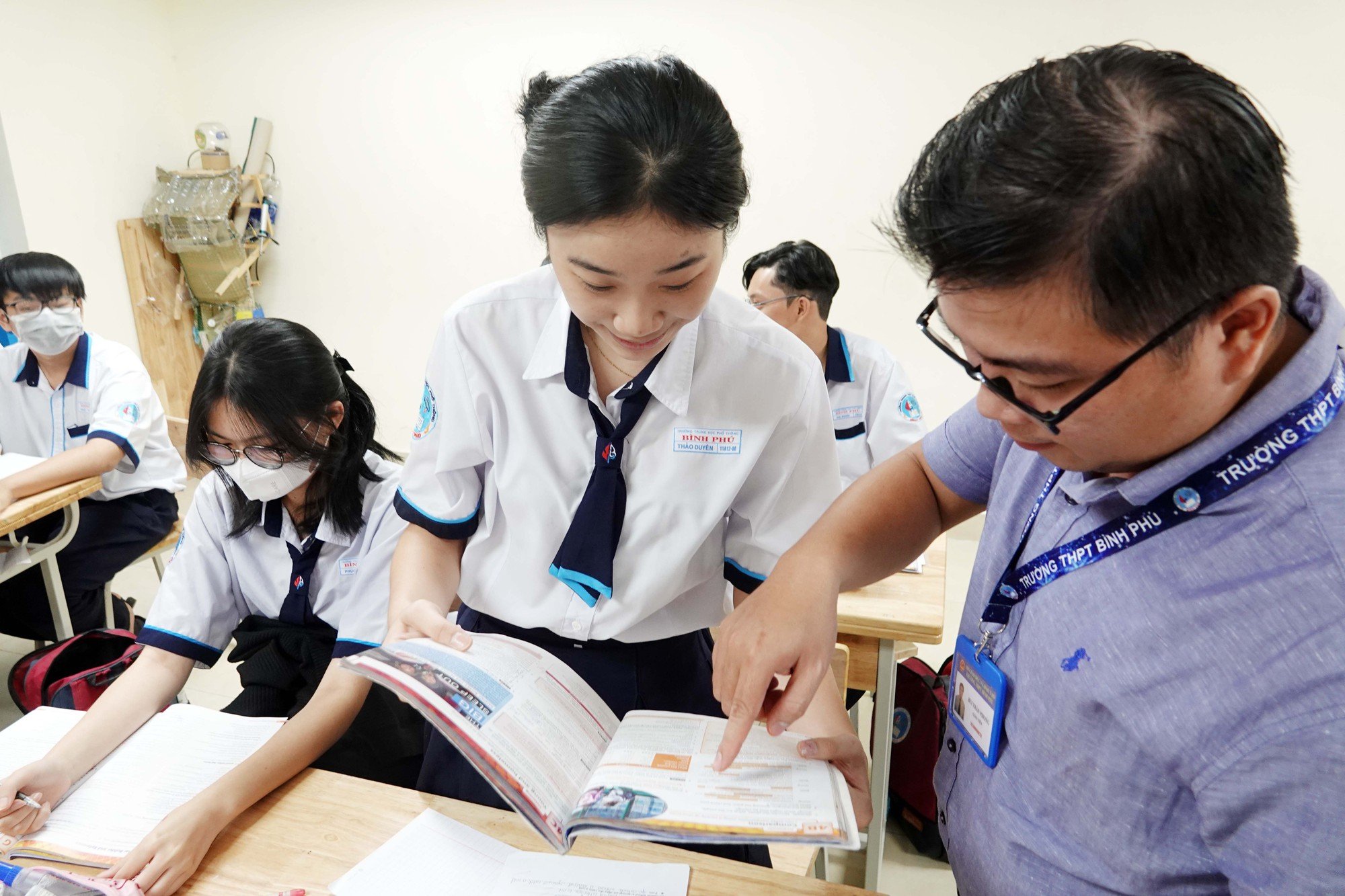
Teachers have made timely adjustments to help students keep up with changes in examinations.
According to Ms. Nhung, the English exam from 2025 onwards will very accurately assess students' true abilities, combining more skills, so teachers and students need to adjust their teaching, learning, and review methods starting now.
Specifically, students need to become familiar with common text types encountered in daily life and related to real-life situations, such as advertisements, announcements, and letters. To excel in the arrangement section, in addition to the necessary vocabulary for understanding, logical thinking skills are extremely important.
The sample exam questions are not difficult for students, but teaching methods will definitely need to be changed.
Ms. Pham Ha Thanh, a literature teacher at Le Quy Don High School in Ha Dong ( Hanoi ), commented: "The exam format recently announced by the Ministry for the literature subject is very similar to the way Hanoi University of Education has been setting competency assessment exams for the past two years. The biggest difference, and also the biggest challenge, in the literature exam from 2025 onwards is that it will not use any materials from the textbook. Therefore, teaching and assessment in high schools must prepare and familiarize students with this."
According to Ms. Thanh, recently, the school's literature exams included materials not found in the textbook, and it must be acknowledged that students faced significant difficulties, even though the school has a top-tier entrance quality. This is understandable and forgivable because while they study and take exams under the new curriculum, they spent nine years studying the old curriculum and undergoing old-style assessments.
Ms. Thanh also assessed that the sample exam's limitation on the number of words in each section of the exam, specifying a maximum of 1,300 words for the text provided (not exceeding 1,300 words), is necessary to suit the exam time, the students' comprehension level, and the presentation of the exam questions...
According to Ms. Thanh, teaching methods under the new curriculum have already changed, but after the release of the sample exam, they will certainly have to change even more drastically. Instead of relying solely on the works in the textbook, teachers must teach by genre, thoroughly analyzing the characteristics of each genre so that when students encounter completely new material, they can identify its genre and, from there, understand it independently and express their own thoughts; avoiding rote memorization and reliance on model essays...
Studying the sample history exam, Ms. Nguyen Thi Dien from Tran Quang Khai High School ( Hung Yen province ) suggested that teachers should plan their lessons in stages. First, they should teach foundational knowledge; then, they should teach and review specific topics to enhance basic knowledge and delve deeper into key lesson units; and finally, conduct tests and assessments to improve teaching methods and approaches in subsequent stages.
Ms. Dien also believes that changing the way test questions are formulated to closely resemble the sample questions is necessary.
Tue Nguyen
Source link


![[Photo] Nhan Dan Newspaper celebrates the 96th anniversary of the founding of the Party.](/_next/image?url=https%3A%2F%2Fvphoto.vietnam.vn%2Fthumb%2F1200x675%2Fvietnam%2Fresource%2FIMAGE%2F2026%2F02%2F03%2F1770093917726_z7495755471262-66d965cdf06fce4e837f306802ae37b1-7408-jpg.webp&w=3840&q=75)


![[Photo] Standing Committee member of the Party Central Committee Tran Cam Tu presents the Decision appointing the Secretary of the Party Committee of the Ho Chi Minh National Academy of Politics.](/_next/image?url=https%3A%2F%2Fvphoto.vietnam.vn%2Fthumb%2F1200x675%2Fvietnam%2Fresource%2FIMAGE%2F2026%2F02%2F02%2F1770039902160_le-cong-bo-bt-hvctqg-11-7880-jpg.webp&w=3840&q=75)






Comment (0)