

Despite the sharp rise in global gold prices, central banks – the "sharks" of the gold market – continued to buy an additional 18 tons of gold in January. The race to fill gold vaults is still ongoing.
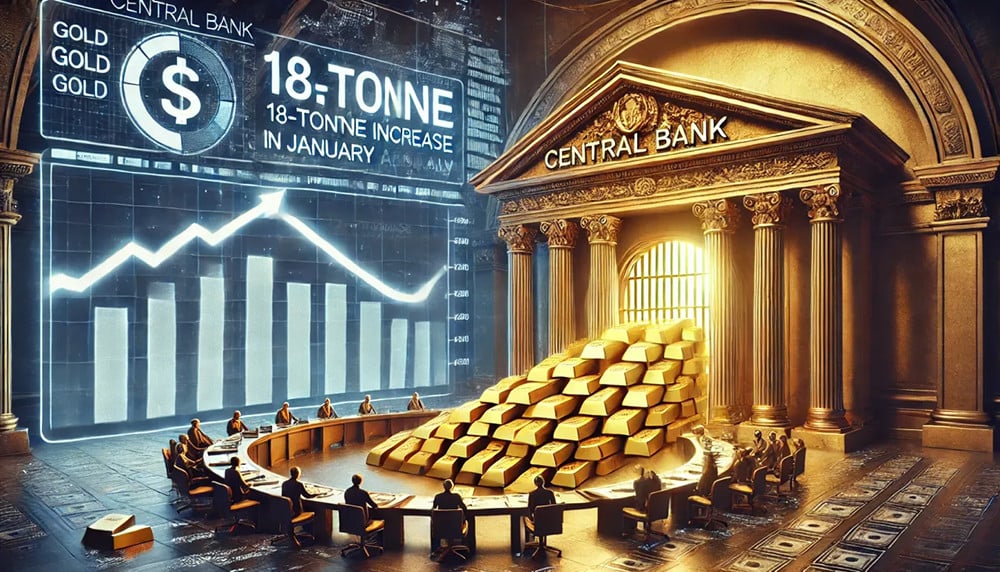
According to the latest report from the World Gold Council (WGC), central banks' demand for gold is far from over. In January, central banks purchased an additional 18 tonnes of gold.
In 2024, central banks purchased a total of 1,045 tonnes of gold, marking the third consecutive year that gold purchases exceeded 1,000 tonnes.
The WGC report indicates that central banks in emerging markets continue to lead in net buying activity.
The Central Bank of Uzbekistan was the biggest buyer in January, increasing its official reserves by 8 tonnes.
China continues to play a leading role after its central bank purchased an additional 5 tons of gold. This marks the third consecutive month that China has increased its gold reserves, following a six-month pause last year.
Gold currently accounts for 6% of China's total foreign exchange reserves. Many analysts believe this figure is still low if China wants to compete with the US dollar as a global reserve currency.
The Central Bank of Kazakhstan was the third-largest buyer of gold in January. Timur Suleimenov, President of the National Bank of Kazakhstan, said the bank had discussed switching to monetary neutrality in its gold purchases, with the aim of boosting international reserves and protecting the economy from external shocks.
This bank has started selling USD – a move that could be seen as related to its gold purchases.
The National Bank of Poland and the Reserve Bank of India each purchased 3 tons of gold. The Czech National Bank increased its gold reserves by 2 tons, and the Central Bank of Qatar purchased 1 ton of gold.
On the selling side, the Central Bank of Russia and the Central Bank of Jordan each sold 3 tons of gold. The National Bank of the Republic of Kyrgyzstan sold 2 tons.
Marissa Salim, Senior Research Lead at WGC, noted that gold remains a crucial asset for central banks in the face of rising geopolitical risks. Central banks continue to play a vital role in global gold demand.
"The shift from armed conflict to broader economic tensions has reinforced the net buying trend of central banks since 2022. Many central banks are taking advantage of temporary price dips as buying opportunities," the expert analyzed.
Regarding the gold market in the near future, Salim believes that gold prices will be supported by the increasing trend of deglobalization. The tariff threats from US President Donald Trump are prompting many emerging market nations to diversify their safe-haven assets beyond the US dollar.
Recently, Trump sparked a global trade war after imposing a 25% tariff on imports from Mexico and Canada, and an additional 10% tariff on imports from China.
Heading towards $3,300 per ounce
Ole Hansen, Head of Commodity Strategy at Saxo Bank, believes gold has room to rise higher after a short correction. He says the $3,000/ounce target has returned.
"Gold still has many supporting factors. Technical charts signal strong demand despite selling pressure from centralized traders. Beyond diversification and safe-haven demand, gold is likely to continue benefiting from central bank buying as concerns about financial debt persist," according to Ole Hansen.
Along with geopolitical instability supporting gold's safe-haven appeal, Hansen said the precious metal is benefiting from the increasing weakness of the greenback as the USD index tests key support at 106 points.
He also noted that slowing economic activity is raising expectations that the Federal Reserve will be forced to cut interest rates this year, even as inflation remains high.
Hansen maintained his new gold price target of $3,300 per ounce.
Source: https://vietnamnet.vn/cuoc-dua-lap-day-cac-ham-vang-cua-ca-map-the-gioi-2377797.html


![OCOP during Tet season: [Part 3] Ultra-thin rice paper takes off.](/_next/image?url=https%3A%2F%2Fvphoto.vietnam.vn%2Fthumb%2F402x226%2Fvietnam%2Fresource%2FIMAGE%2F2026%2F01%2F28%2F1769562783429_004-194121_651-081010.jpeg&w=3840&q=75)




Comment (0)