

Obesity is one of the main risk factors for non-alcoholic fatty liver disease, which can progress to hepatitis, cirrhosis, and hepatocellular carcinoma.
Fatty liver disease is a condition where fat accumulates in more than 5% of the liver's weight (normally it's only 2%-4%). The disease is divided into two types: non-alcoholic fatty liver disease and alcoholic fatty liver disease.
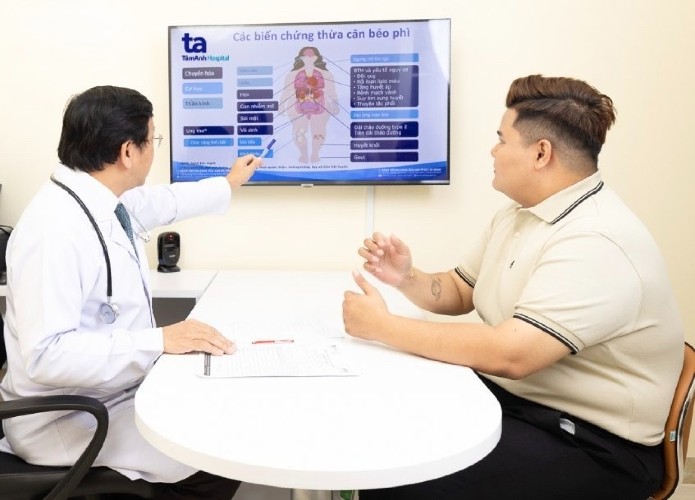 |
| Obesity is one of the main risk factors for non-alcoholic fatty liver disease, which can progress to hepatitis, cirrhosis, and hepatocellular carcinoma. |
The global prevalence of non-alcoholic fatty liver disease is increasing over time, alongside the obesity and diabetes epidemics. The disease is linked to metabolic disorders, including type 2 diabetes, hypertension, dyslipidemia, and especially obesity.
The risk of non-alcoholic fatty liver disease increases with a higher body mass index (BMI). The condition affects 50%-90% of obese individuals, compared to only about 15%-30% in the general population. In fact, 65% of people with grade 1-2 obesity (BMI = 30-39.9 kg/m²) and 85% of people with grade 3 obesity (BMI = 40-59 kg/m²) suffer from this condition.
For example, Mr. NTL (35 years old, Hau Giang ) gained 42kg in less than a year (from 60kg to 102kg), experiencing frequent pain in his knees, shoulders, and neck, and difficulty breathing when climbing stairs.
To lose weight, he tried strict diets and supplements, but without success. He went to a medical facility for an examination, where his Inbody body composition analysis showed a BMI of 41.8 (obesity grade 3). Test results revealed grade 3 fatty liver, dyslipidemia, and prediabetes.
After 10 months of persistent treatment in Ho Chi Minh City, traveling from Hau Giang, he lost 22 kg, his fatty liver disappeared, his obesity decreased from grade 3 to grade 1, and his joint pain and risk of cardiovascular disease and diabetes decreased. His goal is to reduce his weight to 70 kg.
Dr. Lam Van Hoang, Director of the Weight Loss Treatment Center at Tam Anh General Hospital, said that weight loss is key to controlling and treating non-alcoholic fatty liver disease.
Losing just 5-10% of body weight can help reduce liver fat, improve insulin resistance, decrease inflammation, improve lipid metabolism, and enhance liver function.
This is because when you eat too much high-calorie and carbohydrate-rich food, your body can develop insulin resistance. Therefore, more than 70% of obese people suffer from insulin resistance, affecting the body's ability to regulate blood sugar levels, leading to the liver producing excessive glucose (sugar).
As a result, the liver has to convert excess glucose into fat and store it in liver cells, causing fatty liver disease. Conversely, non-alcoholic fatty liver disease also causes and exacerbates insulin resistance, leading to a "vicious cycle".
Obesity is often accompanied by increased levels of free fatty acids in the blood. These fatty acids are transported from adipose tissue to the liver, causing fat accumulation there. When the amount of fat exceeds the liver's ability to metabolize it, the fat accumulates in liver cells, leading to fatty liver disease.
In addition, obese individuals often suffer from lipid metabolism disorders, making it more difficult for the body to utilize and metabolize fats. When the liver cannot metabolize fats effectively, fat accumulates in liver cells, increasing the risk of fatty liver disease.
Furthermore, chronic inflammation associated with obesity can increase levels of oxidative stress (an imbalance between free radicals and antioxidants in the body), damaging liver cells, increasing the risk of fat accumulation in the liver, and progressing to fatty liver disease.
Obesity not only causes fat accumulation in the liver but also in other fatty tissues throughout the body. The increased amount of fat outside the liver puts pressure on the liver and prompts it to absorb more fat from the blood, leading to fatty liver disease.
To prevent non-alcoholic fatty liver disease in obese individuals, weight management is one of the most effective measures.
Overweight and obese individuals require comprehensive, multi-modal weight loss solutions, combining optimal treatment protocols including endocrine therapy, nutritional counseling, exercise regimens, and advanced technology treatments. This aims to minimize complications and maintain overall health for overweight and obese individuals.


![OCOP during Tet season: [Part 3] Ultra-thin rice paper takes off.](/_next/image?url=https%3A%2F%2Fvphoto.vietnam.vn%2Fthumb%2F402x226%2Fvietnam%2Fresource%2FIMAGE%2F2026%2F01%2F28%2F1769562783429_004-194121_651-081010.jpeg&w=3840&q=75)

![OCOP during Tet season: [Part 2] Hoa Thanh incense village glows red.](/_next/image?url=https%3A%2F%2Fvphoto.vietnam.vn%2Fthumb%2F402x226%2Fvietnam%2Fresource%2FIMAGE%2F2026%2F01%2F27%2F1769480573807_505139049_683408031333867_2820052735775418136_n-180643_808-092229.jpeg&w=3840&q=75)


Comment (0)