

Foreign businesses in China are facing a major test as consumers increasingly switch to buying domestic products.
While grappling with a weak economic recovery in China, global consumer brands are simultaneously facing another concern: Chinese consumers are increasingly opting for domestic brands.
Five years ago, the country's consumer market was dominated by foreign brands. At that time, domestic brands struggled to compete and often faced difficulties due to low quality and weak marketing, according to the WSJ .
But now, many Chinese brands are becoming popular on online marketplaces, supermarkets, and shopping malls. Along with this, their reputation for quality, design, and sales techniques is improving, capturing the rapidly changing tastes of consumers.
The pandemic years helped local brands thrive, thanks to their quick adaptation and leveraging of livestreaming sales trends. They increased their hiring of celebrities and influencers and utilized short-video apps for marketing. Products were also carefully crafted to suit local tastes. Examples include eyeshadows designed for Chinese skin tones, ginseng toothpaste, and $200 Li Ning sneakers – named after the Olympic gold medalist.
Global brands like Adidas, Procter & Gamble, and L'Oréal all earn the majority of their global sales in China. Faced with this situation, they are also forced to adopt tactics similar to those used by their domestic competitors, such as boosting online sales channels and designing products that suit Chinese culture.
James Yang, an expert at Bain's Shanghai branch, said that simply bringing foreign brands to China and opening stores is not enough these days. "Now you have to work hard to make money," he said.
Bain stated that China has immense appeal. The country is projected to surpass the US within this decade to become the world's largest consumer market, with spending reaching $5.4 trillion by 2026.
Many people shopped online during the pandemic and continue to do so. E-commerce sales in China increased by 13.8% in the first five months of the year, while sales at small retail stores of individual brands rose by 6%.
Consumers are becoming more frugal as the country's economic growth slows. Many of them are increasingly making purchasing decisions centered on China, partly due to national pride amid tensions with the U.S. And because they view Chinese products as equal to – if not better than – Western brands.
Xiaohan Dou, 47, who works in Beijing, has switched to buying makeup from a local brand called Perfect Diary. She was attracted by the price and presentation. The company's 12-color eyeshadow palette comes in a box decorated with animal motifs. The colors are named after animals like "fox tail" and "fur." It costs only $15, compared to a 6-color L'Oréal palette that starts at $23. "Most consumers are more price-sensitive now than they used to be," Dou said.
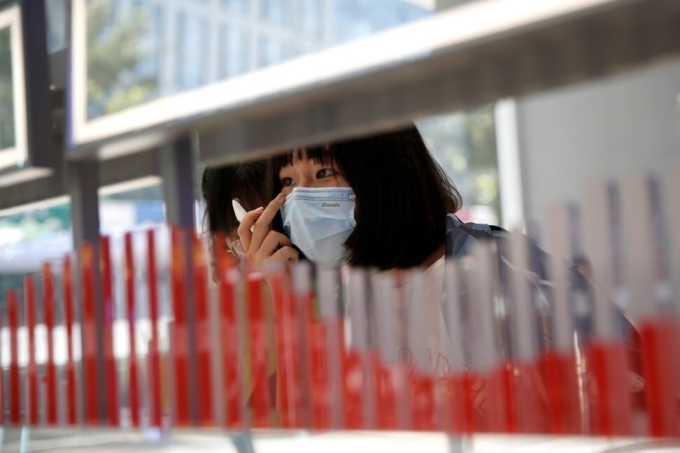
The girl tries out products in a Perfect Diary store. Photo: Reuters
Perfect Diary started as an online brand on Alibaba in 2017, before opening physical stores. Since then, it has become China's best-selling domestic cosmetics retailer, according to market research firm Euromonitor International.
Perfect Diary's parent company and another emerging player, Florasis, together accounted for about 15% of the country's more than $9 billion market for tinted makeup in 2021, up from nothing six years earlier, according to Euromonitor. Their advantage lies in their makeup products being better suited to Chinese skin.
Recently, during a Perfect Diary livestream sales event, the female host introduced lipstick shades and demonstrated the product to over 25,000 viewers. She then distributed discount coupons, gifts, and offered free shipping to buyers. According to McKinsey, livestreaming accounted for approximately 10% of Chinese e-commerce sales in 2021 and is rapidly increasing.
According to the latest Euromonitor data, multinational companies like L'Oréal saw their market share decline from 2016 to 2021. L'Oréal now has online stores on Douyin, and consumers can consult beauty advisors via live video calls. A spokesperson for L'Oréal stated that they maintain their leading position in the Chinese market and that the brand's origin is not the reason for that success.
Beyond good prices and confidence in quality, the shopping habits of Chinese consumers are changing partly thanks to younger customers. They are more interested in their country's heritage and increasingly open to new brands. The government is also supporting domestic brands. At the Party Congress in March, several delegates called on consumers to support local brands.
A decade ago, Chen Meiting, who lives in Shenzhen, bought Nike shoes, Converse All-Stars, and L'Oréal cosmetics because of the quality, design, and brand reputation. Now, the 32-year-old woman buys everything from shoes to sunscreen from domestic brands. She believes they are just as good as foreign brands.
She spent $200 on shoes from Chinese sportswear manufacturer Li Ning and uses them for hiking and dancing. "I even like them more than my Yeezys," Chen said, comparing them to an Adidas brand.
Part of the reason more people are buying domestic goods is the "guochao" trend, a term for "national fashion," which incorporates designs with elements of Chinese culture. This trend has been gaining momentum since Li Ning unveiled its signature red and yellow streetwear collection at its 2018 New York Fashion Week show.
"Consumers previously didn't care much about the 'Made in China' element on their clothing. Now that desire is growing," said Ivan Su, China analyst at Morningstar.
Western brands are following suit. Adidas (Germany) launched short-sleeved shirts with bold Chinese characters printed on them. Last year, the American luxury brand Coach produced a line of clothing featuring the White Rabbit candy logo, a design popular in China.
Two domestic sportswear brands, Li Ning and Anta Sports, have invested in new production lines. Morgan Stanley forecasts their market share will reach 22% by 2024, up from 15% in 2020. They are gaining an advantage over Adidas and Nike, as Chinese consumers view Li Ning and Anta Sports products as offering better value for money when considering quality-to-price ratio.
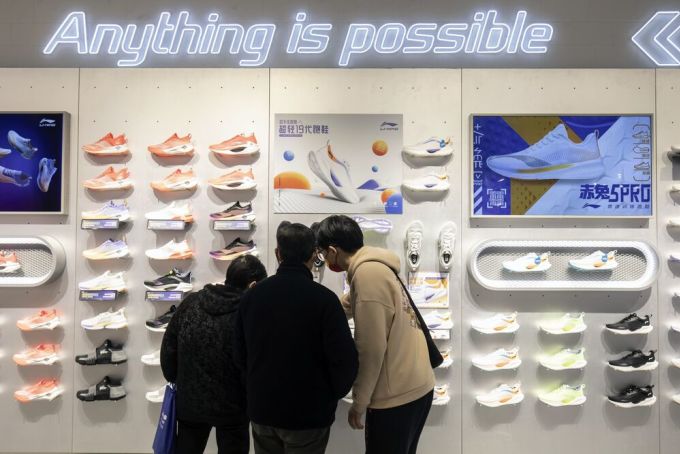
A Li Ning store in Shanghai. Photo: Bloomberg
Morgan Stanley forecasts Adidas' market share will fall to 11% by 2024, down from 19% in 2020. In 2021, Anta surpassed Adidas to become the second-largest sporting goods company in China by sales volume.
In November 2022, Adidas' CFO Harm Ohlmeyer acknowledged the company faced numerous challenges, including geopolitical factors that made lifestyle influencers hesitant to collaborate with Western brands.
An Adidas spokesperson said the company is expanding its product innovation center in the country and adjusting its marketing and retail operations for Chinese customers. Nike remains the leader in the Chinese sporting goods market, with 15% of the group's revenue coming from mainland China, Taiwan, Hong Kong, and Macau.
To maintain its position, Nike is also trying to capture local tastes. Nike CEO John Donahoe said the company is serving Chinese consumers with localized designs, such as incorporating the 12 zodiac animals onto sneakers sold in the country.
Domestic companies are also gaining ground with consumer products such as toothpaste. Yunnan Baiyao Group sells more toothpaste than Procter & Gamble, which owns the Crest and Oral B brands, in China, according to Euromonitor.
Analysts say consumers are drawn to Yunnan Baiyao toothpaste because of its Chinese herbal ingredients. Yunnan Baiyao Group also sells shampoos and ointments. In the seven years leading up to 2021, the company's revenue doubled to over $5 billion.
China is P&G's second-largest market after the US, accounting for approximately 10% of global revenue. In February, P&G CEO Jon Moeller said the company was looking to improve its reach to Chinese consumers by shifting to online retail, livestreaming sales, and social media.
Phiên An ( according to WSJ )
Source link



































































































Comment (0)