


Tan Hoa (Quang Binh province) was once a poor rural area suffering from annual floods, but now it has become "the best tourist village in the world ".
Around 7 PM, darkness had completely enveloped the small village of Tan Hoa in Minh Hoa district. Occasionally, a faint light flickered from a passerby's flashlight. The atmosphere was quiet, only occasionally interrupted by the sound of a motorbike speeding by. Everything was virtually indistinguishable from a typical rural village.
Tan Hoa began developing tourism around 2014 when the Tu Lan discovery tours were put into operation. In the 10 years from 2013 to 2023, the total number of visitors reached approximately 63,000. In the last three years, the number of visitors has consistently recorded strong growth, from less than 4,000 to over 9,000.
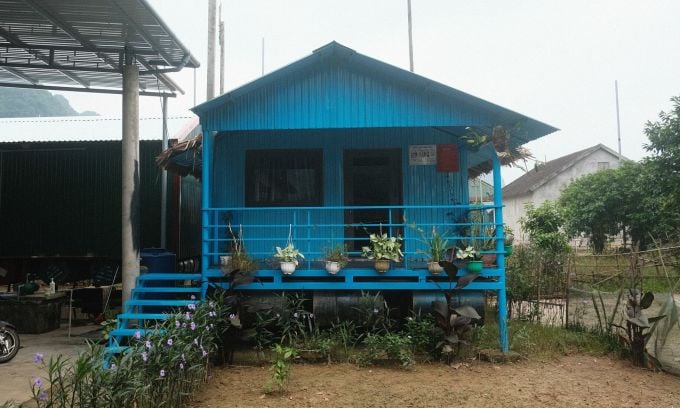
A rural homestay in Tan Hoa has barrels attached underneath that help the house automatically lift itself during floods. Photo: Tu Nguyen
Visitors to Tan Hoa have two accommodation options: rural homestays and Tu Lan Lodge. Currently, the village has 10 rural homestays, with nightly costs ranging from 950,000 VND to 1,500,000 VND (cheaper during the off-season). Some homestays are separate from the host's house, while others are located within the property.
The homestay has a rustic charm, from the choice of sea-blue color scheme and flower basket decorations to the thatched roof. Underneath the houses are barrels used as floats during the flood season. Thanks to this, even during the rainy season, visitors can still come and experience the place. This is how the village adapts its tourism development to the changing weather.
The interior is about 30 square meters with an en-suite bathroom, two beds, and a small camping-style table and chairs. All the furnishings are chosen to be as simple as possible, yet still provide comfort and meet the basic needs of guests.
Outside, the rain began to fall more heavily. Quang Binh is entering its flood season (June-September in the lunar calendar). In 2012, the water level rose to 12 meters, submerging almost all the houses in the village. Since then, Tan Hoa has also been known as the "flood epicenter of Quang Binh".
Following this flood, several solutions were proposed, such as relocating residents or demolishing mountains to create flood drainage channels, which required high costs and impacted the natural ecosystem. Necessity is the mother of invention, and the people of Tan Hoa created floating rafts, later upgraded into floating houses, to live with the floods.
In the morning in Tan Hoa, tourists can experience ATV riding. This is one of the popular activities for visitors to Tan Hoa, besides exploring the caves. The meeting point for the ATVs is near the house of Mr. Truong Xuan Do, famous throughout Quang Binh as the "guardian of the ironwood forest". The ironwood forest area included in the ATV tour is the same forest he has guarded for decades. However, the tour only covers the edge of the forest, not venturing deep inside.
"People are being born in large numbers, but the forests are being depleted. I have to protect them for future generations," said the 73-year-old man.
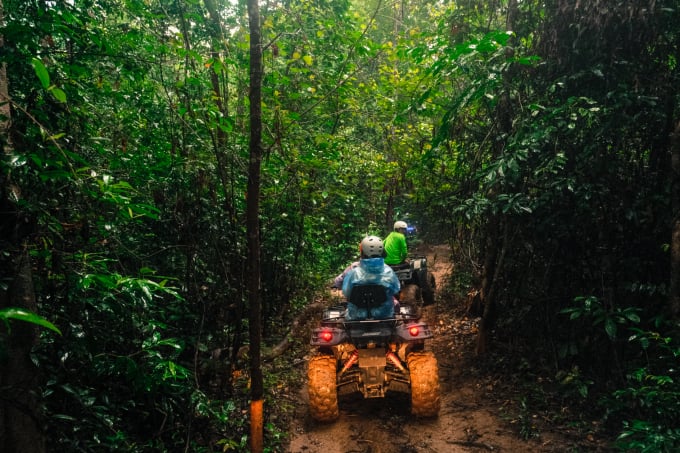
Inside the teak forest area that tourists will pass through when participating in the ATV tour on October 18th. Photo: Tú Nguyễn
The trek through the lim forest isn't long, lasting about 45 minutes, but visitors constantly navigate steep slopes and sharp turns where the driver has to strain to prevent the vehicle from tipping over. Interspersed with these heart-stopping moments are some flat stretches, allowing both the driver and passengers to appreciate the pristine beauty of Quang Binh's nature.
Tan Hoa has people who love nature and are creating tourism products linked to nature. This is also a leading tourism trend in the world after the Covid-19 pandemic, especially attracting foreign tourists.
Following the tourism development model in Tan Hoa, Oxalis company collaborates with the village to create tourism products and jobs for the local people. To date, in addition to 10 homestays, this collaboration has created 70 jobs for porters (people who carry goods through the forest and mountains), 10 homestay restaurants, and four households supplying food and vegetables.
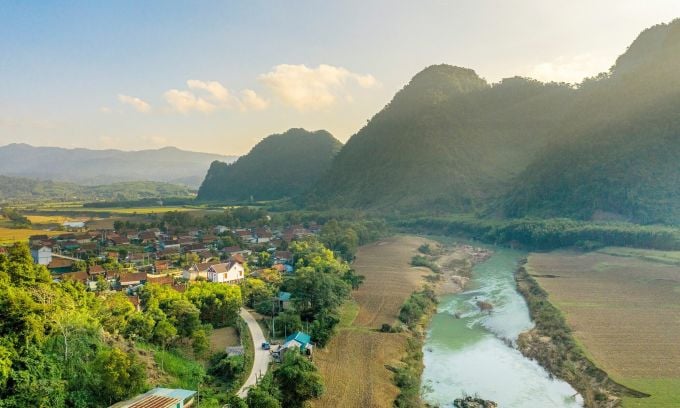
Tan Hoa village viewed from above. Photo: Oxalis
The people of Tan Hoa will handle the operation and service aspects. In the future, as tourism develops and the people become more proficient in tourism activities, Tan Hoa can move towards forming a community tourism cooperative model. Currently, the people of Tan Hoa are only in the initial stages of familiarizing themselves with tourism, mainly focusing on service provision.
Mr. Nguyen Chau A, Director of Oxalis, said that Tan Hoa is taking "slow but steady" steps instead of developing tourism on a massive scale. Despite possessing great tourism potential with its vast cave system, majestic natural landscapes, and historical relics, the people of Tan Hoa have no concept of "doing tourism." Therefore, the company needs to gradually influence and guide them to absorb this new knowledge.
Mr. Á recounted that in the beginning, they hired both domestic and foreign experts to write operating procedures and train staff (who were from Tân Hóa), but it failed. Afterward, they decided to let the locals do things themselves, following their habits and gradually standardizing the process. That's also why the furnishings in both the "rural homestay" and Tú Làn Lodge are quite minimal and simple. Mr. Á said that the more items and complexity there are, the more confused the staff become.
Tourism has also contributed to a positive shift in the mindset of the people of Tan Hoa. Previously, the men of Tan Hoa only went into the forest and did nothing else. Initially, when hiring local men as porters for tours, they adamantly refused to cook for guests, believing it was "women's work."
However, over time, seeing that everyone, including their superiors, was willing to help in the kitchen, they became more willing to learn and work harder, earning more money after each tour. Now, whenever there's an event in Tan Hoa commune, it's the men who pitch in to cook.
Tourism in Tan Hoa also has a positive impact on the environment. The majority of porters come from a background of "forest dwellers"—or illegal loggers—operating primarily in the Tu Lan forest. They exploit forest honey, hunt wild animals, and sell timber. This seriously affects the ecosystem of Tu Lan, causing many rare species such as wild elephants, tigers, bears, and deer to gradually disappear.
Many porters said they were surprised when tourists gasped in amazement at the sight of gibbons or ancient trees. That moment made them realize they had to protect the forest so that more tourists would come.
Tourism also provides job opportunities for households that cook for tourists. Truong Thi Huong, the owner of a cooking household, who has only been cooperating with the company for a year, said that her life has changed significantly thanks to tourism. Ms. Huong's family only needs to focus on cooking; the company takes care of bringing guests back. The work helps her family earn an extra 7-8 million VND per month.
Mr. Tran Xuan Hung, Vice Chairman of the Tan Hoa Commune People's Committee, said that the village still has many areas for improvement despite recently receiving the title of "World's Best Tourist Village". Tan Hoa has about 3,000 residents, but the number of households that can access tourism-related work is still relatively small. In the future, Mr. Hung hopes that at least one-third of the villagers can participate in tourism development.
Mr. Hung shared that participating in tourism is now a dream for most households. For example, a purely agricultural household used to earn a maximum of only about 3 million VND per month. Meanwhile, porter salaries during peak season can sometimes reach 13 million VND per person.
"People are gradually adapting to tourism, from cleaning up trash on the streets and tending to flowers in front of their houses to focusing on education," he said.
Tu Nguyen
Source link








































































![[Photo] Coc Ly market bustling on the eve of Tet](https://vphoto.vietnam.vn/thumb/402x226/vietnam/resource/IMAGE/2026/02/14/1771062261424_baolaocai-br_img-6457-jpg.webp)



Comment (0)