


 |
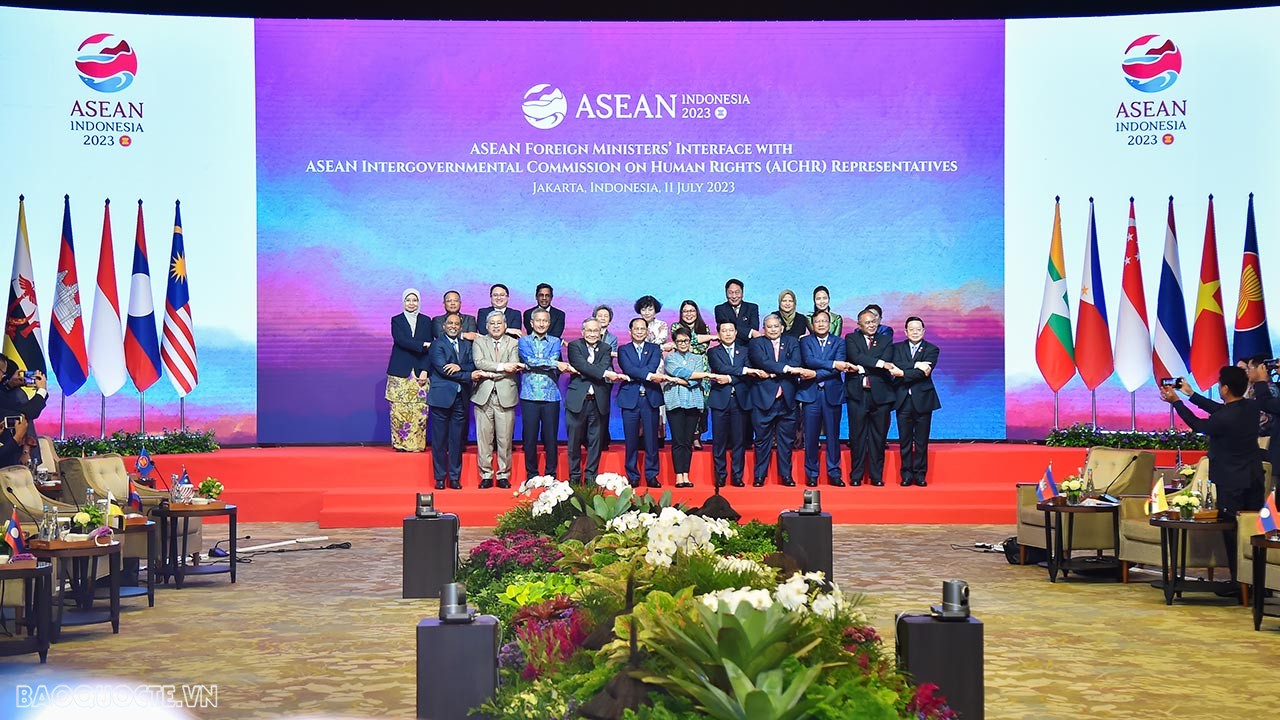
| Delegates attend a dialogue session with the ASEAN Intergovernmental Commission on Human Rights (AICHR) on July 11. (Photo: Tuan Anh) |
The issue of "human security" in the development process of ASEAN.
Since its inception, human security has been a key issue for ASEAN and a goal in the building of the ASEAN Community (AC). ASEAN embraced the concept of “security” during the Cold War, although the Bangkok Declaration did not explicitly mention the word “security”.
At that time, regional cooperation in the security field emphasized cooperation in the military sector while upholding the principles of national sovereignty and non-interference as stipulated in the 1976 Treaty of Friendship and Cooperation (TAC).
With the shift in security concepts, ASEAN's current policy focuses not only on traditional security concepts but also on non-traditional security areas, although this is not explicitly stated in the ASEAN Charter.
Therefore, human security is not purely a security issue but also relates to political , economic, social, and cultural issues. This is encompassed in Article 8 of the ASEAN Charter, based on the principle of comprehensive security.
Furthermore, natural disasters are considered a significant human security issue in Southeast Asia. In the ASEAN Political and Security Community (APSC) Master Plan, the concept of non-traditional security is addressed in section 9 of the chapter on the characteristics and components of the APSC.
The issue of disaster management is clearly addressed in the second characteristic, which is a cohesive, peaceful, and steadfast region with a shared responsibility for comprehensive security.
One of the most significant milestones in disaster management in ASEAN after the promulgation of the ASEAN Charter was the adoption of the ASEAN Agreement on Disaster Management and Emergency Response (AADMER) in 2009, although this agreement had been put forward in 2005.
To fulfill this function, ASEAN established the ASEAN Coordinating Centre for Humanitarian Assistance and Disaster Management (AHA Centre), which began operations in November 2011 and is responsible for coordinating disaster management within ASEAN.
In recent years, due to the need to build the ASEAN Community, member states of the bloc have gradually adjusted their security approach, considering the human factor as one of the main components of national security and promoting regional and global integration.
This is reflected in the ASEAN Charter, adopted in November 2007, and in the national development programs of member states.
The adoption of the ASEAN Charter, which emphasizes human security as stated in the declaration: “Adherence to the principles of democracy, the rule of law and good governance, respect for and protection of human rights and fundamental freedoms” (in Article 9 of the Preamble), and the establishment of a human rights institution, in line with the objectives and principles of the ASEAN Charter on promoting and protecting human rights and fundamental freedoms, demonstrates ASEAN's progressive affirmation of the importance of human security.
The establishment of the ASEAN Community (AC) and the affirmation of the goal of building a people-centered and people-oriented community is the clearest evidence of the importance of human security to ASEAN's development goals.
Obstacles to the “ASEAN Way” in addressing human security challenges.
ASEAN was initially established with the aim of ensuring security for the Southeast Asian region and not to integrate the economic sectors of member states or to establish supranational organizations. ASEAN further strengthened cooperation in the field of defense and security, specifically by issuing the Declaration on the Zone of Peace, Freedom and Neutrality (ZOPFAN) in 1971 and, secondly, at the Bali Conference in 1976, which created the TAC.
ASEAN sought to create regional defense and security stability by strengthening cooperation in social, economic, and cultural fields. At that time, regional cooperation in the security sector focused on military cooperation while maintaining the principles of non-interference and national sovereignty as set out in the 1976 TAC.
The principles of national sovereignty and non-interference set forth in the TAC have become the legal basis for ASEAN mechanisms in addressing issues in Southeast Asia as well as in dealing with member states.
This ASEAN mechanism, known as the “ASEAN Way,” is the core of ASEAN’s security culture and encompasses several elements: sovereign equality, non-use of force, ASEAN’s non-intervention in bilateral conflicts, quiet diplomacy, mutual respect, and tolerance.
The concept of the ASEAN Way itself is a development principle rooted in the traditions of Southeast Asian nations, particularly Indonesia, in addressing issues, specifically the principle of discussion and consensus.
As can be seen, the principle of national sovereignty and non-interference is central to the "ASEAN Way." This principle is strongly implemented by ASEAN member states in Southeast Asia.
In some cases, such as in relations between countries or in resolving conflicts occurring within the territory of an ASEAN member state, this principle is considered a fairly effective guideline for preventing friction from arising in relations between these countries.
However, when it comes to addressing human security issues in Southeast Asia, particularly disaster response, the application of the principle of national sovereignty and absolute non-interference in Southeast Asia by ASEAN member states still faces certain challenges.
Although ASEAN is acutely aware of the role of "human security" in the region, it faces a core challenge in ensuring human security: the "ASEAN Way," with its core principles of "state sovereignty" and "non-interference."
The weakness of the "ASEAN Way" as the "ASEAN Mechanism for Disaster Management in Southeast Asia" lies in the principle that the state bears primary responsibility for managing disasters occurring within its territory. The state has absolute responsibility for protecting its citizens affected by disasters by ensuring the fulfillment of human rights.
However, the principle of absolute state sovereignty and non-intervention under the "ASEAN Way" will not succeed in resolving human security issues, especially in the case of major natural disasters on national borders, as well as when armed conflict occurs and the country is unable or unwilling to handle it.
This is also influenced by the differences in perspective and objectives between the concept of the “ASEAN Way” and the concept of human security, as evidenced in several points such as:
(i) The “ASEAN Way” emphasizes that the object of security is the sovereign nation-states and in some cases the “peoples” of Southeast Asia. “Human security,” on the other hand, emphasizes the object is the individual;
(ii) The “ASEAN Way” defines the nation-state as the appropriate guarantor and enforcer of security, while “human security” defines the global community as the guarantor of security;
(iii) The “ASEAN Way” promotes gradual and voluntary cooperation among states to achieve comprehensive security, while “human security” advocates for short-term and medium-term decisive action with or without cooperation between states.
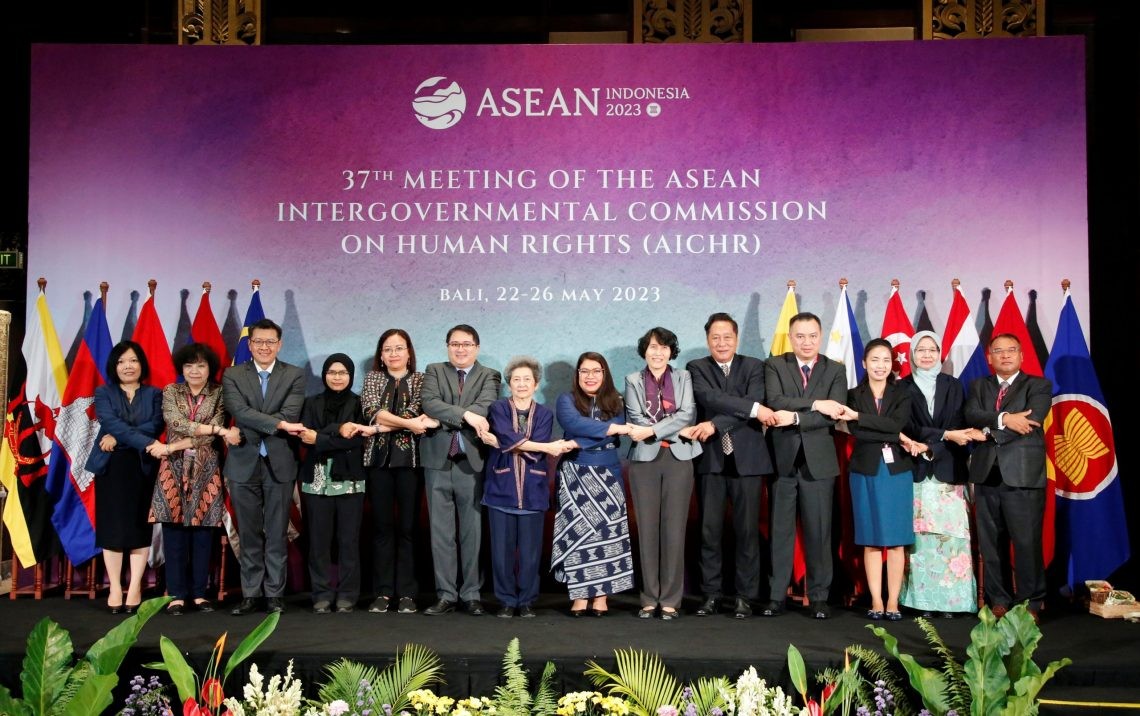 |
| Delegates attending the 37th meeting of the ASEAN Intergovernmental Committee on Human Rights from May 22-26 in Bali, Indonesia. (Source: asean.org) |
ASEAN's perspective on human security issues.
Although ASEAN faces certain obstacles in addressing human security issues, the bloc also has many prospects for promoting human security in the region. For example, ASEAN can leverage ASEAN-led cooperation mechanisms in the region to promote cooperation with partners on human security issues.
A prime example is that when the Covid-19 pandemic broke out, ASEAN was relatively successful in promoting cooperation with partners in responding to and recovering from the pandemic.
In addition, ASEAN can leverage its institutions in ensuring human security. For example, the ASEAN agency with authority in responding to natural disasters in the region is the ASEAN Humanitarian Assistance Centre (AHA).
Furthermore, it is also necessary to strengthen the role of the ASEAN Secretary-General (representing ASEAN as an independent international organization distinct from its member states) in humanitarian emergency response situations.
Currently, the role of the ASEAN Secretary-General remains under the control of member states, limited to coordinating humanitarian assistance in disaster response. The ASEAN Secretary-General could play a more active role in ensuring human security in Southeast Asia.
For example, the ASEAN Secretary-General can make swift decisions and cooperate with other parties in seeking and receiving humanitarian assistance for member states affected by natural disasters in cases where those states are unable or unwilling to respond. This is done only as a way of ensuring the realization of the human rights of disaster victims.
Furthermore, ASEAN could strengthen the role of the ASEAN Intergovernmental Commission on Human Rights (AICHR), established in October 2009, as an ASEAN consultative body. The Commission promotes and protects human rights and fosters regional cooperation on human rights among ASEAN members.
Human security is one of ASEAN's key issues, especially for the future development of the ASEAN Community towards a people-centered, people-oriented approach. ASEAN must prioritize ensuring food self-sufficiency and regional security through innovative solutions to achieve total human security.
At the same time, human security is also one of the important issues that Vietnam is aiming for according to the Resolution of the 13th National Congress of the Party. In the national development orientation for the period 2021-2030, the Party has determined: “Strengthening social development management, ensuring social progress and equity, sustainability in social policies, especially social welfare, social security, and human security.”
Among the six key tasks of the 13th National Congress term is the task of "Awakening the aspiration for a prosperous and happy nation; preserving and promoting the cultural values and human strength of Vietnam in the cause of national construction and defense, and international integration; effectively implementing social policies, ensuring social security and human security; improving the quality of life and happiness index of the Vietnamese people"...
Therefore, clarifying the issue of human security for ASEAN contributes to promoting the cohesion between Vietnam and ASEAN in the common development goals of the region.
| The weakness of the "ASEAN Way" as the "ASEAN Mechanism for Disaster Management in Southeast Asia" lies in the principle that the state bears primary responsibility for managing disasters occurring within its territory. The state has absolute responsibility for protecting its citizens affected by disasters by ensuring the protection of human rights. However, the principle of absolute state sovereignty and non-intervention under the "ASEAN Way" will not be successful in addressing national security issues, especially in cases of major disasters on national borders or when armed conflict occurs, making it impossible or unprepared for the country to handle the situation. |
(*) Institute of Southeast Asian Studies
(**) People's Security Academy
Source











































































![[Photo] Coc Ly market bustling on the eve of Tet](https://vphoto.vietnam.vn/thumb/402x226/vietnam/resource/IMAGE/2026/02/14/1771062261424_baolaocai-br_img-6457-jpg.webp)




Comment (0)