

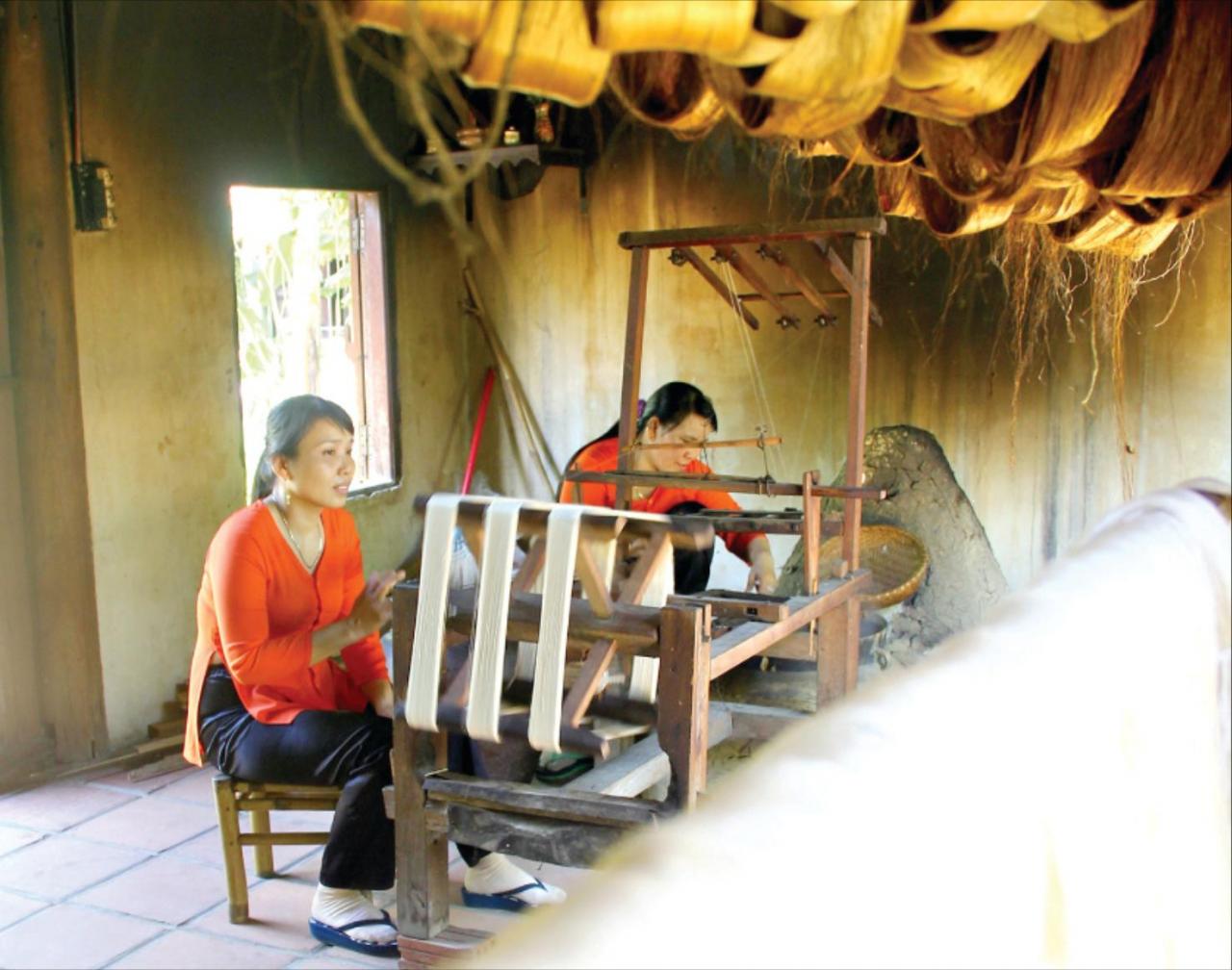
When "Master Quang" is skilled in his craft
The story of "Teacher Quang" was mentioned quite early by Quang Nam scholar Nguyen Van Xuan, but initially only in relation to scholarship. In his 1969 study "The Modernization Movement," he wrote: "Since education flourished, Quang Nam began 'exporting' teachers alongside the black-robed, scholarly streets..."
When Mr. Quang, along with Mr. Bac and Mr. Nghe, came to Binh Dinh, they would often stop there, and from there they would yield the space to Mr. Quang, allowing him to freely manipulate the literary market."
Then, the image of "Teacher Quang" was no longer confined to the "literary market." In 2001, at the conference "Quang Nam - Characteristic Cultural Values," the portrayal of "Teacher Quang" expanded to include his skills and ability to pass on his knowledge.
“In the past, many people from Quang Nam were revered throughout the South Central and Southern regions as 'Teacher Quang.' The title 'Teacher Quang' was different from 'Teacher Bac' and 'Teacher Nghe' because 'Teacher Bac' and 'Teacher Nghe' specialized only in teaching literacy. (...) The title 'Teacher Quang' mentioned above has been passed down for a long time and is not only for teaching literacy but also for teaching various trades and professions.”
Because after 1860, Chinese characters were no longer used in the Southern colony, the teachers from Quang Nam no longer included highly educated people with prestigious degrees who traveled south by boat. Instead, there were only those with average education along with skilled craftsmen…” (Nguyen Van Xuan, People of Quang Nam and the Development of Industries in the South).
Scholar Nguyen Van Xuan always shows interest whenever the topic of learning and professions in Quang Nam comes up. He admires the eagerness of his predecessors to learn trades: "Because he had absolute faith that a profession was essential for national development and strengthening the country, Phan Chau Trinh learned a trade wherever he went and later made a living as a photographer in Paris."
As for Huynh Thuc Khang, a Confucian scholar in Vietnam, when nominated to run a newspaper, he declared, "Without a dedicated person, nothing can be accomplished." The fact that a Vietnamese Confucian scholar even mentioned the word "dedicated person" in 1926 still amazes me. Perhaps he was the first person to use that term! (Excerpt from The Modernization Movement).
Following the southward migration, the groups of people from Quang Nam had many distinct characteristics. For example, in the construction industry, while migrants from other provinces and cities were merely "jack-of-all-trades" (doing whatever work came their way), the Quang Nam workers were more trusted because they had established rules, knew how to pass on their skills to each other, and were bound together by an invisible thread.
The silk trading caravans that poured into the South also created a "special silk road" from Quang Nam, even extending to Phnom Penh. When the experts and weavers from Quang Nam stopped at the Bay Hien intersection, a new craft village immediately took shape in the South...
From the 1870s, Nguyen Thanh Y bringing Quang Nam silk to France for an exhibition was already unusual. By the 1840s, the improved wide-width looms of Mr. Vo Dien (Cuu Dien) in Duy Xuyen, which helped the textile industry modernize, and the addition of motors to run several looms simultaneously in Saigon, was even more remarkable.
The old craft thus spread far and wide across the new land.
Go and stop
On the vast plains of the southern delta, the footprints of people from Quang Nam province were found early on. Professor Le Thanh Khoi noted in "History of Vietnam from its Origins to the Mid-20th Century" that, as early as the first half of the 17th century, vagrants from Thuan Quang, driven out by poverty, settled in Dong Nai . The Nguyen dynasty encouraged this settlement movement, offering tax incentives so that wealthy landowners from Thuan Quang could recruit people from among the common people…
Professor Le Thanh Khoi mentioned "a type of boat with enclosed compartments built and sold by some specialized villages," used to transport rice, livestock, betel nuts, salt, fish sauce, forest products, textiles, etc., between the Gia Dinh and Thuan Quang regions. John Barrow, an English traveler who visited Dang Trong around 1792-1793, also praised the boat-building techniques of these villages.
So which craft village in the Southern region of Vietnam excelled in shipbuilding techniques centuries ago?
Historical records and other documents do not provide specific details. However, through old books, we can discern the presence of a son of An Hai village, An Luu Ha commune, Dien Phuoc district, Dien Ban prefecture, Quang Nam province (now Son Tra district, Da Nang city): Thoai Ngoc Hau – Nguyen Van Thoai. From the age of 17, he went south to join Nguyen Anh's army (later King Gia Long), achieving great success and leaving behind some "traces" related to shipbuilding.
Mr. Nguyen Khac Cuong, a descendant of the famous figure Thoai Ngoc Hau, said that according to family tradition, while accompanying the Emperor in Siam, Thoai Ngoc Hau contributed greatly to the construction of warships and the war against Burma. Professor Nguyen Van Hau recounted this story in his book "Thoai Ngoc Hau and the Exploration of the Hau Giang Region," written in 1971.
The "Quang Nam masters" traveled on cargo boats, goods were transported on "boats with enclosed compartments," and the craft of "building warships" bore the mark of Lord Thoai Ngoc Hau... Such sea voyages are further corroborated in "The History of Land Reclamation in Southern Vietnam" by writer Son Nam. The Ben Nghe area of Saigon at that time managed to "capture" migrants from Central Vietnam.
“The land was fertile and located by the coast, allowing migrants to travel by boat from Central Vietnam to the estuary to establish their livelihoods. Besides the profits from rice cultivation, they also benefited from fish and shrimp. Fishing with nets at sea was a specialty of the Vietnamese people. (...) Thanks to the sea route, communication with their homeland in Central Vietnam was convenient,” writer Son Nam explained.
Source: https://baoquangnam.vn/dau-nghe-tren-dat-phuong-nam-3140896.html
![[Photo] Commemorating the unwavering friendship between Vietnam and Laos](/_next/image?url=https%3A%2F%2Fvphoto.vietnam.vn%2Fthumb%2F1200x675%2Fvietnam%2Fresource%2FIMAGE%2F2026%2F01%2F27%2F1769518372051_ndo_br_1-jpg.webp&w=3840&q=75)


![[Photo] Announcement Ceremony of the Art Program “Light Concert – Welcoming the New Year 2026”](/_next/image?url=https%3A%2F%2Fvphoto.vietnam.vn%2Fthumb%2F1200x675%2Fvietnam%2Fresource%2FIMAGE%2F2026%2F01%2F27%2F1769514762857_le-cong-bo-ct-hoa-nhac-anh-sang-1772-9042-jpg.webp&w=3840&q=75)


![[Hightling] Conference on the Implementation of Tasks for 2026](/_next/image?url=https%3A%2F%2Fvphoto.vietnam.vn%2Fthumb%2F402x226%2Fvietnam%2Fresource%2FIMAGE%2F2026%2F01%2F27%2F1769477856197_dsc01637.jpeg&w=3840&q=75)


![OCOP during Tet season: [Part 2] Hoa Thanh incense village glows red.](/_next/image?url=https%3A%2F%2Fvphoto.vietnam.vn%2Fthumb%2F402x226%2Fvietnam%2Fresource%2FIMAGE%2F2026%2F01%2F27%2F1769480573807_505139049_683408031333867_2820052735775418136_n-180643_808-092229.jpeg&w=3840&q=75)
![OCOP during Tet season: [Part 1] Ba Den custard apples in their 'golden season'](/_next/image?url=https%3A%2F%2Fvphoto.vietnam.vn%2Fthumb%2F402x226%2Fvietnam%2Fresource%2FIMAGE%2F2026%2F01%2F26%2F1769417540049_03-174213_554-154843.jpeg&w=3840&q=75)





Comment (0)