

Experts have spent hundreds of years estimating the Earth's mass, and even now, there is still no consensus on the exact figure.
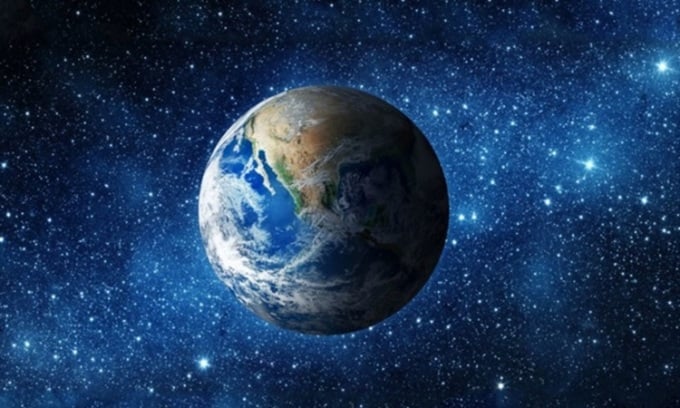
It is very difficult to calculate the exact mass of the Earth. Photo: Science Times
The Earth contains everything from solid rocks and minerals to millions of living organisms, and is also covered by countless natural and man-made structures. Therefore, there is no precise answer to the question of how much the Earth weighs. The Earth's weight depends on the gravitational force acting on it, meaning the Earth could weigh trillions of kilograms or nothing at all, according to Live Science .
According to NASA, the Earth's mass is 5.9722 × 10²⁴ kg, equivalent to approximately 13 quadrillion pyramids of Khafre in Egypt (each pyramid weighing 4.8 billion kg). The Earth's mass fluctuates slightly due to cosmic dust and gases leaking from the atmosphere, but these small changes do not affect the planet for billions of years.
However, physicists around the world still disagree on this figure, and the calculation process is not an easy task. Since it's impossible to weigh the entire Earth on a scale, scientists have to use triangulation to calculate its mass.
The first component in the measurement is Isaac Newton's law of universal gravitation, according to Stephan Schlamminger, a metrologist at the National Institute of Standards and Technology (NIAST). Everything with mass has gravity, meaning any two objects always exert a force on each other. According to Newton's law of universal gravitation, the gravitational force between two objects (F) can be determined by multiplying the respective masses of the objects (m₁ and m₂) by the square of the distance between their centers (r²), and then multiplying by the gravitational constant (G), i.e., F = Gx((m₁xm₂)/r²).
Using this equation, theoretically, scientists could measure the Earth's mass by measuring the planet's gravitational pull on an object on its surface. But the problem was that no one had yet calculated the exact value of G. In 1797, physicist Henry Cavendish began the Cavendish experiment. Using an object called a torsion balance, made of two rotating rods with lead spheres attached, Cavendish found the gravitational force between them by measuring the angle on the rods, which changed as the smaller sphere was pulled by the larger one.
Knowing the masses and distances between the spheres, Cavendish calculated G = 6.74 × 10⁻¹¹ m³ kg⁻¹ s⁻². Currently, the Data Committee of the International Council for Science defines G = 6.67430 × 10⁻¹¹ m³ kg⁻¹ s⁻², only slightly different from Cavendish's original figure. Scientists later used G to calculate the mass of the Earth, using the known masses of other objects, and arrived at the figure of 5.9722 × 10²⁴ kg as we know it today.
However, Schlamminger emphasizes that while Newton's equations and the torsion balance were important tools, measurements based on them were still affected by human error. For centuries after Cavendish's experiment, various scientists measured G dozens of times, each time with slightly different results. Even though these differences were tiny, they were enough to alter calculations of Earth's mass and preoccupy scientists seeking to measure the number.
An Khang (According to Live Science )
Source link


![[Photo] General Secretary To Lam attends the inauguration ceremony of Si Pa Phin multi-level boarding school.](/_next/image?url=https%3A%2F%2Fvphoto.vietnam.vn%2Fthumb%2F1200x675%2Fvietnam%2Fresource%2FIMAGE%2F2026%2F01%2F31%2F1769840655651_ndo_br_z7486540481209-f37c7e00a962aec2a061c64b7db569ef-jpg.webp&w=3840&q=75)


![OCOP during Tet season: [Part 3] Ultra-thin rice paper takes off.](/_next/image?url=https%3A%2F%2Fvphoto.vietnam.vn%2Fthumb%2F402x226%2Fvietnam%2Fresource%2FIMAGE%2F2026%2F01%2F28%2F1769562783429_004-194121_651-081010.jpeg&w=3840&q=75)


![OCOP during Tet season: [Part 2] Hoa Thanh incense village glows red.](/_next/image?url=https%3A%2F%2Fvphoto.vietnam.vn%2Fthumb%2F402x226%2Fvietnam%2Fresource%2FIMAGE%2F2026%2F01%2F27%2F1769480573807_505139049_683408031333867_2820052735775418136_n-180643_808-092229.jpeg&w=3840&q=75)



Comment (0)