

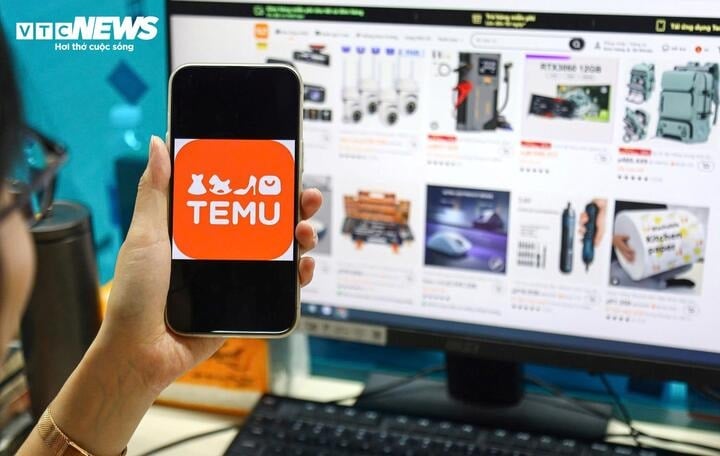
Recently, although not yet registered to operate in Vietnam, the Temu e-commerce platform has been aggressively selling cheap goods, launching numerous promotional programs, and paying very high commissions to reach Vietnamese customers.
Many believe that with these policies, cheap Chinese goods on Temu will directly seize market share, pushing Vietnamese goods into fierce competition right in their own backyard.
Vietnamese people are worried that they won't buy Vietnamese products.
For about two weeks now, almost every Vietnamese consumer familiar with e-commerce platforms has been constantly mentioning Temu. The reason is the "Temu craze" that has swept through, along with many attractive promotions and discounts that customers find hard to resist.
Temu's massive inventory, ranging from fashion and home goods to tech products, offers surprisingly low prices, with some items discounted by up to 90%.
“I found so many things I liked on Temu and they were all on sale. It felt like I'd struck gold”; “Temu is having a massive sale of up to 90% off”; “Free shipping and free returns”; “Don’t miss this opportunity! Lowest prices”; “Great deals, can’t be missed”… These are just some of the advertisements for Temu on social media, enough to pique the curiosity of many people and prompt them to visit Temu to shop.
Among them, many people have opted to buy cheaper Chinese products instead of Vietnamese goods.
Ms. Thu Nga (Dong Da District, Hanoi ) shared that she ordered a Vietnamese-made rice cooker for 300,000 VND and had to pay an additional 30,000 VND for shipping. Meanwhile, if she bought a similar Chinese rice cooker on the Temu app, it would only cost 180,000 VND and shipping would be free.
The delivery times were similar, but the price difference was too great, so she decided to buy from China.
Besides being affordable and offering free shipping, another differentiating factor that is attracting Vietnamese customers is Temu's 90-day return policy.
"I only buy small items, costing just a few tens of thousands of dong, but I can still exchange them if I'm not satisfied. It's very convenient for consumers," commented Mr. Manh Hieu (Cau Giay, Hanoi).
Mr. Hieu recently bought a phone case on Temu for less than 50,000 VND and was able to return it, then bought a different item after not being satisfied with it.
Regarding concerns about poor quality goods, many customers expressed that they didn't mind the money too much. Because goods on Temu are inexpensive, even if they unfortunately buy something unsatisfactory, the loss isn't significant. Since this is a minority, the chances of buying good quality goods at a low price are still higher.
"If Temu wants to survive in the Vietnamese market, they will definitely have to continuously improve the quality of their products. They wouldn't be foolish enough to sell low-quality goods that would damage their reputation. In my opinion, those incidents are just a few isolated cases in the early stages of operation," a customer shared on Facebook.
These consumer mindsets are causing many experts to worry about the risk of Vietnamese people choosing to buy cheap Chinese goods instead of Vietnamese products, which are increasingly flooding into Vietnam through e-commerce platforms like Taobao and now Temu.
"A significant number of customers are attracted to Temu, and they may switch to Vietnamese products if Temu continues to appeal to their psychology by offering a diverse range of products at low prices and applying many incentives," said an economic expert.
However, some argue that there's no need to worry too much about Vietnamese goods. Besides the low-priced segment, there are still segments of mid-priced goods with average quality and high-priced goods with high quality.
Currently, Vietnamese consumers' purchasing habits are gradually changing, becoming more sophisticated, meaning they prefer goods of medium or high quality. Therefore, it is very likely that Temu and other cheap Chinese goods will only be able to gain an advantage in the budget segment.
Huge discounts to attract Vietnamese customers.
Temu's affiliate marketing program, offering discounts of up to 30%, is attracting many Vietnamese consumers. This is seen as a tactic by the e-commerce platform to gain market share.
By clicking on the link in the Facebook post and installing the Temu app, customers will receive 50,000 VND in their shopping account. If the customer shares their account registration link and someone else uses that link to register, the customer will receive an additional 150,000 VND.
The reward amount can be higher if you invite a user with a large following on TikTok or YouTube. Additionally, customers can refer products sold on the platform and receive a commission on the seller's revenue, up to 30%.
Temu also creates a multi-tiered commission model. For example, when an account joins the affiliate program via a link, the person who shared it will receive a certain amount of money. If a lower-level member brings in more partners, the person at the higher level will receive an additional 20% commission.
This unique policy has led to various groups competing to "market" and solicit customers on behalf of Temu, with some even creating a "Temu Affiliate Community - Vietnam" on social media, boasting over 28,000 members to share ways to earn money from Temu.
A marketing expert commented that with this strategy, Temu aims to quickly spread its brand in the Vietnamese market. This demonstrates that Temu has meticulously prepared a strategy for approaching Vietnamese customers in order to quickly gain market share.
Will Vietnamese businesses be affected?
According to Mr. Nguyen Quang Huy from the Finance and Banking Faculty (Nguyen Trai University), the arrival of Temu will have a significant impact on Vietnamese businesses, especially small and medium-sized enterprises (SMEs). These are businesses that often cannot compete with Temu's low prices due to their high production and operating costs.
This forces businesses to find ways to differentiate their products or seek a higher-end market segment.
Mr. Huy further analyzed that, with the emergence of Temu, a large number of consumers have switched, are switching, and will continue to switch to shopping on this platform, reducing the market share of Vietnamese businesses in the low-price segment.
In particular, products without clear differences in quality are easily chosen by consumers who opt for the lower-priced option.
“Specifically, the sectors most vulnerable to Temu’s arrival include fashion, accessories, household goods, and consumer electronics. These are products that consumers are easily attracted to by their low prices and wide variety of choices. The price difference is often not clearly reflected in the quality of these products, making consumers more likely to switch to Temu’s cheaper products. However, specialized products that require high quality or have local cultural elements, such as specialty foods, will be less affected,” he said.
However, from a positive perspective, Mr. Huy believes this is also an opportunity for small and medium-sized enterprises in the country to reinvent themselves, find new directions, and optimize their production systems.
Mr. Huy also stated that, in addition to the efforts of businesses, close involvement from state management agencies is also necessary.
“Regulatory agencies need to implement strict monitoring measures on imported goods, ensuring compliance with tax laws and quality standards. This helps prevent tax evasion and creates a fair business environment.”
"The government needs to create supportive logistics policies for domestic businesses, reducing taxes and costs for domestic transportation services. This will help businesses reduce costs and compete better with foreign competitors," he suggested.
Meanwhile, according to economist Tran Hoang Ngan, there is an urgent need for policies to protect domestic production and goods by setting trade barriers and tariffs to ensure transparency and fairness for domestic producers and businesses compared to foreign ones.
TB (according to VTC)Source: https://baohaiduong.vn/hang-viet-dang-bi-temu-de-doa-396523.html


![OCOP during Tet season: [Part 3] Ultra-thin rice paper takes off.](/_next/image?url=https%3A%2F%2Fvphoto.vietnam.vn%2Fthumb%2F402x226%2Fvietnam%2Fresource%2FIMAGE%2F2026%2F01%2F28%2F1769562783429_004-194121_651-081010.jpeg&w=3840&q=75)


Comment (0)