


According to feng shui expert Nguyen Song Ha (Song Ha Feng Shui Company, Hanoi ), skylights are places that absorb the harmonious energy of heaven, earth, and the universe. The placement of skylights and open-plan areas requires careful consideration to avoid feng shui violations and negative impacts on the living space of each family member.
Is it okay to design a skylight near the kitchen?
Provinces in the South Central region have a hot and dry climate. Long, narrow, tube-shaped houses, even with skylights in the middle, are still insufficient to handle the dissipation of heat and the intake of cool air, especially in houses with the kitchen located at the back.
To bring light into the kitchen space, as well as light and ventilation to the rooms on the floor above directly opposite the kitchen, most families add a skylight at the far end near the kitchen.
However, because skylights are dynamic and receive sunlight and wind, it is considered inauspicious to place them near the kitchen. The kitchen needs to be sheltered from the wind in order to accumulate energy (sheltering from the wind and accumulating energy means that the flow of energy needs to be unobstructed).
If the homeowner has inadvertently designed a skylight near the kitchen, they should incorporate miniature landscapes (mountains and rivers) into the interior design through the creation of rock gardens and ponds. Alternatively, they could place a fish tank with a circulating water filter, or simply a small fountain to help circulate water throughout the house.
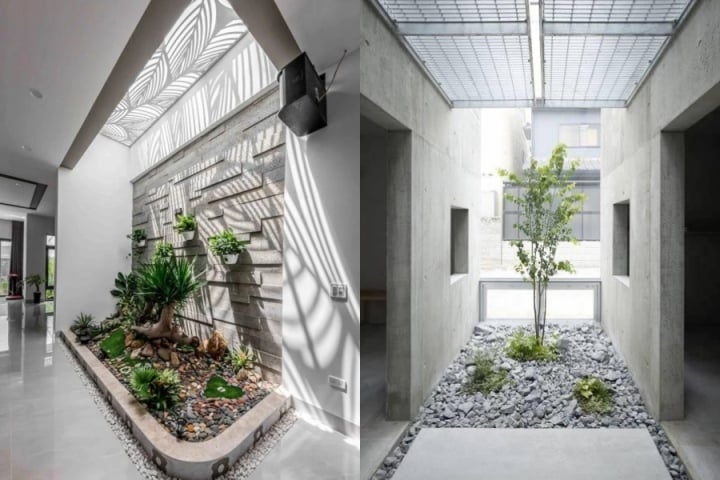
Skylights are places that absorb the harmonious essence of heaven, earth, and the universe.
If the homeowner places the skylight next to the dining room, they can use plants and a water feature to create a harmonious balance of Wood and Water elements. If the skylight is opened to ventilate the kitchen, it should be designed as a vertical exhaust pipe (Wood generates Fire), but it must have a roof to protect it from rain.
Glass roofs or sloping roofs (representing Fire) can be used to create a chimney effect, drawing heat upwards and preventing smoke and odors from spreading to other rooms.
If a skylight is placed near a bedroom, the homeowner should decorate it with elements of Water and Wood, creating a gentle, bright color scheme using materials close to nature…
Where should a skylight be placed?
The ideal location for a skylight is a common concern. Skylights not only bring in more light and improve ventilation, but they also fundamentally balance yin and yang. Placing a skylight in the center of an area activates airflow, enhancing the activity within that central space.
However, if the house is not too long, has a small area, is not dark, and does not have rooms in the middle that must be traversed, then it is not necessary to open a skylight in the middle; simply creating ventilation in the stairwell roof and an open space at the back (combined with a water tank and drying area) will suffice.
Opening too many skylights can even cause an imbalance of yin and yang energy, making the house constantly feel glaringly bright (especially in directions with intense sunlight like the west).
According to the Three Harmony School of Thought, the position of the skylight will be calculated depending on the main orientation of the floor plan as follows:
- North-facing houses have skylights facing East, Southeast, and South.
- The house faces south and has skylights in the northwest and northwest.
- East-facing houses have skylights in the Southwest, Northeast, West, and Northwest directions.
- Houses facing west have skylights in the north, southeast, and east.
- Houses facing northwest can have skylights in the east, southeast, and north.
- The house faces northeast and has skylights in the southwest and south.
- The house faces southwest and has a skylight on the south side.
- Houses facing southeast can have skylights in the northwest, west, southwest, and northeast directions.
Skylights don't have a specific direction, so there's no need to consider their orientation. However, it's not advisable to place an open skylight on the north side of the house, as that direction is often associated with negative energy that is detrimental to human health.
Some notes on the size and shape of the skylight.
Skylights should not be too small or narrow, as this will fail to absorb the vital energy of heaven and earth; on the contrary, it will create the opposite effect, generating negative energy flows.
Skylights that provide ventilation to multiple living spaces should absolutely not pass through bathroom doors, as this will carry foul air to all other living spaces.
The shape of the skylight should be designed to suit the architectural form of the house, meaning it should be in harmony with the five elements of the house's architecture. For a house with a wood-like shape, the skylight should also be a long, wood-like shape, or a gently curving, wavy water-like shape. For a house with an earth-like shape, the skylight should be a square earth-like shape, or a metal-like shape such as a circle or ellipse.
When designing a skylight, it's necessary to consider the house's orientation and the amount of sunlight and wind it receives to determine whether a fixed or retractable skylight cover is appropriate. This allows for better control over light and protection against harsh sunlight and rain entering the house.
AN BINH
Beneficial
Emotion
Creative
Unique
Source

![[Photo] Prime Minister Pham Minh Chinh visits and extends New Year greetings to former Party and State leaders and offers incense to the esteemed predecessors.](https://vphoto.vietnam.vn/thumb/1200x675/vietnam/resource/IMAGE/2026/02/14/1771078465521_dsc-2411-jpg.webp)




































































































Comment (0)