

Defense industry news, March 27: The United States possesses a 'nuclear nightmare'. It's the B61-12 guided bomb with integrated multi-type nuclear warheads.
The US promotes its "nuclear nightmare"; leaked information about the cost of the 6th-generation F-47 fighter jet is among the topics in today's defense industry news on March 27th.
The United States promotes the "nuclear nightmare."
The B61-12 thermonuclear bomb, still the primary weapon of the U.S. strategic nuclear forces, can perform tactical and strategic missions thanks to its ability to adjust its destructive power by changing its warhead. The characteristics of this U.S. “nuclear nightmare” were described in an article by The National Interest (TNI).
The B61-12 bomb is currently in mass production. According to its creator, this type of bomb is one of the most versatile in the world because its destructive power can be varied.
"The B61-12 is essentially four bombs in one. The power of the nuclear weapon can increase to four different values," the TNI publication wrote.
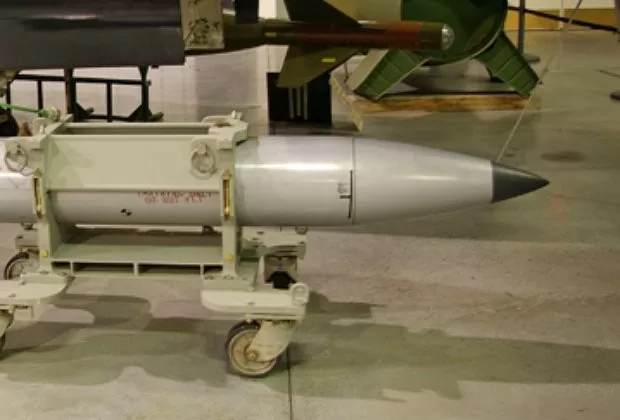 |
| B61-12 nuclear bomb. Photo: Defense News |
Technically, the B61-12 bomb weighs 350 kg, carries a 50-kiloton nuclear warhead, and is equipped with a GPS guidance system and a laser beam tracker at the nose. The B61-12 is designed to be dropped from fighter aircraft such as the F-15, F-16, and F-35. After leaving the aircraft, the B61-12 uses its tail fins and turbofan engines to adjust its flight path, and can land on a target within 30 meters.
In terms of sheer destructive power, the B61-12 is not considered the most dangerous nuclear weapon in the US arsenal. This bomb has a maximum yield of only 50 kilotons, equivalent to 50,000 tons of TNT. In contrast, the B83 nuclear bomb, with a maximum yield of 1,200 kilotons, can completely destroy an entire city. However, what makes the B61-12 a dangerous nuclear weapon in the US arsenal is its availability. This availability stems from a combination of its accuracy and low yield.
The B61-12 has a maximum yield of 50 kilotons, but this yield can be reduced as needed to meet any specific mission. The combination of accuracy and low yield makes the B61-12 nuclear bomb the most widely considered to be in the US arsenal.
In early March 2025, TNI reported that the new B-21 Raider strategic bomber, being developed for the US Air Force, has a longer range than the B-2 Spirit and is compatible with the new B61-12 bomb.
Information regarding the cost of the 6th-generation F-47 fighter jet has been leaked.
According to 19FortyFive, no one wants to discuss the cost of the promising sixth-generation F-47 fighter jet at this time.
According to commentator Caleb Larson, initial estimates of the cost of an F-47 aircraft were around $300 million, nearly three times the cost of the fifth-generation F-35 fighter jet. "To reduce costs, the United States could consider exporting a slightly more stripped-down version to trusted allies," the author of 19FortyFive suggests.
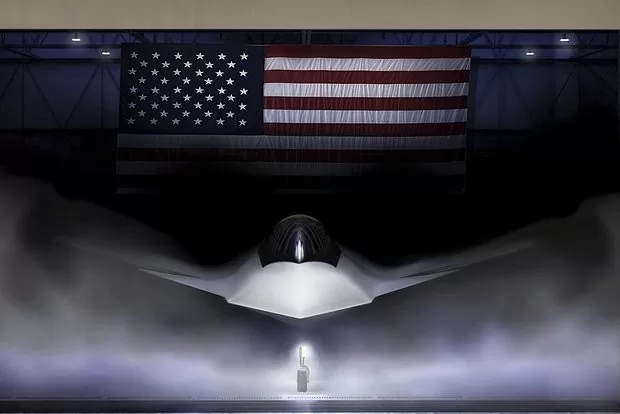 |
| The F-47, a sixth-generation fighter jet. Photo: Topwar |
Larson cited estimates by U.S. Air Force General David Ellwin that the F-47 would be cheaper than the world's first fifth-generation fighter jet, the F-22, which costs between $140 and $350 million, depending on configuration and maintenance.
Previously, The Aviationist magazine reported that US President Donald Trump had announced that the winning bidder for the contract to develop the sixth-generation fighter jet under the NGAD program for the US Air Force was the American aerospace company Boeing, which is currently developing the F-47.
The British Navy has finalized plans to equip ships with laser weapons.
The Royal Navy intends to equip four warships with the DragonFire directed energy weapon system by 2027. According to Navy Recognition magazine, this decision will accelerate the previously approved program, which was initially planned for only one warship.
The publication also notes that this announcement comes after a £2.2 billion increase in the defense budget. This measure will raise defense spending to 2.36% of GDP by 2025, with a target of 2.5% by 2027.
The development of DragonFire is being carried out by the Defence Science and Technology Laboratory in collaboration with industry partners – the UK divisions of the Italian engineering firm Leonardo and the international missile systems manufacturer MBDA. The British defense company QinetiQ is also involved in the project.
 |
| DragonFire laser weapon system. Photo: Defense Talk |
The DragonFire prototype was first demonstrated in 2017. In July 2022, accuracy tests of the guidance system against air and sea targets were conducted at the Hebrides.
The prototype, operating at 50 kW, has proven to be powerful enough to effectively counter threats such as drones and high-speed boats. The total investment in the project is approximately £100 million.
The DragonFire program is seen as a pilot project for the UK government 's new integrated procurement model, launched to accelerate the rearmament of the British armed forces. According to Naval News, laser weapons are likely to be deployed first on Type-45 class destroyers.
Laser weapons are seen as a cost-effective alternative to short-range anti-aircraft missiles, which often cost more than small drones capable of threatening ships. Each DragonFire shot costs only a few dozen pounds, compared to hundreds of thousands or even millions of pounds for guided missiles or anti-aircraft missiles.
In the long term, the British military hopes to acquire laser systems with a power output exceeding 100 kW, which it expects to be effective against ballistic missiles and hypersonic missiles.
Source: https://congthuong.vn/hoa-ky-so-huu-loai-bom-con-ac-mong-hat-nhan-380247.html













































































































Comment (0)