


ANTD.VN - Modern agricultural production utilizes many advanced technologies and machinery to replace human labor. However, farming is still heavily influenced by weather, soil, irrigation water, seeds, pests, and fertilizers for optimal plant growth and development. Among these, fertilizers are one of the most important factors, decisively impacting productivity and investment costs.
Fertilizers provide essential nutrients for plant growth. Proper and timely fertilization promotes growth and development processes such as: healthy tillering, lush green foliage, abundant and simultaneous flowering, and a high fruit set rate. Fertilizers also nourish root development, allowing roots to penetrate deep into the soil and form a wide root system, reducing lodging. Furthermore, they increase the plant's resistance and resilience.
Besides providing nutrients for plant growth, fertilizers also impact the entire agricultural ecosystem. Fertilizers promote processes such as decomposition and transformation of substances, increasing the absorption of nutrients, breaking down difficult-to-absorb substances into easily absorbable ones, and creating favorable conditions for healthy plant growth and development.
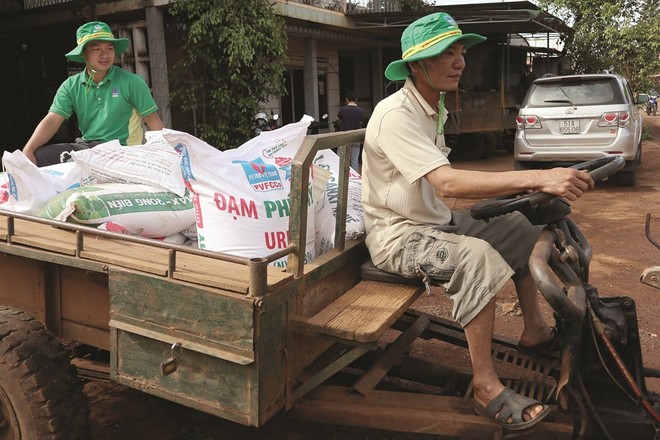 |
Farmers are buying Phu My NPK fertilizer. |
Throughout the growing season, a lack of fertilizer at any stage will result in stunted or slow growth. Typical symptoms of fertilizer deficiency include stunted growth, low tillering capacity, few branches and leaves, small and yellow leaves, little or no flowering, low fruit set, poorly developed root system, increased susceptibility to pests and diseases, and poor resistance to adverse conditions.
For crops to grow and develop healthily, resulting in a high-yield harvest, farmers need to use adequate and appropriate fertilizers for each stage of growth; only then will the fertilizers be fully effective.
Since fertilizers are the most important factor for crop growth and development, they account for the highest proportion of total crop costs. This is also a concern for farmers, as fertilizer prices continuously increase throughout the crop's growth period, while the price of the harvested product depends on the market.
Sharing about the investment costs for the past season, Ms. Vo Lam Que (54 years old), a durian farmer in Phuoc An town, Krong Pak district, Dak Lak province, said that to ensure her durian orchard of about 1,500m2 produces consistent, abundant fruit with minimal pests and diseases, the initial cost for fertilizers and pesticides was about 40 million VND, not including the cost of irrigation water, labor for care and harvesting.
During a durian harvesting cycle, farmers apply fertilizer in multiple stages, primarily NPK fertilizer, for leaf development, flowering, and fruit development after harvesting. This is a crucial period for the tree's recovery, and fertilizer costs are quite high during this time. Ms. Que stated that most of the fertilizer used for durian trees is imported NPK. Based on her experience, imported fertilizers dissolve quickly, allowing for faster absorption by the trees, resulting in higher yields and lower costs compared to domestic fertilizers, which is why farmers here often choose imported fertilizers.
Ms. Que also stated that one difficulty for farmers is the continuously rising price of fertilizers, leading to increasingly higher investment costs, while post-harvest selling prices depend on the market. Besides ensuring the trees are healthy and produce abundant fruit, farmers have no control over any other aspect of their farming, being completely dependent on the market. This often results in situations where "good harvest, low prices; high prices, poor harvest."
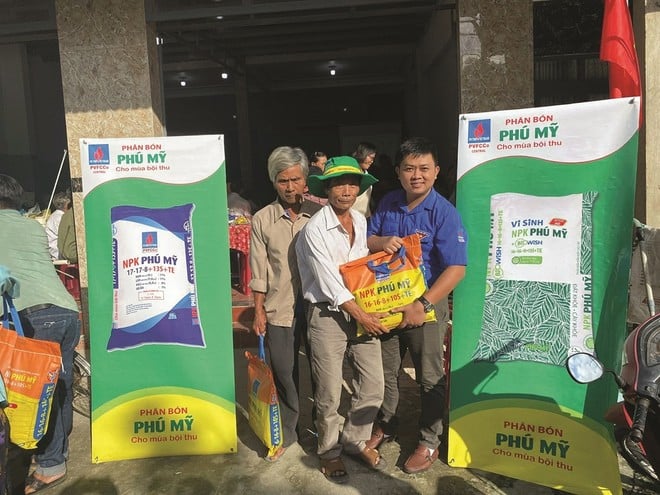 |
Farmers are buying Phu My NPK fertilizer. |
Durian is a high-value agricultural product that yields attractive profits, but farmers are still worried about fertilizer prices. And what about rice? Although it is a staple food, the input costs are too high, and the selling price does not match the effort put in, leading to many cases of farmers abandoning their fields to switch to other farming models.
The Mekong Delta is the largest rice-producing region in the country, accounting for over 50% of the national rice output, approximately 90% of rice exports, and 70% of fruit production. However, the recent sharp increase in input costs, especially fertilizer prices, has significantly impacted farmers' production. Farmers are largely losing interest in rice cultivation. Many rice farmers want to abandon their fields because rice production is unprofitable, or even results in losses.
In a state of mind where he wants to abandon his rice fields and switch to other crops, Mr. Nguyen Van Thanh, 58 years old, from Tan Tuyen commune, Tri Ton district, An Giang province, said that he has spent his whole life cultivating rice, but now he is facing difficulties with his own rice crop. The price of fertilizers is constantly increasing, causing input costs to rise, but the profits received at harvest time are not commensurate with the effort put in. Around him, people have switched to cultivating fruit trees and other crops. But he, out of attachment to his familiar rice fields, still clings to rice cultivation.
In reality, fertilizer costs account for a significant portion of the total input costs of a harvest. Farmers may accept the effort and enjoy the fruits of their labor and that of their families. However, fertilizer is an essential nutrient for any crop or vegetable, so the continuous increase and persistence of high fertilizer prices are causing difficulties for farmers. A policy is urgently needed to bring down fertilizer prices, ensuring a balance between costs and selling prices, so that farmers can remain committed to their fields and familiar rice paddies and prosper from their homeland.
Source: https://www.anninhthudo.vn/nong-dan-va-ganh-nang-phan-bon-post593524.antd























































Comment (0)