

Initial estimates suggest the search operation for the Titan submersible will cost more than $1.2 million, but it is unclear who will pay for this.
Upon learning of the disappearance of OceanGate's Titan submersible on June 8th while exploring the Titanic wreck at a depth of nearly 4,000 meters in the Atlantic Ocean, the U.S. Coast Guard launched a large-scale search operation. Numerous other U.S. and Canadian forces subsequently deployed equipment and personnel to search the waters approximately 600 kilometers off the coast of Newfoundland, Canada.
Until the wreckage of the Titan was discovered on the seabed on June 22, the US government had spent at least $1.2 million, according to preliminary estimates by Mark Cancian, a senior adviser at the Center for Strategic and International Studies (CSIS), as well as research from the Washington Post .
Cancian said he based this figure on the costs of fuel, vehicle maintenance, and personnel mobilized for the search operation. The final figure could be higher, because even though the search operation ended in the middle of June 23, some experts and unmanned submersibles continued to remain at the scene to survey the debris.
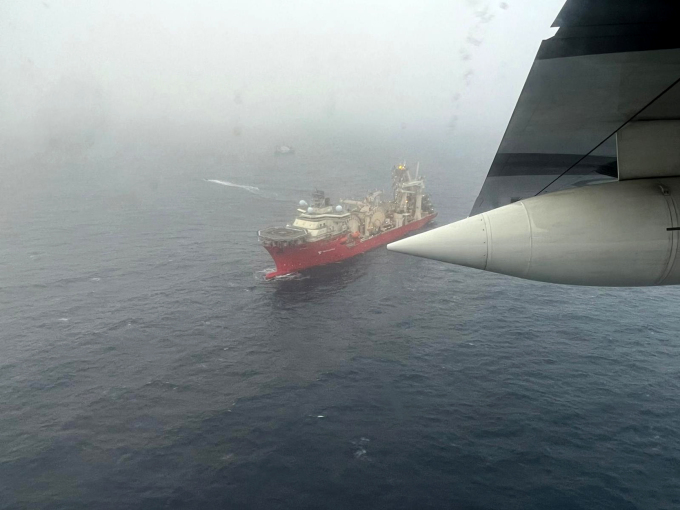
A US HC-130 Hercules aircraft flies over Deep Energy during the search operation for the Titan submersible in the Atlantic Ocean on June 20. Photo: AFP
The question of total cost and who will pay is currently unanswerable, as it depends on many factors. The search operation involves private companies and research vessels carrying remotely operated vehicles (ROVs). The U.S. government will only pay these organizations if they have contracts with the Pentagon.
The Coast Guard is part of the U.S. Department of Homeland Security, but is supported by the Navy and Air Force, both part of the U.S. Department of Defense . To pay for missions such as deploying aircraft for search and rescue at sea, the military will use "appropriate funds that have been allocated," said Patrick Ryder, a Pentagon spokesman. "Therefore, there are flight hours that have already been paid for."
However, the U.S. military will also have to account for unforeseen costs, according to Cancian, because personnel and equipment could be used for operations different from the original plan.
In addition to the US, a range of international resources were deployed, including the naval vessel HMCS Glace Bay, the coast guard ships John Cabot, Ann Harvey, and Terry Fox, the CP-140 Aurora aircraft, the Canadian vessel Horizon Arctic, the French research vessel L'Atalante, and ROVs from Magellan, an international company specializing in exploration .
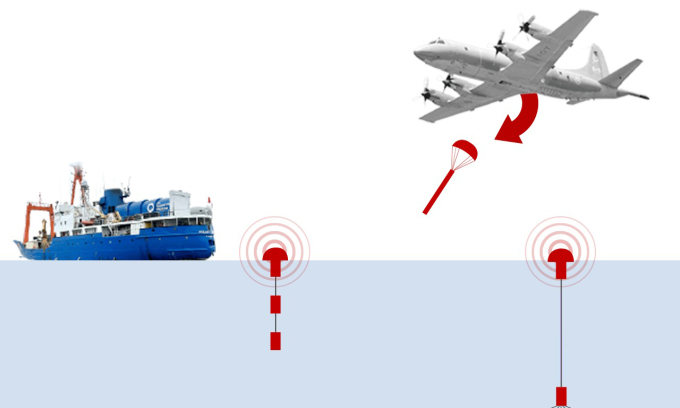
The scale of the search operation for the Titan spacecraft. Click on the image for details.
Mikki Hastings, president of the National Association for Search and Rescue in the US, said information about the total cost of the search operation is unclear. "Things are still ongoing, so we won't know the final figure for some time," Hastings said.
OceanGate Expedition, the company that owns and operates Titan, will not have to reimburse the U.S. government for search costs, according to Paul Zukunft, commander of the U.S. Coast Guard from 2014 to 2018. "There is no difference between searching for a ship by an organization and rescuing an individual. We still conduct search and rescue operations; we don't include them in the cost calculation," Zukunft said.
The Canadian government is believed to have deployed more resources to the search area than the US, due to the Titanic wreck being closer to Canadian territory and the urgency of the operation. Canadian officials have so far declined to comment on the cost of the search operation.
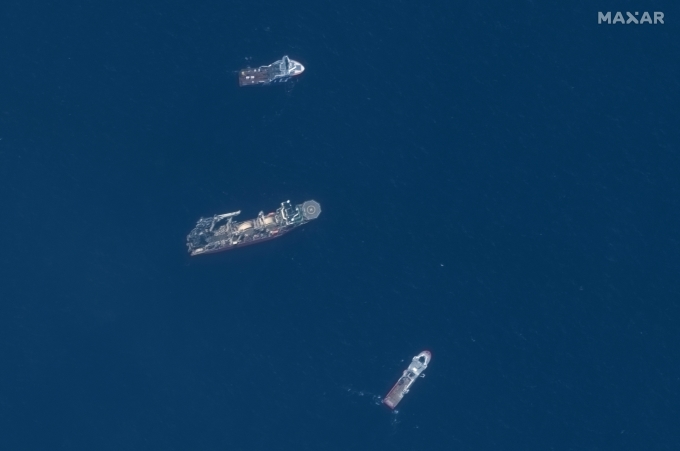
Three ships, Horizon Arctic (above), Deep Energy (middle), and Skandi Vinland, are searching for the Titan submersible in the Atlantic Ocean on June 22. Photo: AFP
"I don't have information on the cost, but I believe it's not that important," Joyce Murray, Canada's Minister for Fisheries, Oceans and Coast Guard, told reporters on June 22. "What's important is that we have the opportunity to search for and rescue the Titan."
According to Ms. Murray, "nothing is too much." "We need to do everything we can, because there are many lives on the missing ship and we need to save them," she added.
The top priority in such operations is always saving lives, and search and rescue companies are budgeted for this, Hastings said. Emergency services don't want people in distress to have to think about the cost of deploying a helicopter or other resources to rescue them.
"Anyone who goes missing deserves to be searched for. That's our mission, no matter who they are," said Hastings.
By Như Tâm (Based on Washington Post, AP )
Source link
































![[Photo] Tran Cam Tu, Standing Member of the Secretariat of the Central Committee, presides over the first meeting of the Central Steering Committee on the Development of Vietnamese Culture.](https://vphoto.vietnam.vn/thumb/1200x675/vietnam/resource/IMAGE/2026/03/19/1773895004549_ndo-br-bnd-1195-2-jpg.webp)






































































Comment (0)