


Russia has repeatedly warned of "red lines." Some fear a nuclear catastrophe, while others consider it merely a "verbal threat"!
From Russia's perspective, the nuclear triad remains the most important guarantee of national security and the security of its people; it is a tool for maintaining strategic balance and power in the world .
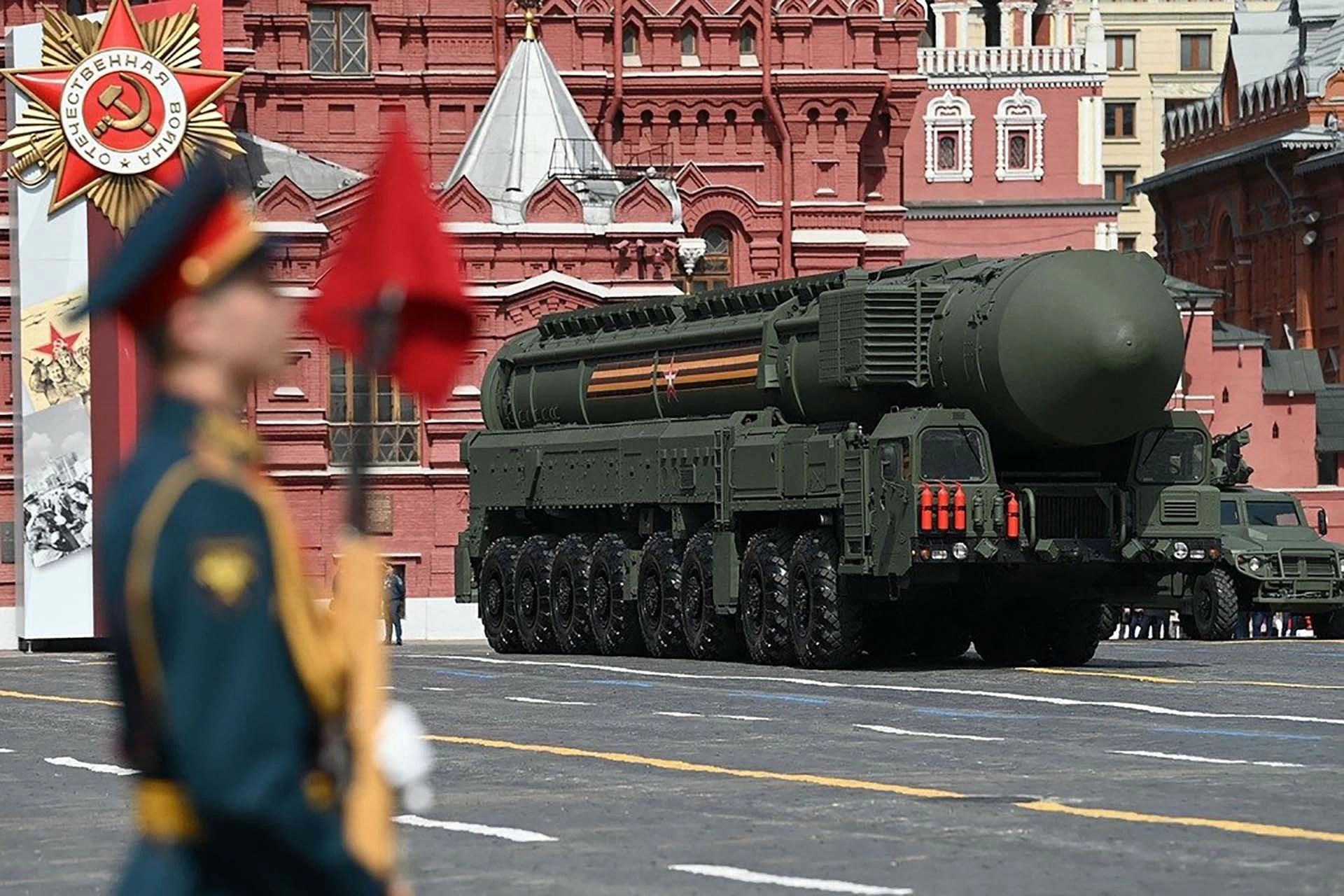 |
| Russia's Yars intercontinental ballistic missile system participates in the Victory Day parade in Moscow in 2022. (Source: Reuters) |
Unprecedented strength
Russia's 2020 nuclear doctrine outlines four possible scenarios for the use of nuclear weapons. First, when there is “reliable information” that an enemy has launched ballistic missiles against Russia and its allies. Second , when an enemy uses nuclear weapons or other weapons of mass destruction against Russia and its allies. Third, when an enemy attacks “critical military or state facilities” that could disrupt the nuclear forces' response capabilities. Fourth, when an enemy attacks with conventional weapons that could threaten Russia's national survival.
On September 25, at a meeting of the National Security Council, President Vladimir Putin stated that the global political and military situation is undergoing major changes, with new threats emerging, making it necessary to adjust and update the nuclear doctrine.
The new proposal highlights three key points regarding the circumstances/thresholds under which Russia could retaliate with nuclear weapons. First, when any country launches a large-scale air attack on Russian territory using conventional weapons, threatening Russian sovereignty. Second, an action against Russia by “any non-nuclear state, with the participation and support of a nuclear state” constitutes an attack by their “joint coalition.” Moscow would retaliate against both targets. Third, the expanded circumstances would also apply to its ally, Belarus.
The lowering of the threshold for using nuclear weapons means a heightened threat and likelihood of nuclear war. This is an unprecedentedly strong warning from Russia.
"Nuclear blackmail"?
The West was both "on edge" and underestimated the danger of the situation. Some leaders dismissed it as merely "verbal threats"! Moscow was "playing psychological games"! US Secretary of State Antony Blinken declared it an "irresponsible and ill-timed warning".
Ukrainian President's Chief of Staff Andrey Yemark sees this as a sign of Russian weakness! The basis for these views is Moscow's failure to retaliate when several "red lines" were crossed, and the fact that they have not seen any signs of Russia preparing to use nuclear weapons that would be detected by NATO's reconnaissance capabilities.
Conversely, some Western politicians and experts have expressed concern. American military commentator Earl Rasmussen believes that Russia is very serious and that ignoring Moscow's warnings "is a grave mistake."
According to some experts, NATO and the West have not yet violated two of the "most taboo" rules: agreeing to allow Kyiv to widely use long-range missiles and the most modern weapons to strike deep into Russian territory, and not directly deploying troops to fight in Ukraine.
What will happen?
The declaration on the use of nuclear weapons specifies the condition of having "reliable information" about an enemy attack. The danger is that the decision to press the nuclear button is not based solely on complete and accurate data systems, but also on subjective warnings and assumptions from certain parts of the system.
Miscalculations and strategic decisions by the leaders of nuclear powers are extremely dangerous for themselves and for humanity. Returning to the conflict in Ukraine, although Russia genuinely does not want to use nuclear weapons and considers it a difficult decision, the worst-case scenario cannot be completely ruled out.
One, NATO and the West support and provide assistance to Ukraine in launching a large-scale air attack on Russian territory, or seizing Crimea. Two, the situation risks collapse, with NATO and the West pouring modern weapons into Ukraine and directly deploying troops to rescue it. Three, the battlefield situation shifts unfavorably for Moscow; NATO and the West continue to provoke Russia.
If Russia decides to use nuclear weapons, even on a tactical scale, it could lead to NATO and the West responding with tactical nuclear weapons and increasing their forces to encircle Russia, risking the outbreak of nuclear war. If either side launches a preemptive nuclear strike, it would lead to an all-out nuclear war, triggering World War III.
Nuclear war, in any form or scale, has catastrophic consequences. In the event of a full-scale nuclear war, vast areas of the planet would be wiped out, nuclear clouds would cover most of the sky; the Millennium Development Goals, decisions made at the Summit of the Future, and the 79th session of the United Nations General Assembly would become a thing of the past…
Even without a nuclear scenario, the nuclear arms race would still erupt fiercely. Countries that possess or are capable of possessing nuclear weapons would accelerate their testing and increase the number of weapons in their nuclear arsenals... Other countries would scramble to seize the nuclear umbrellas of the superpowers.
Therefore, the international community, especially the people of nuclear powers, must strongly urge their governments to implement conventions, agreements, and protocols on the non-proliferation of weapons of mass destruction, nuclear-weapon-free zones, etc. The role of the United Nations should be promoted, and mechanisms and initiatives proposed to prevent the development, production, stockpiling, and use of weapons of mass destruction should be proposed.
Governments of all countries, especially major powers, need to genuinely adhere to the principles of the United Nations Charter and international law, refraining from the use of force and the threat of force in international relations; resolving conflicts and disputes through peaceful, reasonable, and fair means, based on international law, including the 1982 UNCLOS.
Source: https://baoquocte.vn/tham-hoa-vu-khi-hat-nhan-canh-bao-suy-doan-va-kich-ban-288589.html
![[Photo] Prime Minister Pham Minh Chinh presides over the meeting of the Steering Committee for the Development of Science, Technology, Innovation, Digital Transformation and Project 06.](https://vphoto.vietnam.vn/thumb/1200x675/vietnam/resource/IMAGE/2026/02/25/1772024613089_1772024091685-jpg.webp)

![[Photo] Prime Minister Pham Minh Chinh receives the Director General of TASS News Agency (Russian Federation)](https://vphoto.vietnam.vn/thumb/1200x675/vietnam/resource/IMAGE/2026/02/25/1772024599891_dsc-8041-jpg.webp)
































![[Infographic] Eight task groups in the Action Program to implement Resolution 80-NQ/TW on the development of Vietnamese culture](https://vphoto.vietnam.vn/thumb/402x226/vietnam/resource/IMAGE/2026/02/26/1772064804794_chuong-trinh-17720096665761428525089-0-105-1400-2345-crop-17720097331061282725800.jpeg)




















Comment (0)