

It accounts for 25% of the total credit capital in the economy.
Therefore, many policies and solutions have been implemented to facilitate increased access to bank credit for this sector. Currently, the whole country has over 90 credit institutions and nearly 1,100 people's credit funds participating in lending to serve agricultural and rural development, with an expanding network covering even remote areas to help people in economically disadvantaged regions access loan capital and banking services.
Speaking at a scientific conference on the topic: Financial and credit solutions to promote the rapid and sustainable development of agriculture, rural areas, and farmers, Ms. Ha Thu Giang, Director of the Department of Credit for Economic Sectors under the State Bank of Vietnam, said that the State Bank of Vietnam has advised the Government to issue Decree No. 55/2015/ND-CP dated June 9, 2015, on credit policies serving agricultural and rural development, and Decree No. 116/2018/ND-CP dated September 7, 2018, amending and supplementing Decree No. 55/2015/ND-CP to better suit the requirements of restructuring and reorganizing the agricultural sector in the new situation.
Over nearly 10 years of implementation, the results of credit investment by the banking system for the agricultural and rural sectors have made a significant contribution to achieving the goals set out in the Resolutions of the Party and Government. By ensuring that the needs of agricultural production, from production to procurement, processing, consumption, and export, as well as the consumption needs of rural people, are met, it has actively contributed to supporting the growth of the agricultural sector's GDP, increasing export turnover, and enhancing its position in the global market.
Currently, investment credit for agriculture and rural areas accounts for 25% of the total credit capital of the entire economy; nearly four times higher after 9 years since Decree 55 was issued. This includes approximately 31.5% for businesses, 68.3% for individuals, households, and business households, and about 0.25% for cooperatives and other entities.
As a leading lending bank in the agricultural sector, Mr. Hoang Minh Ngoc, Deputy General Director of Agribank, stated that by September 30, 2024, Agribank's total outstanding loans reached over 1.6 trillion VND. Of this, loans to agriculture and rural areas amounted to over 1 trillion VND with 2.8 million customers, more than double the amount in 2015 – when Government Decree 55 was first implemented. With these results, Agribank holds the largest market share in lending to the agricultural sector within the banking system. Agribank's credit capital has covered 100% of communes nationwide, contributing to the economic restructuring of agriculture, the formation of specialized commodity production areas, job creation, and improved living standards and income, making a positive contribution to poverty reduction and the construction of new rural areas.
Meanwhile, at the Social Policy Bank, Mr. Nguyen Duc Hai, Deputy General Director, shared that thanks to social policy credit capital, poor households and other policy beneficiaries in rural areas, especially ethnic minority and mountainous regions, have developed production and business to escape poverty. The material and spiritual lives of rural people have continuously improved, creating strong changes in poor areas, and the appearance of rural areas, remote areas, ethnic minority and mountainous regions has clearly brightened.
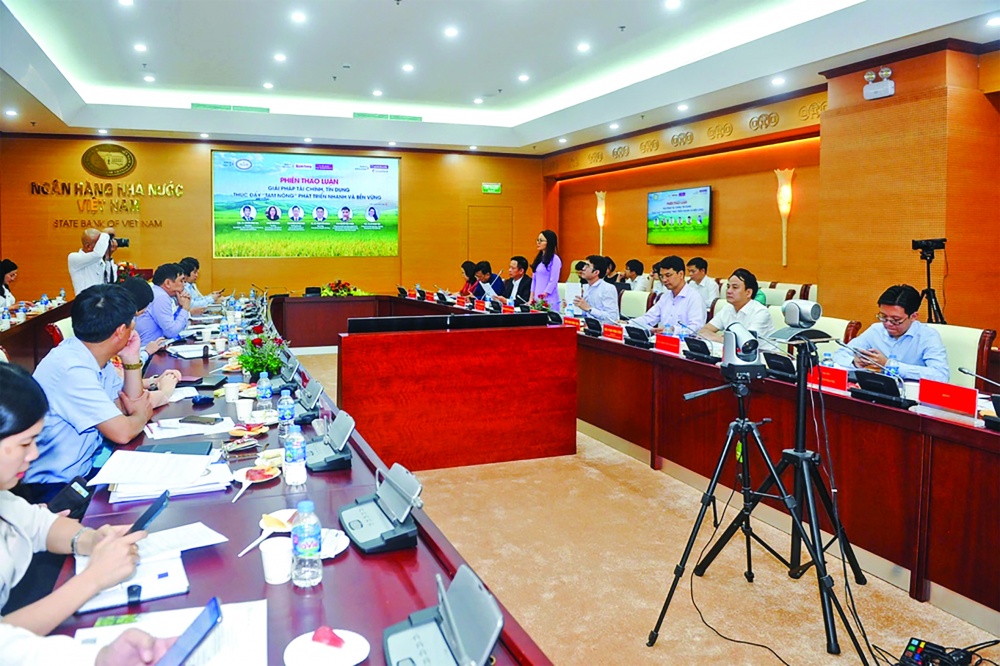 |
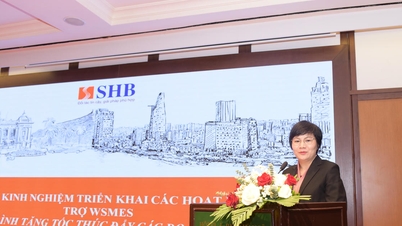
| Overview of the conference |
Promoting credit for agriculture, rural areas, and farmers.
It can be seen that bank credit flows have contributed to promoting the reorganization of agricultural production and effectively implementing the restructuring process of the agricultural sector. This has supported people and businesses in investing in expanding production and business, applying mechanization and scientific and technical advancements to production, improving quality, and increasing investment in processing to enhance the added value of agricultural products.
However, according to Ms. Ha Thu Giang's assessment, there are still many difficulties in expanding credit for agriculture, rural areas, and farmers. For example, there are difficulties in providing cheap, long-term capital. Currently, the main source of capital for credit institutions to lend to this sector is capital mobilized from economic organizations and individuals, with short maturities and market interest rates. Difficulties also arise from lending without collateral, the limited financial and management capacity of some customers in the agricultural and rural sectors, unconvincing production and business plans; and the ability to manage cash flow in lending to the agricultural and rural sectors still faces many challenges…
Besides that, there are other obstacles such as increasingly complex climate change, which has a significant impact on agricultural production; the agricultural and rural infrastructure remains weak, continuing to be a major challenge to the industrialization and modernization of agriculture and rural areas. During its development, the agricultural sector still has many unsustainable elements, its growth is not yet stable; it has not yet met the demands of large-scale, concentrated commodity production and high standards from the international market. On the other hand, the majority of farmers are small-scale, fragmented producers, lacking linkages in the production stages…
To support the implementation of credit policies serving agricultural and rural development, Ms. Giang suggested that synchronized solutions from all levels and sectors, from the central to local governments, are needed, such as agricultural insurance policies, land issues in agricultural production, and the development of sustainable agricultural value chains... "In particular, it is necessary to consider expanding the scope of insurance coverage and subsidizing insurance premiums for farmers cultivating large areas in regions frequently affected by natural disasters and crop failures," Ms. Giang added.
Faced with difficulties in supporting the agricultural sector, Mr. Vu Duy Hung, Deputy Head of the Farmers' Support Fund Management Board, Vietnam Farmers' Association, also suggested that the Government continue to issue policies and guidelines on credit for agricultural development, farmers, and rural areas to create conditions for people to access larger capital sources, longer loan terms, and preferential interest rates. At the same time, he proposed mechanisms to encourage the banking sector to focus on providing credit to the agricultural and rural areas; creating an environment to attract banks to expand their transaction locations to serve the people.





















































































Comment (0)