

Having moved out of particularly disadvantaged areas, many people no longer benefit from state support policies to participate in health insurance. Life for many people was already difficult, and the lack of health insurance further increased the risk of falling back into poverty whenever they fell ill.
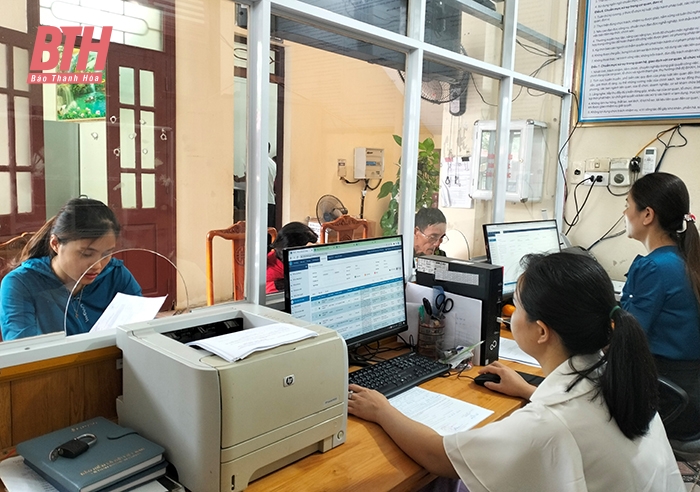
When near-poor households say no to health insurance.
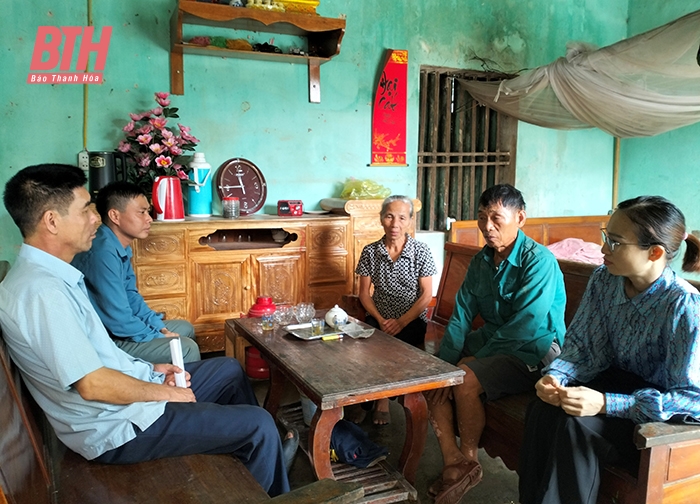
In a small house by Provincial Road 519, the lunch of Mr. Le Dinh Binh, Mrs. Trinh Thi Thu (both born in 1955), their daughter-in-law Cam Thi Phuong, and their two grandchildren consists only of a bowl of soup and a pot of rice placed on a tattered mat. In Cong Thuong village, Van Xuan commune (Thuong Xuan district), Mr. Binh's family is one of the few households with agricultural land, with 3 sao (approximately 0.3 hectares) of rice paddies, but they are not much better off. Their children have to work far away, sending money back to their parents to support their young children. Even Mr. and Mrs. Binh, nearly 70 years old, have to work tirelessly, sometimes in the fields, sometimes as laborers. It took a great effort for the family to escape poverty and become a near-poor household in 2022. If they participated in health insurance, Mr. Binh and his wife and family members would only have to pay 30% of the health insurance premium (because the State subsidizes 70% according to the Health Insurance Law), which is 241,380 VND/year/person. For a family of seven adults, the total annual payment would be approximately 1.7 million VND.
With a weary expression, Mr. Binh said, "Honestly, I'd like to join health insurance to protect myself from illness, but my family is too poor. There are 10 people in the family, 4 of whom work far away and send money home, but it's inconsistent. We only have 3 acres of rice paddies to feed 6 people, so we can't possibly improve our situation."
Not far from Mr. Binh's house, Ms. Truong Thi Binh's family is also a near-poor household but has not yet participated in health insurance. Her family has no land for farming, her husband passed away early, and she has to travel around on her old motorbike selling vegetables, fruits, meat, and fish to people in the village and surrounding areas to earn money to support her two children. Now that her children are grown, her hardships are lessened, but her family is still a near-poor household. She said: "I have been informed and encouraged by village and commune officials, as well as post office staff, and I would like to join health insurance, but due to difficult circumstances, I have to give up."
Among the 74 communes that have recently emerged from the list of particularly disadvantaged areas according to Decision No. 861/QD-TTg dated June 4, 2021, of the Prime Minister approving the list of communes in areas III, II, and I belonging to ethnic minority and mountainous regions for the period 2021-2025 (hereinafter referred to as Decision 861), Van Xuan commune has better conditions, as it was a new rural commune in 2020. The households we visited were also considered better off than the near-poor households in the commune, as they were located near the provincial road and were Kinh ethnic people who had moved there to live. However, they still face difficulties, and the boundary between poverty and poverty is very thin. In reality, according to the 2022 review results, Van Xuan commune still has 15.74% poor households and 40.6% near-poor households. Therefore, to date, the commune has only achieved a 69.5% participation rate in health insurance.
According to Le Minh Tuan, Vice Chairman of the People's Committee of the commune: Although the commune has organized many meetings in the villages to disseminate information and visited each household to encourage participation, many households eligible for partial state support still do not enroll in health insurance. This is due to several reasons, including the fact that their economic situation is still difficult.
Similarly, although it has been removed from the list of particularly disadvantaged villages according to Decision No. 612/QD-UBDT dated September 16, 2021, of the Committee for Ethnic Minorities Affairs approving the list of particularly disadvantaged villages in ethnic minority and mountainous areas for the period 2021-2025 (referred to as Decision 612), Khu 1 village, Giao Thien commune (Lang Chanh district) still has 86 poor households and 134 near-poor households out of a total of 287 households with 1,181 people. Village head Pham Thi Ly said: “To date, the percentage of people in the village participating in health insurance is less than 60%. Meanwhile, the village has organized many propaganda and mobilization efforts. Many near-poor households without health insurance cards unfortunately have to go to the hospital for treatment when they get sick, which is very expensive, so the risk of falling back into poverty is very high.”
The rate of people participating in health insurance has decreased.
According to the Provincial Social Insurance Agency, after Decisions 861 and 612 came into effect, 345,182 people in Thanh Hoa province were affected and no longer received full state support for health insurance premiums. Subsequently, the Provincial People's Council issued a resolution providing local budget support to residents of communes, villages, and hamlets that had recently emerged from particularly difficult areas to purchase health insurance cards until the end of 2021. Therefore, the percentage of people participating in health insurance in the province did not decrease during that year. In 2022, the Provincial People's Committee continued to provide partial funding from the local budget to purchase health insurance cards for near-poor households (20% of the local budget in addition to the 70% already supported by the State budget). Along with this, the Provincial Social Insurance Agency implemented a comprehensive set of effective solutions to increase the number of people participating in health insurance, especially by strengthening propaganda and mobilization efforts among the people. However, as of December 31, 2022, many mountainous districts still saw a decrease in the percentage of people participating in health insurance compared to December 31, 2021, such as Ngoc Lac (down 10,689 people), Cam Thuy (down 8,120 people), Thach Thanh (down 5,598 people), Quan Son (down 2,543 people)...
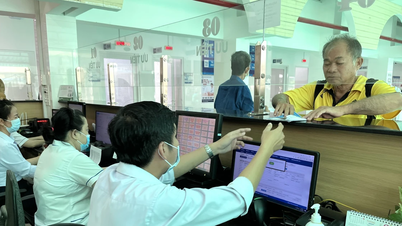
To achieve the target for the percentage of people participating in health insurance this year and in the following years, the Social Insurance agencies in mountainous districts have actively and proactively implemented a comprehensive set of practical solutions. For example, in Thuong Xuan district, in addition to expanding health insurance agencies, the district's Social Insurance agency has advised the District People's Committee to strengthen the steering committee, assign targets for the percentage of people participating in health insurance to each commune, and emphasize the responsibility of the heads of each commune in achieving this goal. Furthermore, the district's Social Insurance agency has assigned staff to directly go to the grassroots level to work with local Party committees and authorities to promote and encourage participation from Party branch secretaries, village heads, elders, and influential people in ethnic minority areas. They also update, monitor, and evaluate results daily as a basis for guidance and management. Many district Social Insurance officials have even worked on holidays to accompany local Party committees and authorities in promoting and encouraging people to participate. However, as of May 12th, Thuong Xuan district had only achieved 75% of its population participating in health insurance. The target for this rate in 2023 was 93.5%. According to Cam Ba Dung, Vice Chairman of the Thuong Xuan District People's Committee, to achieve the target for health insurance participation this year, the district has no other solution than to actively promote and encourage participation.
It must be said that the reason people have not participated in health insurance, especially those whose contributions are partially or largely subsidized by the State (near-poor households, households engaged in agriculture, forestry, and salt production with average living standards), is not entirely due to difficult economic conditions. It is also due to a lack of full awareness of the benefits of participating in health insurance, or a mindset of dependence and reliance. For example, we visited some near-poor households with few members where the annual health insurance premium for the whole family is only about 700,000 VND, but they were not enthusiastic about it, not because of economic reasons, but because of their mindset and awareness. And then, when many people do not participate in health insurance, they lack this "protective shield" for their health. This not only affects their rights in medical examinations and treatment but also significantly impacts the achievement of social security goals and the economic development of the locality.
Now, without partial support from local budgets as in the last six months of 2021 and the fourth quarter of 2022, Party committees, authorities, and the Social Insurance sector will have to intensify efforts to encourage people to participate. Meanwhile, according to Resolution No. 69/QH15, dated November 11, 2022, of the National Assembly on the State budget estimate for 2023, from July 1, 2023, the basic salary will increase from 1.49 million VND/month to 1.8 million VND/month. This means that the health insurance contribution rate of 4.5% of the basic salary for citizens will also increase. For near-poor households, the health insurance contribution will increase from 241,380 VND/year to 291,600 VND/year per person. The contribution rate for households engaged in agriculture, forestry, fisheries, and salt production with an average standard of living, as well as students (who receive a 30% subsidy from the State), will increase from 563,220 VND/year to 680,400 VND/year. This pressure could make the task of encouraging people to participate in health insurance in communes, villages, and hamlets that have just emerged from particularly difficult areas even more challenging.
Text and photos: Do Duc
Source
















![[E-Magazine]: A Smile in the Mist](https://vphoto.vietnam.vn/thumb/402x226/vietnam/resource/IMAGE/2026/01/09/1767966303539_e-magazine-nu-c-w1200t0-di2601d199d5141507t11920l1-nctsm-155.webp)


























































Comment (0)