

Although the merger of provinces and cities has been thoroughly researched and carefully considered by the competent authorities, and has received the consensus of the vast majority of the people, there are still some concerns...
Merging provinces, abolishing districts, and streamlining communes is a major policy that has attracted public attention. Looking back at history, from the time of Emperor Minh Mạng to the present day, over two centuries, our country has experienced 10 instances of provincial separation and merger. This shows that this is not a new phenomenon but an objective law, constantly evolving according to the development needs of each period.
Removing barriers to development
Vietnam currently has an area of 331,212 km² and a population of over 100 million people, yet maintains an administrative apparatus comprising 63 provinces and cities; 705 districts; and 10,595 communes and wards. Compared to countries of similar size, this apparatus is excessively large, consumes a huge budget, limits resources for development, and lacks coordination, posing a major obstacle to breakthroughs in the future.
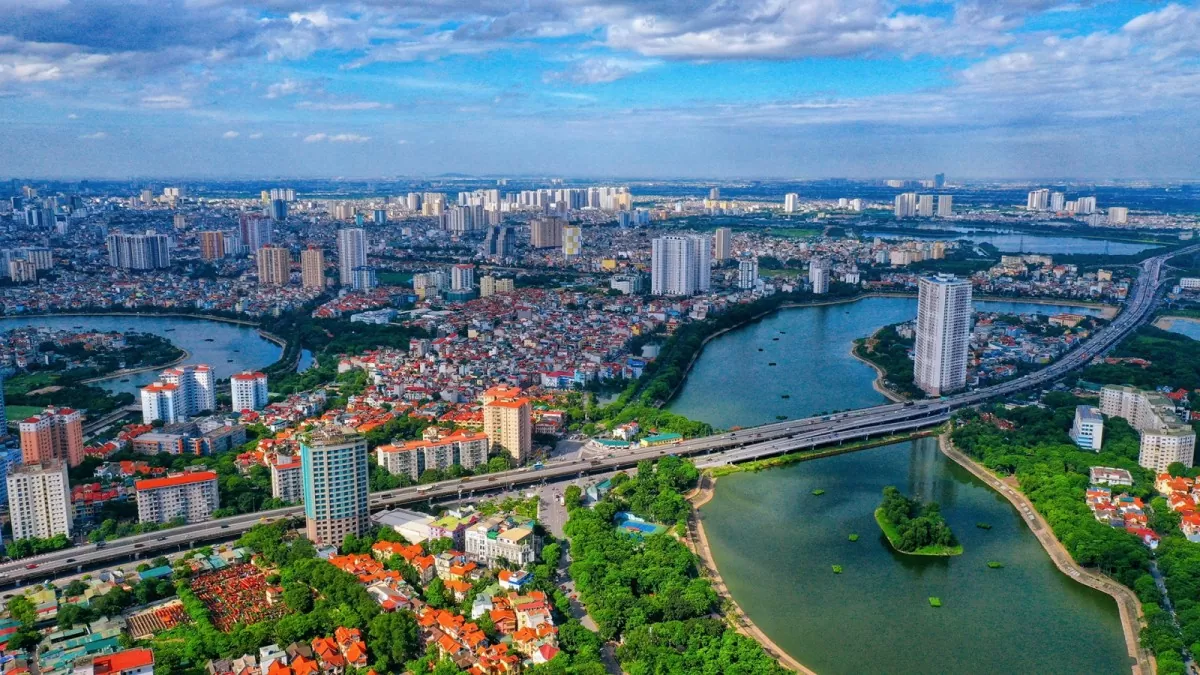 |
| In 2008, Hanoi expanded its administrative boundaries, merging with Ha Tay, which not only increased the capital's population to 8 million but also led to breakthroughs in attracting investment and achieving rapid growth (Photo: Quang Dung). |
Without reform, Vietnam risks being trapped in the middle-income trap and lagging behind in the globalized world. Therefore, the Party and Government 's policy of merging provinces and streamlining the administrative apparatus is seen as an inevitable step, receiving the highest level of consensus from the people due to its enormous, long-term, and promising benefits.
Besides reducing budget costs and easing administrative burdens, merging provinces also opens up opportunities for synchronized regional economic development, avoiding overlapping planning. A social media post hypothesized that, assuming we merge several provinces in the Northeast, a "super province" of the Northeast economy could emerge, creating a strong impetus for the development of seaports, tourism, and industry through linkages, overcoming the situation where each locality has its own planning style and acts independently.
Lessons from the past show that this model is not unfamiliar and is highly effective. For example, in 2008, Hanoi expanded its administrative boundaries, merging with Ha Tay, which not only increased the capital's population to 8 million but also led to breakthroughs in attracting investment and achieving rapid growth. This is clear evidence that when administrative barriers are removed, resources are allocated more rationally, creating momentum for sustainable development.
On the other hand, it's crucial to create greater synergy and coherence in planning and policies. Currently, many smaller provinces struggle to compete with larger ones, yet they share strong economic ties. This leads to numerous shortcomings in development, especially in infrastructure.
Take the example of highways: one province has the budget to build roads, but the neighboring province lacks the resources, causing disruptions to the transportation network and delaying development. If these localities were merged, planning would become more systematic and unified, making it easier for the central government to implement inter-regional projects, such as the North-South expressway, without being hindered or interrupted by administrative boundaries.
Let's grow stronger together!
Of course, merging provinces is not a simple task, but a major step requiring careful consideration. However, it must be emphasized that there is no more opportune time than now, when the country is fully prepared to carry out a thorough reform, a complete and groundbreaking administrative revolution. Missing this opportunity will undoubtedly lead to more obstacles in the future.
Previously, one of the major obstacles to provincial mergers was regional prejudice and local parochialism. However, times have changed, and modern culture has shifted towards greater integration and openness. Instead of parochial thinking, people are gradually accepting unity in diversity, preserving their own identity but without isolation. Therefore, provincial mergers blur geographical boundaries, narrow the gap between localities, and strengthen solidarity, creating a foundation for a more sustainable and shared future.
Furthermore, the competent authorities did not overlook a crucial factor regarding criteria and standards when studying provincial mergers: cultural and social similarities and regional linkages. Vietnam's six socio-economic regions have been clearly defined, so adjusting them through mergers to better suit reality is inevitable. This not only addresses the concerns of the people but also creates the highest level of consensus within society and the political system.
Furthermore, administrative and daily life disruptions are no longer a major concern when implementing provincial mergers. Previously, some opinions expressed concern that, after the merger, people in remote areas would have to travel hundreds of kilometers to the new provincial center to complete procedures, which would be particularly difficult for people in mountainous areas with rugged terrain.
However, in the context of rapid digital transformation, the government is accelerating administrative reforms towards online services, minimizing the need for people to travel. Therefore, the main challenge lies not in geographical distance, but in disseminating knowledge and guiding people to access digitized processes. But with support from the grassroots level, people will gradually become familiar with the new methods, making administrative procedures faster and more convenient.
Furthermore, the current time is considered opportune, with the 14th National Party Congress approaching. Typically, after each Party Congress, the leadership apparatus is restructured. If reorganization waits until after that, the already stable apparatus will be disrupted again, leading to further personnel and staffing issues that need to be addressed. Therefore, implementing the provincial merger before the Party Congress will ensure a smooth process, guarantee stability, and achieve the highest possible efficiency.
However, despite the advantages mentioned above, several issues still require careful consideration, such as the naming of the new province after the merger and the selection of an administrative and political center that ensures continuity while also being suitable for the new stage of development. In particular, historical, cultural, and traditional factors need to be thoroughly considered to ensure that the final decision is not only rational from a governance perspective but also receives public consensus.
However, no matter how we implement it, it will be difficult to satisfy everyone, and public sentiment will undoubtedly be affected to some extent. But, each of us needs to adapt, prioritizing the common good over personal, fleeting emotions. Let's look beyond the immediate changes to see a future where the country operates efficiently, develops strongly, and progresses sustainably.
Administrative reform has never been an easy path; only when the whole society is united can all difficulties and obstacles be overcome. For example, for the greater good, when two provinces merge, priority should be given to selecting an existing development center with modern infrastructure to serve as the "capital," instead of spreading resources thinly on new construction, which is costly, wasteful, and prolongs the transition period. The important thing is not the name or the administrative center's location, but rather the innovation of thinking, streamlining the apparatus, and improving the efficiency of national governance. Merging provinces and cities is not about loss, but about mutual growth! |
Source: https://congthuong.vn/sap-nhap-tinh-thanh-khong-mat-di-ma-cung-lon-manh-378331.html





























































































Comment (0)