

Many students at Hanoi Pedagogical University say they have not received their living allowance for months.
Things are getting harder and harder.
Tran Phuong Lien, a second-year student at Hanoi Pedagogical University, said she signed a commitment to work in the education sector to be exempt from tuition fees and receive a monthly living allowance of 3.63 million VND from the government budget.
However, after receiving the tuition payment for the first semester of her first year nearly a year ago, this student has not received any further financial support. This is causing difficulties for Lien because her family is in a difficult financial situation. "It was precisely because of the living allowance that I chose to attend a teacher training college to ease the financial burden on my family," Lien said.
Tran Phuong Lien's difficulties are also the common situation of students at many teacher training colleges across the country. According to Decree 116, from 2021, teacher training students receive 100% tuition fee support from the state, along with 3.63 million VND per month for living expenses.
This funding is drawn from the budgets of localities, ministries, and sectors, through a contracting arrangement with schools. The annual enrollment quota for teacher training programs is determined by the Ministry of Education and Training (MOET).
This policy led many students to enroll in teacher training programs to reduce financial burdens on their families. However, in reality, many teacher training students are still owed this living allowance.
Explaining the delay in paying student living expenses, many teacher training colleges stated that this situation stems from the training orders placed by localities under Decree 116 and the numerous obstacles in the allocation of funds.
Local authorities are reluctant to place orders because this policy stipulates that graduates must work in the education sector, otherwise they must reimburse the costs.
Meanwhile, there is no binding mechanism between students and the local authorities. Furthermore, even after graduation and returning home, students still have to take civil service exams according to the regulations of the Ministry of Interior, and there is no guarantee of success.
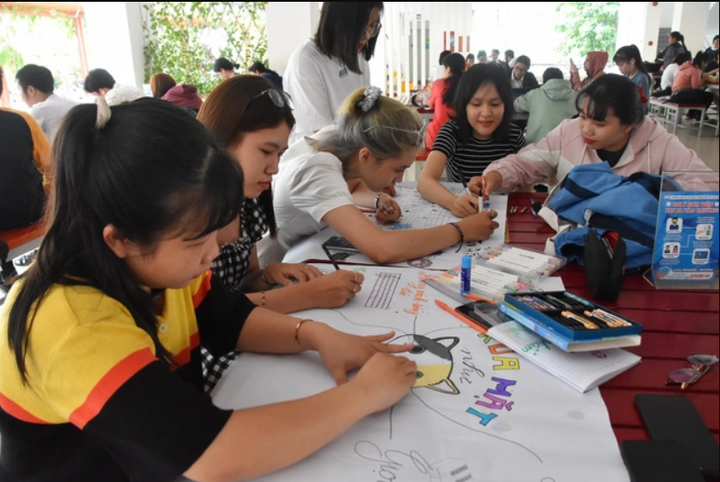
Students at Ho Chi Minh City University of Education during a project session for their course. (Photo: TAN THANH)
Many obstacles
According to a recent report submitted to the Government, the Ministry of Education and Training stated that the percentage of students who received assignments or tasks from local authorities accounted for only 17.4% of the total number of enrolled students and 24.3% of the total number of students registered to benefit from the policy.
The number of students registered to benefit from the policy was 30,807, while the number of localities placing orders was 1,928 and assigning tasks was 5,563. 23 out of 63 provinces and cities actually carried out the task assignment and ordering.
Thus, the number of students under the "training according to social needs" program, funded by the state budget (through the Ministry of Education and Training), accounts for 75.7% of the students registered for the policy and 82.6% of the students enrolled. It can be said that the method of ordering/assigning/bidding for teacher training has not been implemented to the extent and effectiveness intended by Decree 116.
There are 6 training institutions that have been commissioned by local and neighboring localities but have not yet paid the fees, or have only paid a small portion of them, including 2 key institutions: Hanoi University of Education and Ho Chi Minh City University of Education.
This affects training costs, funding for teacher training students, and creates inequality between teacher training students trained through commissioned/assigned/tendered mechanisms and those trained to meet societal needs.
Each year, the Ministry of Finance only allocates about 54% of the funding needed for teacher training students at teacher training institutions under the Ministry of Education and Training. Therefore, funding for teacher training students is always delayed compared to the training plan, leading to difficulties for teacher training institutions and teacher training students.
Furthermore, the Ministry of Education and Training also stated that due to uneven development, disparities in resource conditions, and differences in educational finance policies between localities, many localities face difficulties and lack sufficient funds to implement teacher training programs through commissioning/assigning tasks/bidding processes.
According to the Ministry of Education and Training, the methods of ordering and assigning tasks are also inconsistent in legal documents. Students who are ordered/assigned tasks/bid on receive funding from the local budget, but after graduation, they may not be able to find employment in the local education sector.
Secondly, providing financial support to teacher training students from other localities is inconsistent with the provisions of the State Budget Law, because local funds should only be used to ensure the socio-economic development goals of that locality.
Another drawback is that the need for teacher recruitment and training is linked to funding for teacher training students, but not to the right to employment or priority in hiring teacher training students after graduation. This makes localities hesitant to allocate funding for support without being able to recruit teacher training students after graduation.
Furthermore, the People's Committees of the provinces have not yet paid sufficient attention to directing and assigning agencies in their localities to guide, monitor, and supervise teacher training students who are subject to the training order program.
Pay students as soon as possible.
Faced with the difficulties of students not yet receiving living allowance support, Professor Nguyen Van Minh, Rector of Hanoi Pedagogical University, said that the school had to conduct counseling and encourage students to share in the common difficulties.
For students from disadvantaged backgrounds, the university will provide partial support upfront from its own resources. The Ministry of Education and Training is expected to disburse the funds next week. Once the money is available, the university will promptly disburse it to the students.
Local orders are placed according to demand.
In a recent submission to the Government regarding the amendment and supplementation of several articles of Decree No. 116 regulating policies on financial support for tuition fees and living expenses for teacher training students, the Ministry of Education and Training proposed maintaining the method of assigning tasks and commissioning the training of teacher training students.
However, the Ministry of Education and Training proposes that localities are not required to implement this, but rather should do so depending on their conditions and needs, in accordance with Government Decree No. 32, which stipulates the assignment of tasks, ordering, or bidding for the supply of public products and services using state budget funds from recurrent expenditure sources.
The Ministry of Education and Training believes that this regulation clearly defines the responsibility of the state budget to ensure funding for support policies for teacher training students according to the budget allocation system.
Training institutions under central ministries and agencies are funded by the central budget, while training institutions under local governments are funded by the local governments.
"This regulation ensures that teacher training students will receive funding in accordance with the provisions of the 2019 Education Law, eliminating the current situation where teacher training students are not receiving or are delayed in receiving support policies."
"At the same time, this regulation still addresses the needs of localities that want to order training from local training institutions or other higher-quality training institutions," the Ministry of Education and Training stated.
Postponing tuition fee collection to alleviate difficulties.
Representatives from Saigon University stated that nearly 1,600 students across three cohorts registered to benefit from the policy under Decree 116. For each cohort, the university sent information to the People's Committees and Departments of Education and Training in the provinces and cities, but most did not respond.
Rarely, in 2021, only Long An and Ninh Thuan announced orders for 34 students. These students have received their first installment of tuition and living expenses and are about to receive the second installment. In 2022 and 2023, Long An also sent out order notifications and is taking the next steps to pay tuition and living expenses for these students.
For the remaining students, the university has forwarded the case to the governing body, the Ho Chi Minh City People's Committee, for assistance. "For the past three years, we have followed the correct procedures, but currently more than 1,500 students have not received support," said a representative from Saigon University.
Currently, universities are doing many things to support students. For example, at Saigon University, the school has postponed tuition fee collection to reduce pressure on students, while continuing to submit proposals to the governing body.
(Source: Nguoi Lao Dong Newspaper)
Source


![[Photo] President Luong Cuong receives Speaker of the Jordanian House of Representatives Mazen Turki El Qadi](/_next/image?url=https%3A%2F%2Fvphoto.vietnam.vn%2Fthumb%2F1200x675%2Fvietnam%2Fresource%2FIMAGE%2F2026%2F02%2F03%2F1770112220330_ndo_br_1-3704-jpg.webp&w=3840&q=75)


Comment (0)