

Around 10 PM on the last day of November, the actors of the Green Coconut Water Puppet Art Troupe gathered behind the stage of the Brass Band and Puppet Festival at 23 September Park (Ho Chi Minh City) to prepare their props.
This was their second night at the festival, but due to a change, the performance, instead of 7 PM, had to be moved to near the end of the show. Beside the prop box, 68-year-old Nguyen Tien Hoa (Ba Hoa) was busy using screws to repair loose joints in the puppets. He is the oldest actor in the troupe and also the director, originally from the Ben Tre Cai Luong (traditional Vietnamese opera) troupe.
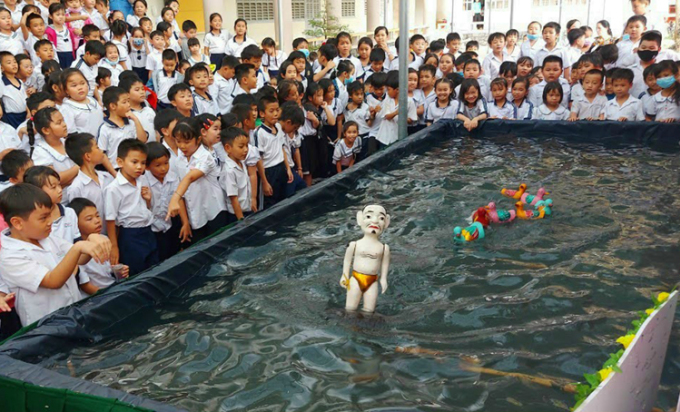
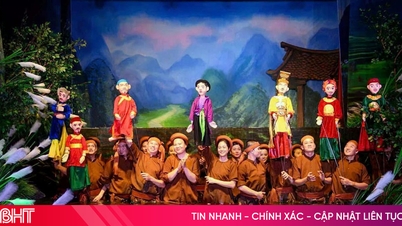
The students enjoyed watching the water puppet show "Catching the Fox and the Duck". Photo: Hoang Nam
Passionate about water puppetry, in 1988 Mr. Hoa left his cải lương (traditional Vietnamese opera) troupe, sold 6 chỉ (units) of gold, and went to the capital to learn the craft. Six months later, he returned to work at the puppet troupe of the former Hau Giang province. In 1990, he returned to his hometown to establish his own water puppetry troupe. However, due to financial difficulties, the troupe had to disband after only 1.5 years. Mr. Ba then continued working at the Department of Culture, Sports and Tourism of the province until his retirement in 2019.
At this time, Pham Tan Vu, 33 years old, an employee of the Ben Tre Museum and also a passionate water puppet artist, approached Mr. Hoa to ask for his help in establishing a puppet troupe. Given the opportunity to fulfill a dream left unfulfilled more than 30 years ago, Mr. Hoa readily agreed.
The teacher and his student spent over 100 million VND of their own money to buy nearly 30 puppets from Hanoi . They then inquired around and recruited nearly 20 members who shared the same passion. Notably, there was even a case where a husband and wife both participated in water puppetry.
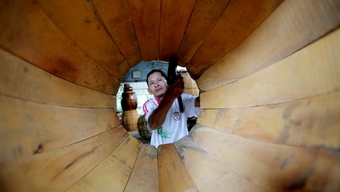
Starting with the traditional material of fig wood, which is lightweight, buoyant, and less prone to cracking during crafting, the group then experimented with making puppets from water guava wood, which is abundant locally. Although water guava wood is heavier, it is twice as durable as fig wood, and with the help of carving machines, it can last up to 3 years.
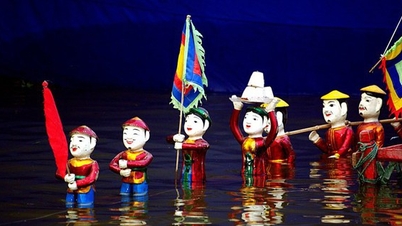
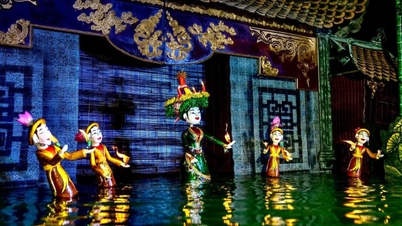
Mr. Ba said that the number and names of the puppets remain the same as the traditional Northern Vietnamese style, but the costumes have been modified to include the traditional Southern Vietnamese style of áo bà ba (traditional blouse) and khăn rằn (checked scarf). He also improved some parts of the puppets, such as the frame of the lion's head and body, using iron rods wrapped in plastic tubes instead of rattan to increase durability.
Furthermore, according to the veteran artisan, the puppets' dialogues are also interwoven with Southern Vietnamese folk melodies such as "Ly Chim Xanh" (Blue Bird Song), "Ly Con Khi" (Monkey Song), "Ly Keo Chai" (Fishing Song), and "Ho The Muc" (Squid Card Song). In particular, the troupe has a performance titled "Luc Van Tien Defeats Phong Lai to Rescue Kieu Nguyet Nga," based on the epic poem "Luc Van Tien" by Nguyen Dinh Chieu, a native of Ben Tre province.
According to Mr. Ba Hoa, this job is tough but full of fun memories. One day, when the troupe was about to perform, they discovered the prop ball had fallen off. Mr. Ba cleverly found a dried coconut to replace it, and the "lion playing ball" act was transformed into lion playing with coconuts. Unexpectedly, the foreign tourists found it very amusing. On another occasion, while performing a duck herding act, the ducks' ropes broke, splitting the flock in two. The voice actor quickly shouted "the ducks have scattered," and the audience below, unaware of the incident, continued to applaud enthusiastically.
With about 10 minutes left until the performance, Mr. Ba Hoa took the opportunity to warm up his body by stretching his limbs before immersing himself in the water in the chilly night air. Despite wearing raincoats, for difficult acts like dragon and lion dances, the performers still went shirtless for greater flexibility. "The most important thing is to fulfill my passion," Mr. Ba said.
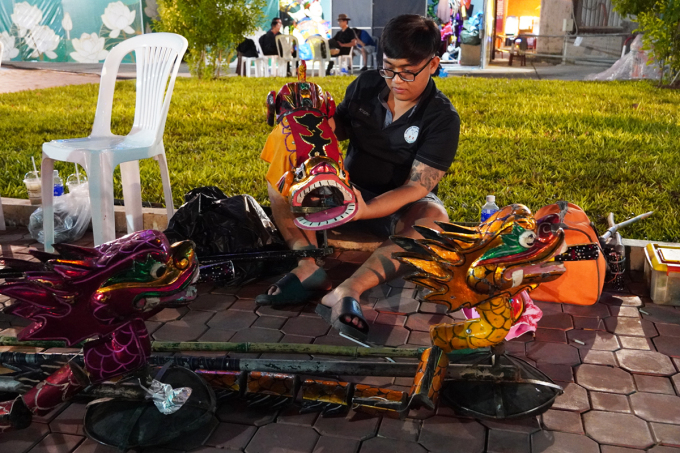
Actor Le Thanh Hai inspects the puppets before a performance. Photo: Hoang Nam
Joining the Green Coconut Puppet Troupe at the age of 17 and being the youngest member, Le Thanh Hai said that he used to be a driver, but he had learned lion dance, drumming, and also knew how to play some traditional musical instruments, so he was invited to join the troupe.
New trainees are taught to dance with simple puppets like ducks and fish, then move on to more difficult puppets like dragons – long and heavy, requiring flexibility combined with technique and skill. After more than a month of training, the dancers will know the basics. After 4 years, Hai is now a leading dancer in the troupe.
"For each performance, the actors are paid 500,000 VND, but because it's seasonal work, we have to do other jobs to make ends meet and maintain our passion," Hai said.
After four years of operation, the Coconut Land Puppet Troupe has toured most provinces in the Mekong Delta, performing at schools, festivals, and anniversaries. On average, they have more than 10 performances per month, with the longest show lasting 12 minutes and the shortest 3 minutes. The troupe currently has over 50 puppets used in approximately 15 performances, the largest of which is a dragon about 1.5 meters long and weighing nearly 2 kg.
Mr. Nguyen Hoai Anh, Director of the Ben Tre Cultural and Film Center, said that the center is temporarily lending a corner of its headquarters to the water puppet troupe for use as a workspace and stage design. "While the government doesn't yet have the resources to invest, the efforts of these young people to maintain this traditional art form are very commendable," Mr. Anh said.
According to Hoang Nam - VnExpress
Source




























































Comment (0)