

The hottest place in the universe may be the quasar 3C273, with an estimated temperature of around 10 trillion degrees Celsius.
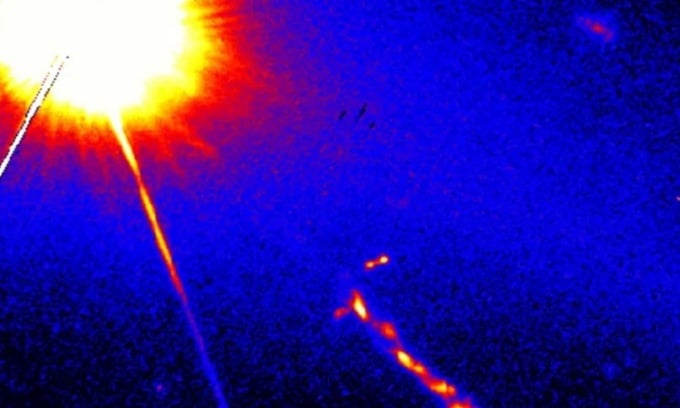
Quasar 3C273 as seen in this image from the Hubble Space Telescope. Photo: NASA
Despite being the hottest object in the system, the Sun's temperature is relatively low compared to some other celestial bodies. According to Daniel Palumbo, a postdoctoral researcher at the Black Hole Initiative at Harvard University, the hottest place in the universe is very close to supermassive black holes, especially those that are devouring gas. These gas-eating black holes have relativistic jets, massive streams of matter propelled to near the speed of light and exceptionally hot, according to Live Science .
The hottest place in the universe known to researchers is the quasar 3C273, the extremely bright region surrounding a supermassive black hole located 2.4 billion light-years from Earth. This region has a core temperature of over 10 trillion degrees Celsius, according to the Greenbank Observatory in West Virginia. However, this temperature estimate is still uncertain.
Supermassive black holes are extremely powerful and are located at the center of most galaxies. As their name suggests, they are enormous in size. For example, Sagittarius A*, the supermassive black hole at the center of the Milky Way, is millions of times heavier than the Sun. Like any other black hole, the quasar 3C273 has such a strong gravitational pull that no object, including light, can escape. Opposite to this pull is a ring of gas rotating around the black hole called an accretion disk.
When molecules are sucked into a black hole at high speeds, the friction created by the collisions can generate temperatures of trillions of degrees Celsius. Compared to that, the surface of the Sun has a temperature of 5,500 degrees Celsius. This temperature only increases when the black hole's extremely strong gravitational pull slams nearby matter into relativistic jets ejected into space, Palumbo said.
However, the answer to the hottest place in the universe may depend on when the question is asked, according to Koushik Chatterjee, a graduate student at the Black Hole Initiative. When two massive celestial bodies collide, the explosion they create can generate extremely high temperatures. For example, two neutron stars, the collapsed cores of massive stars, crashing into each other can generate temperatures of up to 800 billion degrees Celsius, according to research published in 2019 in the journal Nature Physics. A black hole colliding with a neutron star can also radiate exceptionally high temperatures.
It's difficult to pinpoint the hottest place in the universe precisely because studying the temperature of distant objects is challenging. Researchers are still unsure about the true temperature of black holes. Instead, scientists measure the energy emitted from supermassive black holes in the form of visible light, radio waves, and X-rays. They can estimate the temperature based on the wavelength patterns of the electromagnetic radiation produced by these sources.
A future X-ray observatory called the X-ray Imaging and Spectroscopy Mission (XRISM) will help scientists measure high-temperature gases in space more precisely. Thanks to more advanced instruments, they may be able to find regions hotter than even the quasar 3C273.
An Khang (According to Live Science )
Source link


![OCOP during Tet season: [Part 3] Ultra-thin rice paper takes off.](/_next/image?url=https%3A%2F%2Fvphoto.vietnam.vn%2Fthumb%2F402x226%2Fvietnam%2Fresource%2FIMAGE%2F2026%2F01%2F28%2F1769562783429_004-194121_651-081010.jpeg&w=3840&q=75)





Comment (0)