


On November 27, a resolution of the NATO Parliamentary Assembly called on member states of the alliance to provide Ukraine with intermediate-range missiles with a range of 1,000-5,000 km, as stipulated by the Intermediate-Range Nuclear Forces Treaty (INF).
Despite receiving the approval of the NATO Parliamentary Assembly, the plan to provide intermediate-range missiles to Ukraine has yet to receive a commitment from any country. This is due to the fact that only a few NATO countries possess missiles with a range exceeding 1,000 km, and the United States is leading with its Tomahawk missiles.
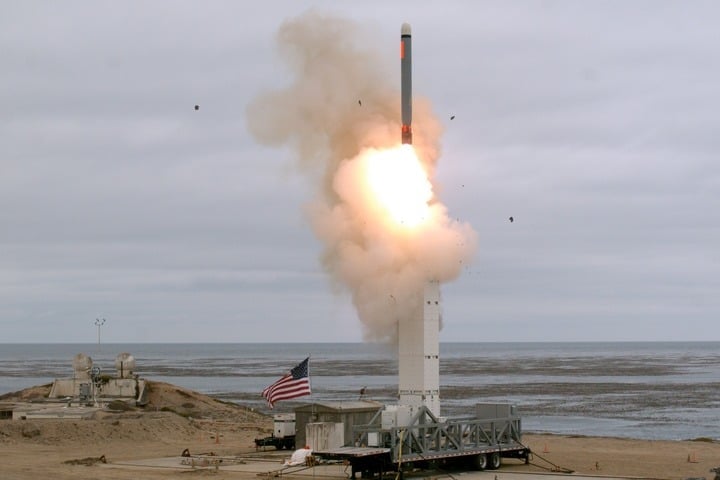
A mobile Tomahawk missile launcher of the U.S. military. (Photo: U.S. Department of Defense )
If assessing the possibility of providing intermediate-range missiles to Ukraine, only the United States has the capacity to meet the current intensity of the battlefield. The Tomahawk missile itself has seen combat in numerous conflicts and has proven its effectiveness.
The biggest problem right now is that to deploy the Tomahawk, Ukraine needs Mk 70 vertical launch systems and MRC Typhon launchers. These are all new pieces of equipment, and even the US military hasn't been equipped with them on a large scale.
Another issue is that US President Joe Biden's term has less than two months left, and pushing ahead with the Tomahawk missile transfer plan is too rushed. Furthermore, even with Tomahawk missiles, Kyiv has no chance of ending the conflict with just a few missiles.
Even if it were possible to transfer a few dozen Tomahawk missiles to Kyiv, such an action would lead to an uncontrolled escalation of the conflict. Moscow's reaction could be even stronger than the US allowing Ukraine to use ballistic missiles to attack Russian territory.
In a worst-case scenario, the US or even NATO could be drawn into a direct conflict with Russia, because Ukraine lacks the capability to operate NATO missiles, and most of the work is handled by US military advisors.
Experts believe that the current escalation of conflict is part of a larger strategy by the Biden administration to "complicate the issue as much as possible." The ultimate goal is to prevent any peace negotiations after President-elect Donald Trump takes office.
Another solution, easier than transferring Tomahawk missiles, is for Washington to supply JASSM-ER air-to-ground missiles. This weapon has a range of up to 1,000 km and can be deployed from F-16 fighter jets.
Like the Tomahawk, the JASSM-ER also failed to alter the balance of the conflict and was not powerful enough to lead Ukraine to victory. The use of long-range missiles would only lead to stronger reactions from Russia with unpredictable consequences.
The transfer of Tomahawk missiles and JASSM-ER missiles also requires support from the United States. If Mr. Trump changes policy after returning to the White House, all current efforts will become meaningless.
NATO leaders are well aware of the risks of such actions but have still given their support to the plan.
Source: https://vtcnews.vn/my-se-chuyen-giao-ten-lua-tomahawk-cho-ukraine-ar910167.html



























































































Comment (0)