

According to a draft circular from the Ministry of Transport , private vehicles with up to nine seats that are not used for commercial transportation will have their inspection cycle automatically extended if their inspection certificate expires.
The Ministry of Transport is seeking feedback from ministries and agencies on the draft circular amending Circular No. 16/2021 on technical safety and environmental protection inspection of motor vehicles.
According to the draft amendment, passenger cars with up to 9 seats not used for commercial transport that expire within one year of the Circular's issuance will have their inspection deadlines automatically extended to the new cycle. Owners will be issued a new inspection certificate without having to bring their vehicles to the inspection center for re-inspection. It is expected that nearly 1.4 million private passenger cars with up to 9 seats will have their inspection deadlines automatically postponed by 6 months.
For example, a car with fewer than 9 seats, manufactured 5 years ago, whose current inspection cycle expires on June 30, 2024, will automatically have its cycle extended by 6 months, until December 31, 2024. At this point, the owner must take the car for inspection to continue with a new cycle.

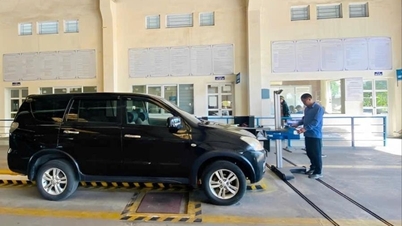
Vehicle inspection in Hanoi . Photo: Ngoc Thanh
Vehicles with expired inspection certificates prior to the effective date of this Circular will not be immediately eligible for the new inspection cycle and must still go to the vehicle inspection center to obtain the inspection certificate and sticker.
Regarding the draft circular that only applies to vehicles with fewer than 9 seats not used for commercial transport, the Vietnam Registering and Inspection Department stated that this group consists of personal vehicles with infrequent use, and owners maintain and repair them better than commercial vehicles. The pass rate on the first inspection for this group is high, approximately 95% of the total number of vehicles. This shows that re-inspecting vehicles before extending the inspection cycle is unnecessary while still ensuring safety requirements.
Vehicles with fewer than 9 seats that are not used for commercial transport account for 33-43% of the total number of vehicles due for monthly inspection, concentrated in Hanoi and Ho Chi Minh City. Automatically extending the inspection cycle, so owners don't have to bring their vehicles in for inspection, will help reduce the workload on vehicle inspection centers.
Vehicles with more than 9 seats manufactured up to 5 years ago, and trucks and tractor-trailers manufactured 20 years or more ago are also eligible for extended inspection cycles. However, these vehicles are used frequently and require inspection before the cycle can be extended. Statistics show that the pass rate on the first inspection for this group of vehicles is low, sometimes reaching only 67%.
To facilitate the automatic extension of vehicle inspection cycles, the Vietnam Registering and Inspection Department is developing software, leasing transmission lines, and information technology infrastructure to enable vehicle owners to look up and print the Certificate of Validity of Inspection Certificates and Inspection Stickers, which they can use alongside previously issued Inspection Certificates and Stickers when participating in traffic.
The Vietnam Registering and Inspection Department stated that the automatic extension of the inspection cycle by six months will affect the revenue of inspection centers. However, this will fundamentally resolve the current congestion in motor vehicle inspections, meeting the inspection needs of individuals and businesses.
According to Circular No. 2/2023 of the Ministry of Transport, passenger vehicles with fewer than 9 seats not used for commercial transport, manufactured up to 7 years ago, are exempt from inspection for 36 months (previously 30 months), with a periodic inspection cycle of 24 months (an increase of 6 months); vehicles manufactured between 7 and 20 years ago (previously 12 years) have a periodic inspection cycle of 12 months; and vehicles over 20 years old have a cycle of 6 months. Vehicle owners must have their vehicles inspected before confirming the start of the new inspection cycle.
Source link


![[Photo] Two flights successfully landed and took off at Long Thanh Airport.](/_next/image?url=https%3A%2F%2Fvphoto.vietnam.vn%2Fthumb%2F1200x675%2Fvietnam%2Fresource%2FIMAGE%2F2025%2F12%2F15%2F1765808718882_ndo_br_img-8897-resize-5807-jpg.webp&w=3840&q=75)


































































































Comment (0)