

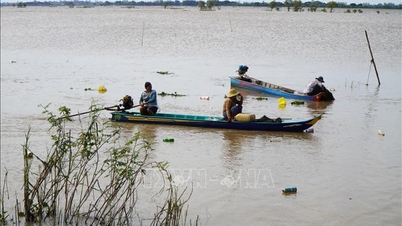
In some low-lying areas of Soc Trang province, the water level rises and floods the fields during this time (commonly known as the flood season). Many farmers, instead of planting rice, surround their fields with nets to raise freshwater fish in a natural way.
This method of raising fish in rice paddies, which locals call "pond farming" (managing fish in rice paddies), has yielded fairly stable economic results in recent years.
Looking at the 30 acres of rice paddies filled with water, their banks submerged and surrounded by nets, Mr. Le Van Thuong in My Thanh hamlet, My Tu commune, My Tu district (Soc Trang province) said that he has been practicing this model of raising fish in enclosed rice paddies for about 5 years now.
At the end of the summer-autumn rice harvest, when the fields are flooded (the flood season), he begins to surround the fields with nets to keep and raise wild fish.
In addition to the naturally occurring fish in the rice paddies, he also released 10 kg of tilapia fingerlings and 10 kg of silver carp fingerlings to increase the fish yield in the rice paddies.
In addition, he also raises hundreds of ducks. Mr. Thuong said that from this model of raising fish in the rice paddies combined with raising ducks, he earns an income of over 40 million VND per season.
"I find this method of raising freshwater fish in enclosed ponds very effective; farmers don't have to leave their land fallow during the autumn-winter season."
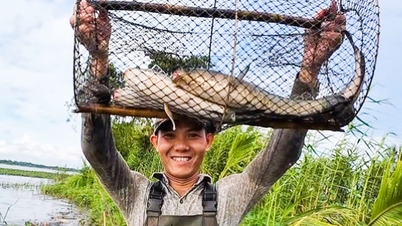
"I've been raising these freshwater fish for three months now. Each one probably weighs about 1kg, especially the spotted carp. There are plenty of other freshwater fish. I'll harvest them for sale when it's time to plant the winter-spring rice crop," Mr. Thuong added.

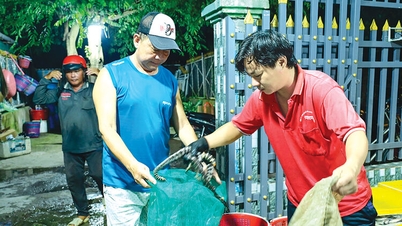
Raising freshwater fish in enclosed ponds during the flood season is quite common in the low-lying areas of Soc Trang province. Photo by Huy Minh.
My Tu commune, My Tu district (Soc Trang province) has a low-lying terrain. After harvesting the summer-autumn rice crop, around August, water begins to flow from upstream, combined with rain, causing the fields to flood. As a result, people here often abandon their fields and do not plant rice. The flood season usually lasts from August to November.
In recent years, to exploit natural aquatic resources in the rice fields, farmers have invested in purchasing nets to surround their fields and implement a model of raising fish in enclosed ponds. This method helps farmers earn income while leaving the fields fallow while waiting for the water to recede for the winter-spring rice crop.
From just a few initial households, the model of raising freshwater fish in enclosed ponds has now developed in almost all hamlets throughout My Tu commune.
In My Hoa hamlet, for a long time, people have left their fields uncultivated during the flood season. However, for the past two years, after visiting and learning about the economic benefits of the fish farming model using enclosed ponds, several households have joined forces to implement the model last year.
Mr. Pham Van Doi from My Hoa hamlet said that last year the group chose 10 hectares of rice fields to surround with netting.
In addition to the existing freshwater fish, the group of households also released 50kg of various types of fish fry. At the end of the season, they earned a profit of over 30 million VND.
Building on their initial success, this year during the flood season, the group has expanded their rice paddy fish farming area to 20 hectares, with nearly 10 households participating. Mr. Doi said that because the fish raised in rice paddies grow quickly, the expected income will be even higher.
According to Mr. Doi, in this case, the Department of Agriculture and Rural Development of My Tu district (Soc Trang province) provided over 300 kg of fish fry and nets to surround the rice fields, with farmers contributing 50% of the capital.
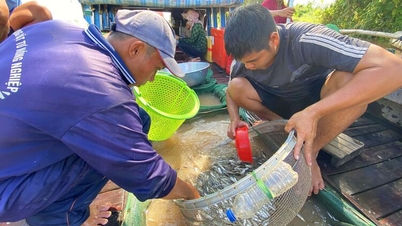
Today, the fish weigh about 3-5 fish per kilogram. The fish in the other pond were released earlier and have reached a larger weight, about 2 fish per kilogram. Carp grow very quickly.

Mr. Le Van Thuong, residing in My Thanh hamlet, My Tu commune (Soc Trang province), earns tens of millions of dong annually from his model of raising freshwater fish in enclosed ponds within flooded rice fields during the rainy season. Photo by Huy Minh.
After many years of implementation, the model of raising fish in enclosed areas in My Tu commune has become popular. From just a few households with only about 10 hectares initially, it has now developed to over 300 hectares.
Comrade Le Quoc Khoi, Vice Chairman of the People's Committee of My Tu commune, My Tu district (Soc Trang province), said that the model of raising fish in enclosed nets has always yielded stable economic results in recent years.
This model requires little investment and is easy to implement, while the fish's food source utilizes natural food sources in the rice paddies.
Raising rice in enclosed pens is not only a model that provides stable income for people and creates jobs for rural laborers during the off-season, but it also helps increase soil fertility, reduce fertilizer costs for the next rice crop, and increase rice yield.
Comrade Le Quoc Khoi, Vice Chairman of the People's Committee of My Tu commune (My Tu district, Soc Trang province) further emphasized: "For the commune, it has been determined that during the flood season, people cannot sow rice and have to switch to raising fish in enclosed ponds."
Therefore, in the past period, the People's Committee of the commune has also submitted a request to the District Department of Agriculture and Rural Development and the District People's Committee, firstly for support in terms of seeds and nets; secondly, for technical support in managing fish in rice fields for households that are new to fish farming. In addition, training should be provided to farmers to help them grasp the techniques for achieving the highest efficiency in fish farming.”
Given its economic benefits, the model of raising fish in cages during the flood season is considered a sustainable agricultural model, a "harmonious with nature" aquaculture model.
Source: https://danviet.vn/nuoc-tran-dong-dan-soc-trang-nuoi-ca-dong-trong-ruong-lua-kieu-gi-ma-he-bat-len-la-ban-het-veo-20241114081150679.htm
![[Photo] Prime Minister Pham Minh Chinh receives Lao Minister of Education and Sports Thongsalith Mangnormek](/_next/image?url=https%3A%2F%2Fvphoto.vietnam.vn%2Fthumb%2F1200x675%2Fvietnam%2Fresource%2FIMAGE%2F2025%2F12%2F16%2F1765876834721_dsc-7519-jpg.webp&w=3840&q=75)
![[Photo] Prime Minister Pham Minh Chinh receives the Governor of Tochigi Province (Japan)](/_next/image?url=https%3A%2F%2Fvphoto.vietnam.vn%2Fthumb%2F1200x675%2Fvietnam%2Fresource%2FIMAGE%2F2025%2F12%2F16%2F1765892133176_dsc-8082-6425-jpg.webp&w=3840&q=75)
![[Image] Leaked images ahead of the 2025 Community Action Awards gala.](/_next/image?url=https%3A%2F%2Fvphoto.vietnam.vn%2Fthumb%2F1200x675%2Fvietnam%2Fresource%2FIMAGE%2F2025%2F12%2F16%2F1765882828720_ndo_br_thiet-ke-chua-co-ten-45-png.webp&w=3840&q=75)


![[Live] 2025 Community Action Awards Gala](/_next/image?url=https%3A%2F%2Fvphoto.vietnam.vn%2Fthumb%2F1200x675%2Fvietnam%2Fresource%2FIMAGE%2F2025%2F12%2F16%2F1765899631650_ndo_tr_z7334013144784-9f9fe10a6d63584c85aff40f2957c250-jpg.webp&w=3840&q=75)























































Comment (0)