

Currently, the amount of by-products in rice production and processing in our country is very large and diverse. Reusing rice by-products is considered to bring high economic benefits and reduce greenhouse gas emissions...
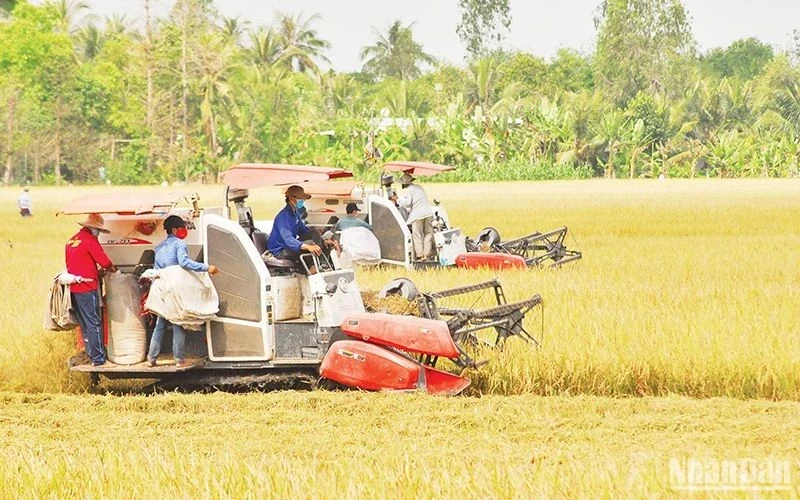
However, a large portion of rice by-products are not being utilized properly, leading to waste and negative environmental impacts, making it difficult for the rice industry to achieve its goal of developing a circular economy.
According to the Department of Crop Production ( Ministry of Agriculture and Rural Development ), the annual rice production nationwide reaches approximately 44-45 million tons. The main by-products in rice production and processing include: straw production of about 45 million tons, rice husk production of 8-9 million tons, and bran production of about 4-4.5 million tons...
The value of by-products has not been fully exploited.
According to Dong Van Canh, Director of New Green Farm Cooperative (Tan Hung Ward, Thot Not District, Can Tho City): The cooperative is currently cultivating about 100 hectares of rice per season; each hectare of rice yields about 100 bales of straw. The cooperative is now using the straw to make organic fertilizer, selling it for about 3.5 million VND per ton and about 70,000 VND per 20 kg bag. The cooperative produces one batch every 45 days. organic fertilizer from 30-60 tons.
According to Pham Thi Minh Hieu, Head of the Can Tho Department of Crop Production and Plant Protection, if rice is cultivated using traditional methods, farmers can earn a profit of about 86 million VND per hectare per year (3 harvests per year). However, if they utilize rice straw products to grow mushrooms or make organic fertilizer, the profit can reach 133 million VND per hectare per year. Currently, however, very few cooperatives are effectively utilizing these by-products.
According to Deputy Director of the Department of Crop Production Le Thanh Tung: Vietnam is focusing on implementing the Project for the sustainable development of one million hectares of high-quality, low-emission rice cultivation associated with green growth in the Mekong Delta by 2030. Therefore, the issue of handling post-harvest rice by-products to increase farmers' income and contribute to limiting environmental impact is extremely important.
Currently, the Mekong Delta produces approximately 24.4 million tons of rice straw annually, but only 30% (about 7.4 million tons) is collected, while the remaining 70% is burned or buried. rice paddy fields. This practice wastes rice by-products and causes environmental pollution, increasing greenhouse gas emissions. According to a report by the Office of Agricultural and Rural Coordination in the Mekong Delta, out of the cooperatives participating in the One Million Hectare New Rice Project, only 80% have implemented measures to collect rice straw from the fields. Most of the straw is collected from the fields during the winter-spring crop season for reuse in mushroom cultivation, livestock farming, and organic fertilizer production.
During the winter-spring crop season, 29% of cooperatives collected more than 70% of the straw, 28% collected 50-70% of the straw from the fields, and 43% did not collect straw from the fields but used straw shredding machines.
combined spraying biological products Some straw is used for decomposition and plowing, while others are burned in the fields. During the summer-autumn and autumn-winter seasons, the rate of uncollected straw reaches 69.78% due to difficulties in collection during the rainy season. Currently, straw baling machines can be used in both the dry and rainy seasons, making collection very convenient. In some localities, straw is purchased at prices ranging from 400,000 to 800,000 VND/ha; and sold to users at 25,000 to 40,000 VND per bale.
However, rice-growing areas located near orchards are quite advantageous because the orchard owners have a need for straw. Conversely, areas where only rice is cultivated on large plots have less demand for straw, often relying on self-sufficiency. Furthermore, straw is quite bulky and difficult to transport, and the high cost of transporting it from the fields means that cooperatives have not yet increased their profits from buying and selling straw.
Besides straw, the economic benefits from using rice husk and bran by-products are also significant but have not been fully exploited. Specifically, this includes processing rice husk into animal feed; processing rice husk into fuel for export, etc.
Regarding the processing of products from bran, bran oil processing yields the highest efficiency, with added value reaching 25.5 million VND/ton, and businesses earning a profit of approximately 14.5 million VND/ton. However, all these processing methods have high costs and require advanced technology, so their utilization efficiency remains low because businesses mainly invest in production and do not yet have the resources to focus on processing by-products.
Technological and policy solutions
Mr. Phan Van Tam, Deputy General Director of Binh Dien Fertilizer Joint Stock Company, said: The company is gradually building a circular agriculture model from rice by-products, such as researching the production of organic fertilizers, substrates, and biochar from rice straw. The company also cooperates with the International Rice Research Institute (IRRI) to support cooperatives in producing compost from straw; building a circular agriculture business model from straw (collecting, growing mushrooms, making organic fertilizer, etc.); and researching emission reduction by processing straw in dry fields…
To effectively utilize by-products, attention should be paid to transportation infrastructure to facilitate the transport of raw materials and by-products from production areas to processing plants, thereby reducing costs and enhancing the competitiveness of processed products made from by-products.
Given the urgent need to transform Vietnam's rice industry towards a circular economy model, the utilization and processing of by-products need to be implemented more effectively. The Department of Quality, Processing and Market Development believes that in the future, strong technical, financial, and policy solutions are needed to create leverage for this activity.
Specifically, this involves applying modern, high-productivity technologies such as using presses from India and Taiwan in the production of fuel pellets from rice husks to lower costs and increase added value; investing in bran storage facilities at large milling plants to improve bran quality and minimize mold; increasing the use of bran in animal feed processing to partially replace imported raw materials, as the domestic demand for animal feed processing raw materials remains very high; and establishing facilities for extracting and refining bran oil at large rice milling centers in the Mekong Delta.
Regarding science, technology, and industrial promotion, it is necessary to focus investment on researching and manufacturing technology and processing lines for agricultural by-products using modern technology and advanced equipment, with reasonable investment costs, suitable for the scale of the raw material area; standardizing small-scale processing equipment and lines for agricultural by-products; encouraging organizations and individuals to participate in research projects on the use of agricultural by-products; and focusing on developing technologies that have proven economic and environmental effectiveness.
Accordingly, relevant authorities need to develop specific mechanisms and policies to encourage the development of small and medium-sized enterprises processing agricultural by-products to consume these products locally for farmers; refine investment attraction policies for each locality with the specific characteristics of different regions and industries in accordance with the Law on Supporting Small and Medium-Sized Enterprises; and simultaneously provide loan support policies for machinery and equipment for preliminary processing, preservation, and processing to encourage businesses to invest in processing agricultural by-products.
Source


Comment (0)