

Their goal is to sow misconceptions, skepticism, anxiety, and resentment in society and the community; subtly incite disobedience and opposition to laws, social norms, and community standards; and instigate acts of riot and violence... Many people call these "dirty comments."
The dangers of "dirty comments"
In reality, "dirty comments" come in many forms. The most easily recognizable form is obscene comments. These comments are usually vulgar, uncivilized, and full of profanity, but often the words lack specific meaning and are simply intended to join in the destructive behavior. This type of comment is easily found on forums without direct administrators or websites with weak language filters. However, the number of such comments is usually very large, making it easy to get out of control.
The second type of "dirty comment" is more sophisticated and easier to evade scrutiny because, at first glance, it seems harmless. Those who frequently post this type of "dirty comment" spend time monitoring what other forum members are discussing in order to find fault, question, etc. These comments are usually more aggressive than usual. The commenter is always ready to fiercely retort to the "thread starter" (a term used by netizens to refer to the person who created the topic) to prove their point, thus creating a ripple effect online.
The third type of "dirty comment" is the comment initiated by the original poster to create a topic for discussion among netizens, or by using a topic to offer their own opinions, judgments, and assessments, thereby inciting others to comment in order to achieve their goals. This type of "dirty comment" is often deliberately orchestrated, possibly for political , economic, or social purposes. This article will only address the "dirty comment" type used by hostile forces, reactionary elements, and political opportunists who exploit social media to distort, slander, undermine the reputation, and insult the honor of veteran revolutionaries, Party and State leaders, and military leaders.
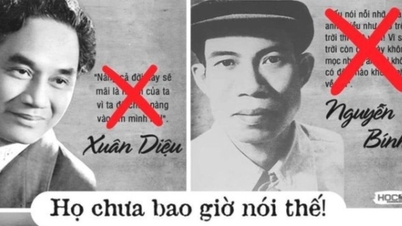
Those who carry out these schemes are quite well-trained and supported by information technology, so they are acting more frequently and sophisticatedly. Their targets are veteran revolutionaries, leaders of the Party, State, and Army, and those with significant positions, roles, and influence on the country's economic , political, and social life, or cadres and Party members who regularly and directly interact with the people. Common forms include: distorting and fabricating personal histories and careers; insulting private lives and family life; and fabricating social relationships. To increase effectiveness, they often release this information at politically sensitive times, such as: major political events in the country; before, during, and after major national holidays; Party congresses; and elections for National Assembly and People's Council representatives at all levels.
Furthermore, they exploit a phenomenon, an individual official or party member who has become corrupt and degenerate and been severely punished by law, to distort concepts, generalize, and equate it with the essence of the social system, the essence of the Party and the State. Even a single action or statement by an official or party member is analyzed, dissected, and distorted from multiple angles to fabricate sensational and scandalous stories. They even deliberately set up "traps" to incite and provoke inexperienced officials and party members, causing them to lose self-control in specific situations, then organize filming and photography, editing and fabricating stories to create public outrage. Moreover, they are very skilled at exaggerating events to attract attention and create hotspots in public opinion. From a small, inappropriate action by a particular official or party member, they can "paint" a complete picture of the ethics, lifestyle, social skills, and public service culture of an entire agency, unit, Party, or society, and then compare it to other countries, regardless of the inconsistencies. More dangerously, to manipulate public opinion according to their agenda, they block or eliminate dissenting comments and dissenting opinions from those with independent views, creating one-sided information that benefits their subversive goals.
It's not difficult to recognize these as tactics of "peaceful evolution" in the political and ideological spheres, promoting "self-evolution" and "self-transformation" within the ranks of hostile, reactionary, and politically opportunistic forces. Because, no matter how sophisticated or cunning the tactics, their essence is simply "new wine in old bottles." The problem here is that many people, due to curiosity, simplistic and biased understanding, and even a segment of cadres, party members, intellectuals, and artists, have inadvertently or intentionally participated in these enthusiastic "comments," creating a rapidly spreading "wave" with thousands, even millions, of comments, thereby helping hostile and reactionary forces achieve their subversive goals. Therefore, how to prevent this is a pressing question for relevant agencies, departments, and even those participating in social media.
How can we prevent "dirty comments"?
Firstly, for relevant Party and State agencies and entities responsible for managing cybersecurity laws: Emphasis should be placed on leadership and guidance to strengthen educational and propaganda measures to raise citizens' awareness of the law, especially the Cybersecurity Law; directives and regulations on the provision, development, and use of social media platforms; and the awareness, responsibility, and principles of citizens when participating in social media platforms. Regulations on managing information on social media should be improved; research should focus on developing a law on managing information on the internet and a Cybersecurity Law to create a complete and appropriate legal framework; and a scientific and progressive legal framework should be actively built to ensure that social media operates and develops healthily and in the right direction, and to effectively manage social media.
Social media service providers and users are strictly adhering to the Code of Conduct for Social Media, aiming to build a healthy and safe social media environment in Vietnam. Individuals and organizations must take legal responsibility for the information they post on social media to minimize reckless statements, invasion of privacy, and defamation of individuals and organizations online. The implementation of the Press Law should be developed and improved, with a focus on enhancing the role of leading media outlets in guiding information, and actively and proactively criticizing and refuting harmful and toxic information on social media to help overcome the negative aspects of social media.
Secondly, regarding social media providers: Providers and operators of social media services, especially cross-border service providers, must be responsible for complying with Vietnamese law and respecting Vietnam's sovereignty, national interests, and national security. Partners are required to clearly demonstrate cooperation and compliance with regulations when operating in Vietnam, such as: establishing representative offices, verifying user identities in account registration, actively cooperating to promptly remove fake pages and topics that intentionally distort, defame, or insult individuals and organizations, and thoroughly deleting accounts that spread false information. At the same time, greater emphasis should be placed on economic measures, ensuring that the responsibility of these businesses is commensurate with the benefits they receive.
Thirdly, for agencies managing and supervising media: It is necessary to continue to comprehensively improve the legal framework with specific, clear, practical, and appropriate provisions that keep pace with the rapid changes in social media, instead of merely offering regulatory guidelines. Further strengthen inspection, examination, and handling of violations, especially the coordination between relevant functional agencies and the entire political system, to strictly address harmful violations such as: storing, providing, posting, and disseminating false, inaccurate, distorted, slanderous, defamatory, and provocative acts against the Party and the State on the internet and social media...
Strengthening technical measures to prevent, dismantle, and eliminate harmful information that infringes on national security and undermines Vietnam is a necessary and effective measure in the current context. Specialized cybersecurity units need to promptly assist organizations and individuals when they detect signs of security vulnerabilities and when cybercriminals attack them, in order to rectify the situation and create a healthy and clean online environment so that users can confidently use social media for their legitimate personal and organizational needs.
Fourth, for social media users: When participating in the online environment, "netizens" should spread positive information and images about social activities and community service, criticize bad habits and deviant behaviors, and aim for humane messages, building a culture of polite and civilized behavior on social media. At the same time, they need to preserve the purity of the Vietnamese language, avoiding the use of hybrid, vulgar, or violent language; only post and disseminate information with clear sources and verified information. In particular, they should not form groups or associations to slander, defame, or insult others or attack each other; they should not blindly follow the crowd without understanding the situation or without evidence. When posting information, netizens should not post fabricated information or information that violates the law; they should not use applications of unknown origin to avoid being bothered by spam or having their account information stolen. Internet users need to understand and comply with the regulations of the Cybersecurity Law. Based on this, each person should transform their social media account into a healthy information channel and engage in social media communication with a sense of community responsibility, promptly detecting, commenting on, criticizing, and refuting reactionary and harmful information on social media.
When participating in social media, "residents" need to equip themselves with skills to protect their personal information and learn how to filter and receive information. It is crucial for users to enhance their "resistance," acquire legal knowledge, develop good cultural filters, behave civilly in debates and discussions, and possess the ability to assess the reliability of information on social media. Only then can the use of social media be effective, practical, and healthy, and users can protect their own values, those of their community, and their nation.
Lieutenant Colonel, PhD LE DUC THANG (Institute of Military Social Sciences and Humanities)
Source

![[Photo] Solemn bathing ceremony and Buddha procession in Hue](https://vphoto.vietnam.vn/thumb/1200x675/vietnam/resource/IMAGE/2026/05/31/1780228263543_1-jpg.webp)
![[Photo] The General Secretary, President and his wife begin their state visit to the Philippines.](https://vphoto.vietnam.vn/thumb/1200x675/vietnam/resource/IMAGE/2026/05/31/1780230559452_anh-man-hinh-2026-05-31-luc-19-28-11.png)

![[Image] Hanoi Police officially crowned champions of V-League 2025/2026](https://vphoto.vietnam.vn/thumb/1200x675/vietnam/resource/IMAGE/2026/05/31/1780244769054_ndo_br_039d561b692be875b13a-jpg.webp)
![[Photo] Admire the coral "masterpiece" amidst the million-year-old heritage of Dak Lak province.](https://vphoto.vietnam.vn/thumb/1200x675/vietnam/resource/IMAGE/2026/05/31/1780221235105_anh-man-hinh-2026-05-31-luc-16-53-27.png)











![[Video] Sunset at Lap An Lagoon – Where the sun sets over the fishing nets](https://vphoto.vietnam.vn/thumb/340x192/vietnam/resource/IMAGE/2026/05/31/1780192137701_beach-landscape-sea-water-nature-grass-745871-pxhere-com.jpeg)
































![[Photo] Admire the coral "masterpiece" amidst the million-year-old heritage of Dak Lak province.](https://vphoto.vietnam.vn/thumb/402x226/vietnam/resource/IMAGE/2026/05/31/1780221235105_anh-man-hinh-2026-05-31-luc-16-53-27.png)






























Comment (0)