

The famous, crystal-clear, sparkling Golconda diamonds may originate from volcanic quarries located 300 km from where they are mined.
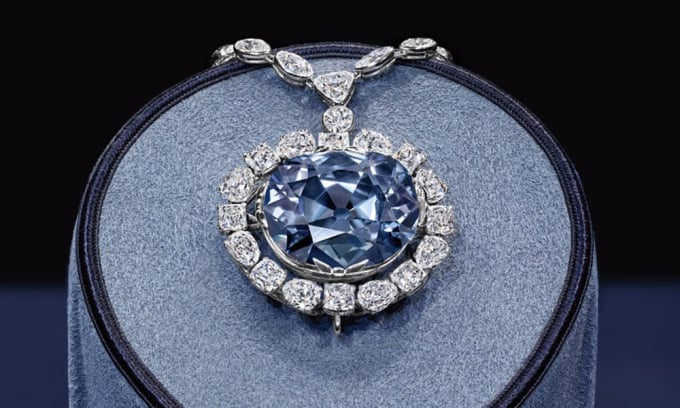
The Hope Diamond – one of the world's most famous gemstones. Photo: Telegraph
Researchers may have discovered the true origin of famous Golconda diamonds such as the Hope and Koh-i-noor, Live Science reported on April 21.
Golconda diamonds are exceptional because they contain very few impurities and low levels of nitrogen, making them extremely clear and free of blemishes that detract from their brilliance. They are also very large. The Koh-i-noor diamond, currently in the British Royal Collection of Ceremonial Objects housed in the Tower of London, weighs 105.60 carats. The Hope Diamond, on display at the Smithsonian National Museum of Natural History in Washington, D.C., weighs 45.52 carats.
These Golconda diamonds were discovered in southern India between the 1600s and 1800s. They were mined in placer deposits – shallow pits dug into riverside sediments. But before that, diamonds were brought to the Earth's surface in large volcanic rock formations called kimberlite, and experts didn't know where the kimberlite containing these diamonds came from.
New research published in the journal Earth System Science suggests that Golconda diamonds may have originated from the Wajrakarur kimberlite mine in present-day Andhra Pradesh, India, about 300 km from where they were mined.
To trace the origin of the Golconda diamond, geologists Hero Kalra, Ashish Dongre, and Swapnil Vyas from Savitiba University in Phule Pune studied the chemical properties of the surrounding kimberlite and lamproite rocks. These are rocks that form from the Earth's crust and upper mantle, where most diamonds are formed.
The research team discovered that kimberlite from the Wajrakarur mine may have been pushed up from depths where diamonds form and contained minerals commonly found alongside diamonds. They then conducted surveys using remote sensing data such as satellite imagery, vegetation measurements, and moisture levels. The surveys revealed that an ancient, long-dried river may have transported diamonds from Wajrakarur to the Krishna River and its tributaries, where the diamonds were found.
However, this result is not necessarily accurate, according to Yakov Weiss, a diamond geochemist at the Hebrew University of Jerusalem. In the new study, the authors investigated the geochemical characteristics of ordinary diamonds from the lithosphere—the Earth's hard crust and upper mantle—and determined that the Wajrakarur deposit may contain diamonds. However, Golconda diamonds form at greater depths in the mantle, perhaps in the transition zone near the Earth's core.
It is difficult to directly determine the origin of Golconda diamonds because they lack the fluid-containing inclusions from the mantle where they begin to form. Weiss says this makes them beautiful and highly sought after, but provides very little information for geochemists. Therefore, Golconda diamonds will likely always remain a mystery.
Thu Thao (According to Live Science )
Source link


![[Image] Vietnam's colorful journey of innovation](/_next/image?url=https%3A%2F%2Fvphoto.vietnam.vn%2Fthumb%2F1200x675%2Fvietnam%2Fresource%2FIMAGE%2F2025%2F12%2F14%2F1765703036409_image-1.jpeg&w=3840&q=75)






























































![[Image] Vietnam's colorful journey of innovation](https://vphoto.vietnam.vn/thumb/402x226/vietnam/resource/IMAGE/2025/12/14/1765703036409_image-1.jpeg)


































Comment (0)