

Inspired by hot air balloons, inventor Jacques Charles decided to build hydrogen-powered balloons, which he believed were safer.
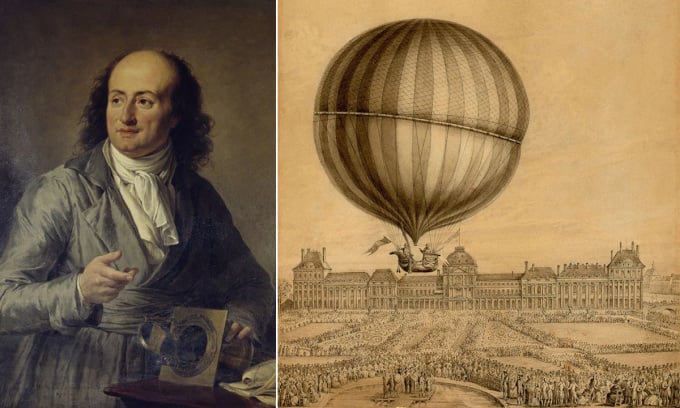
Illustration of Jacques Charles and his first passenger hydrogen balloon flight with Nicolas-Louis Robert on December 1, 1783. Photo: Amusing Planet
On June 4, 1783, the Montgolfier brothers made their first public demonstration of a hot air balloon in southern France. The balloon, made from burlap lined with paper, rose to an altitude of nearly 2 kilometers and remained airborne for 10 minutes. News of their success quickly reached Paris and intrigued Jacques Charles, a French inventor and scientist knowledgeable in the properties of gases.
After studying the work of Robert Boyle and his contemporaries such as Henry Cavendish, Joseph Black, and Tiberius Cavallo, Charles believed that hydrogen was more suitable for ballooning than hot air. He argued that hot air balloons were quite dangerous with open flames, while hydrogen, although flammable, was completely enclosed within the balloon, making it safer.
Jacques Charles decided to build a new balloon. He hired two engineers, brothers Anne-Jean Robert and Nicolas-Louis Robert, to help build what would later become the world's first hydrogen balloon. To finance this expensive undertaking, naturalist and geologist Barthélemy Faujas de Saint-Fond opened a public subscription fund and sold tickets for balloon demonstrations. Parisian elites, having witnessed the impressive flight of the Montgolfier brothers a few weeks earlier, enthusiastically signed up.
Charles designed the airship and suggested that the Robert brothers create a lightweight yet airtight air bag. The Robert brothers devised a method of dissolving rubber in a turpentine solution and using this solution to coat silk sheets, making them airtight. They then sewed the silk sheets together to form the main shell.
The balloon is relatively small, about 4 meters in diameter, and can only lift about 9 kg. To pump hydrogen into the balloon, a large amount of hydrochloric acid is first poured into a container of iron filings. The hydrogen produced is then delivered to the balloon through a pipe connecting from the container.
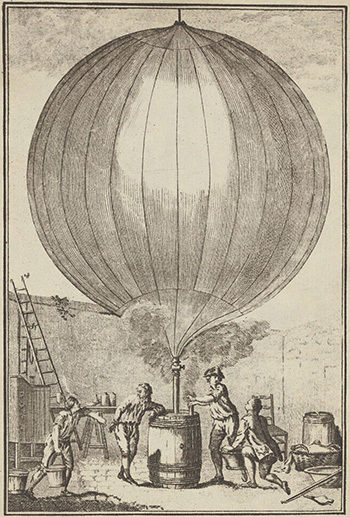
The process of inflating the first hydrogen balloon. Photo: National Air and Space Museum
On August 27, 1783, the world's first unmanned hydrogen balloon took off from the Champ de Mars in Paris. The balloon ascended just as a thunderstorm began to gather. But the bad weather did not dampen the enthusiasm of the crowd below. The balloon soared straight up into the sky and disappeared into the clouds within minutes.
About 45 minutes after takeoff, the balloon lost some hydrogen, descended, and landed in a village 24 km north of Paris. The villagers, unaware of the balloon's existence and frightened by its sudden appearance from the sky, attacked the strange object with various farming tools and even guns.
Excited by the success of their first flight, Charles and the Robert brothers began preparing for their next attempt – to send one or two people aboard a hot air balloon. On December 1, 1783, Charles and Nicolas-Louis boarded the balloon and ascended to an altitude of about 500 meters. They flew for 2 hours and 5 minutes, covering 36 kilometers, before landing safely on the Nesle plain, north of Paris, at sunset.
Nicolas-Louis disembarked while Charles took off again, this time flying rapidly to an altitude of about 3,000 meters and seeing the sun again. However, the sharp pain in his ears due to low atmospheric pressure began to bother him, forcing him to descend. He landed softly at Tour du Lay, about 3 km away.
Despite this successful flight, Charles decided to give up flying, although he continued designing balloons. One of his designs was a long, steerable balloon, built on a proposal by the French mathematician Jean Baptiste Meusnier. This vehicle was equipped with rudders and paddles for thrust, but they proved ineffective.
On July 15, 1784, the Robert brothers flew in this balloon for 45 minutes. They then continued their journey with M. Collin-Hullin on September 19, 1784. They flew for 6 hours and 40 minutes, covering a distance of 186 km from Paris to Beuvry near Bethune, becoming the first balloonists to travel more than 100 km.
Thu Thao (According to Amusing Planet )
Source link


![[Photo] Prime Minister Pham Minh Chinh attends the Conference summarizing and implementing tasks of the judicial sector.](/_next/image?url=https%3A%2F%2Fvphoto.vietnam.vn%2Fthumb%2F1200x675%2Fvietnam%2Fresource%2FIMAGE%2F2025%2F12%2F13%2F1765616082148_dsc-5565-jpg.webp&w=3840&q=75)
![[Infographic] Preventing students from making their own firecrackers: 7 things parents need to know](https://vphoto.vietnam.vn/thumb/402x226/vietnam/resource/IMAGE/2025/12/11/1765466656703_img_0320_20251211183542.jpeg)

























































































Comment (0)