

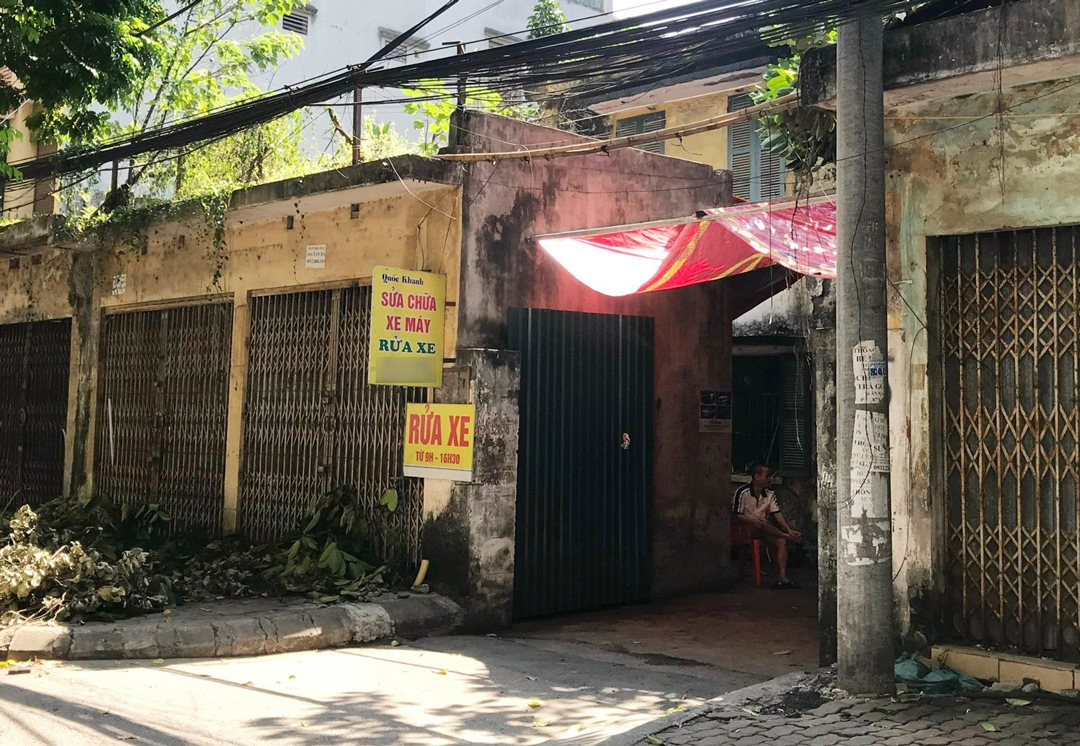
The headquarters is exposed to the sun and rain.
Following the adjustment of the administrative boundaries of Hanoi (since 2008), due to the merger of agencies and units (from Ha Tay province and Hanoi city), many headquarters are unused and unutilized.
Observations by reporters from HanoiMoi Newspaper in October 2023 revealed that the second branch of the Hanoi City Statistics Department, located in a prime location on the bustling To Hieu street (Ha Dong district), had fallen into disrepair. Weeds and moss covered the surrounding area. A motorbike repair shop, whose exact location was unclear, was visible at the entrance. Inside, the offices were covered in thick dust. Not far away, the People's Procuracy building was also closed and locked. Due to prolonged disuse, the building had deteriorated, with many sections of the walls peeling.
This situation is also occurring in many other localities after administrative unit mergers. In Thanh Hoa province, there is currently a significant surplus of land and buildings in districts, towns, and cities. The surplus public works and assets after the reorganization of administrative agencies and units in the province fall into three groups: commune-level offices, commune-level cultural centers, commune-level health stations, village/hamlet/neighborhood cultural houses; headquarters of reorganized district-level public service units; and headquarters of central government agencies located in the province. Generally, there are no specific plans for handling the surplus land and buildings after the reorganization of administrative agencies and units; many assets have been unused for a long time, resulting in damage, deterioration, and abandonment; the conversion of their intended use and the handover of public works and assets to other agencies and units for management and use have not been widespread, leading to a waste of state assets...
The Ministry of Finance stated that the current state of abandoned, wasted, and dilapidated public buildings and land is mainly due to the need to address issues arising from the reorganization of district and commune-level administrative units. In reality, the implementation of plans for handling these buildings and land during the reorganization, especially the sale and transfer plans, has been slow, leading to some properties being left vacant and deteriorating. To date, nearly 500 properties and land parcels from the 2019-2021 period that were surplus during the reorganization of district and commune-level administrative units remain unaddressed.
Meanwhile, data reported by ministries, central and local agencies to the Ministry of Finance shows that the total number of land and housing facilities (including land and housing of state-owned enterprises and joint-stock companies with more than 50% state capital) subject to restructuring and handling under Government Decree No. 167/2017/ND-CP on the restructuring and handling of public assets and Government Decree No. 67/2021/ND-CP amending and supplementing some articles of Decree No. 167/2017/ND-CP is 266,502 facilities. As of August 31, 2023, the total number of land and housing facilities that have been approved by competent authorities is 189,524 facilities; The number of unapproved housing and land properties is 76,978, of which 34,839 are under central government management and 42,139 are under local government management.
No consensus has been reached on how to resolve the issue.
Regarding the above situation, according to Mai Cong Quyen, Deputy Director of the Hanoi Department of Finance, it is due to the fact that the management, use, and exploitation of houses and land, in addition to the regulations of the Law on Management and Use of Public Assets, are also governed by many specialized laws (on land, housing, management and use of state capital invested in production and business at enterprises...). Therefore, during the implementation process, there are still many differing opinions, requiring exchange, discussion, and seeking guidance from the Ministry of Finance and relevant agencies to reach a consensus, ensuring prudence, effectiveness, and compliance with regulations.
Meanwhile, the completion of legal documentation regarding houses and land in accordance with the law and the directives of the Hanoi People's Committee has not received sufficient attention in some agencies and units. To date, some units have not yet conducted surveys, provided planning information, or submitted applications to the Department of Natural Resources and Environment for the issuance of Certificates of Land Use Rights, Ownership of Houses and Other Assets Attached to Land. This significantly affects the progress of developing plans for rearranging and handling houses and land of these agencies and units.
For centrally managed properties located within the city, the process of transferring headquarters back to the local authorities after relocation to new premises has been slow, mainly involving small-scale offices of agencies and units under ministries and departments.
Furthermore, the Ministry of Finance stated that, in addition to the large scale of administrative unit restructuring at the district and commune levels, and the significant number of surplus office buildings that need to be reorganized, the restructuring and handling of these buildings depend on the needs of the administrative agencies and units, as well as on land use planning and plans. Because the restructuring of administrative units under local management and those of central government agencies located within the area are carried out simultaneously, the possibility of transferring these buildings to other units is virtually impossible. Selling, transferring, or reclaiming them would require adjustments to land use planning and detailed construction plans, which takes time.
Furthermore, the majority of surplus land and buildings that have not been processed are located in rural, mountainous, and remote areas; many units lack office space but are not located in the same area, so they cannot be relocated for use, while in the areas where relocation is possible, there are no units in need of receiving them. Not to mention, the real estate market has been sluggish recently, making sales and transfers difficult due to a lack of investor interest.
Another reason is that determining land and property prices still faces many obstacles, especially regarding valuation methods and hiring appraisal companies to determine land and property values; land and house records are incomplete, management and use histories are complex, and the rearrangement and handling of land and houses involve many legal regulations and are carried out by multiple agencies.
Notably, the responsibility of the heads of units directly managing and using houses and land, as well as of the managing agencies, is not high enough. In reality, Decree No. 151/2017/ND-CP, which details some provisions of the Law on Management and Use of Public Assets, has also given rise to some difficulties in its implementation. For example, some aspects of managing and using public assets at agencies, organizations, and units lack specific guiding regulations, such as: the procedures for transferring assets in kind to agencies, organizations, and units; the authority to decide on maintenance, repair, and hiring units with the function of managing and operating public assets; and the exploitation of public assets after recovery...
Furthermore, the current regulations on the procedures for handling public assets are inadequate, for example, regarding the handling of public assets in cases of mergers, consolidations, divisions, or dissolutions. According to the procedure, the agency assigned to manage and use the assets proposes and prepares the necessary documents for disposal. However, in many cases, the agency assigned to manage and use the public assets no longer exists due to mergers, consolidations, or dissolutions.
Notably, the use of public assets at public service units for business purposes, leasing, joint ventures, and partnerships has revealed many difficulties. For example, selecting joint venture and partnership partners according to current regulations is challenging due to the lack of a basis for evaluating and scoring each criterion. Furthermore, in practice, there are some cases where, during the joint venture or partnership process, due to force majeure, the project cannot be continued, leading to requests for early termination of the contract. However, there are currently no specific regulations for this situation, causing confusion in handling it.
(To be continued)
Source






































































































Comment (0)