

I just arrived at my maternal grandparents' village this afternoon. It's May, and even before ten o'clock, the sun was blazing hot. Adding to that the stifling heat was the hot, humid wind from Laos, making the heat even more intense and uncomfortable. The village road was crowded with ox carts and farm trucks loaded with rice. People were rushing back and forth, everyone hurrying as if trying to finish their work quickly and get home as fast as possible, as if escaping the heat. From my uncle's kitchen, I could smell the aroma of freshly cooked rice, the scent of fried onions and peppers in lard, and the aroma of clam soup with vegetables – a simple dish I'll never forget.
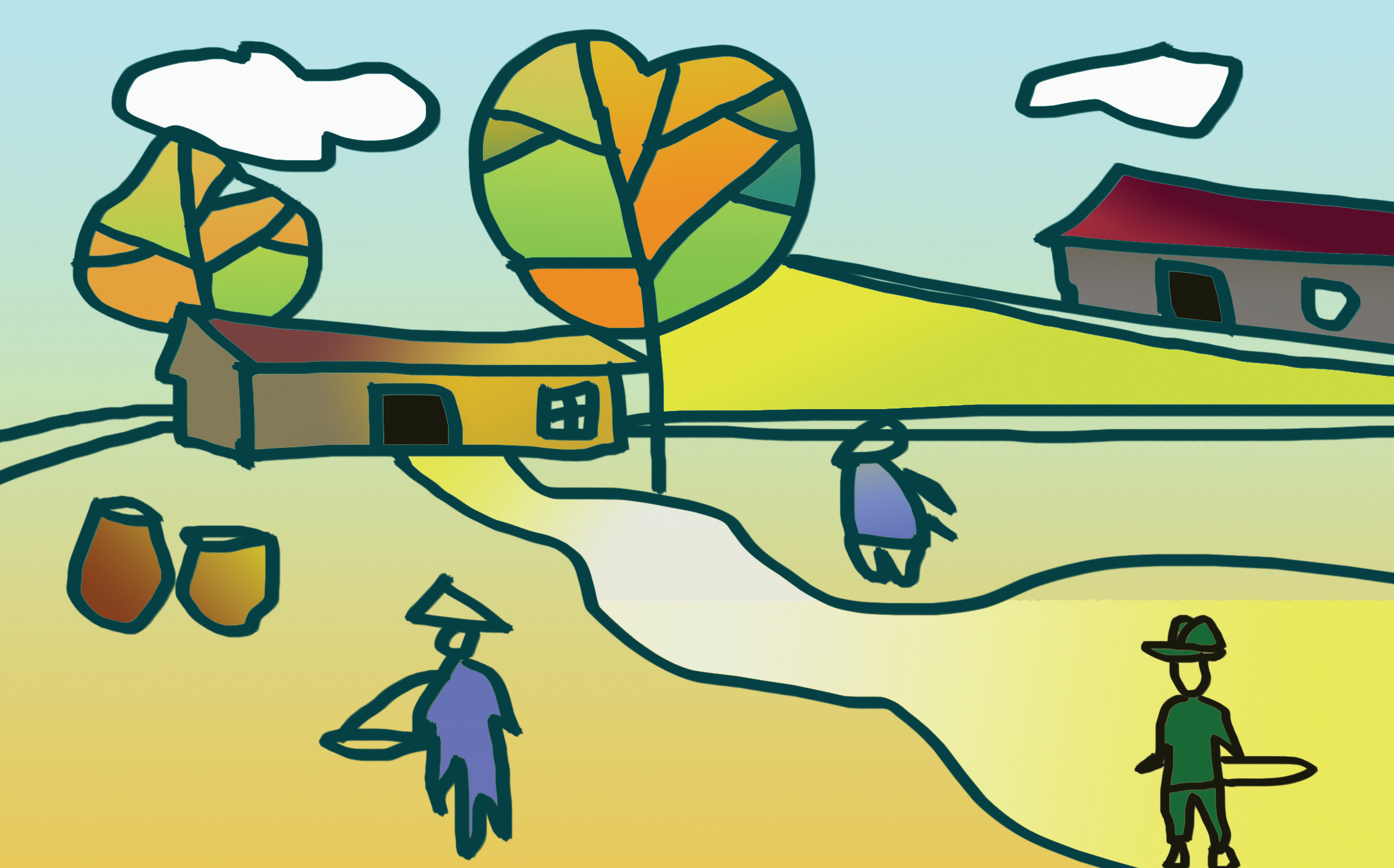
Illustration: NGOC DUY
I can't remember exactly how many times I've visited Mai village, my maternal hometown. Each time I return, I get to enjoy the familiar, flavorful local cuisine . Decades have passed since my first visit. Even though I live far from my maternal hometown, my thoughts always turn to it.
In my early childhood, when I was only nine or ten years old, I vaguely knew about my maternal grandparents' village through my parents' stories. Though young, I remember every story about my grandparents' village very clearly. I remember place names like Cửa Tùng, Cửa Việt, Cồn Tiên, Dốc Miếu... and especially the two words "Làng Mai" (Mai Village), which I memorized from a very young age. And every time I hear those two words, I feel a deep resonance in my heart. I longed to visit my grandparents' village once. To see with my own eyes the Hiền Lương bridge and the river with its clear, gentle, flowing water, calm all year round. To run and play happily on the village paths.
And what I loved most was going to the river to gather clams, peeling the shells in my hands, and then every morning, joining the village children to build a stove, light a fire, and play "cooking clam soup," carrying it around to sell, shouting loudly: "Clam soup here, who wants clam soup!", just like my mother and her friends used to play when they were little! Once, my mother pointed to the map I was studying and sadly said to me: "Your maternal grandparents' village is right across the Ben Hai River, but to cross this river, we'll have to wait until the reunification of the country!" From then on, I understood that my maternal grandparents' village was occupied by the American invaders. And, I would have to wait until the reunification of the country before I could visit my grandparents' village.
Back then, my father was a soldier fighting on the battlefield in the South. My mother was a teacher and a female guerrilla fighter from Mai village. My parents met and got married, and a week later, my mother followed my father to the North. From then on, she stayed in my father's hometown, while my father returned to the battlefield. They were separated for a long time, without letters or news. It wasn't until almost ten years later that my father returned to the North for the first time. I remember it was probably after the Tet Offensive in 1968, when we had just launched a major offensive in the South.
That year I had just turned ten. My father came home very quickly and left just as quickly. It seemed he was in a hurry, perhaps the situation didn't allow him to stay any longer. Then, for six or seven years afterward, until the complete liberation of South Vietnam, my father only returned once more, around the time the Paris Agreement was signed. Usually, when my father returned, even though the time was very short, sometimes only a day or two, it was enough for my small family to gather together, to be filled with joy and happiness.
My father doted on me immensely. Every time the family gathered, he would habitually lift me up, shower me with kisses on my cheek, and then cradle me comfortably in his lap. He would stroke my hair and comfort me, while I would wrap my arms around his neck, my small hands gently caressing his stubble-covered chin. My mother would sit opposite us, smiling happily as she watched us.
My mother's face showed both joy and emotion. Looking at her, I knew how happy she was each time my father returned home. Listening to their conversations, I learned many things, including things that a child like me shouldn't have to care about. But for some reason, I listened attentively to every story my father told my mother and remembered them very well. Like the situation of the war in the South, where we fought, where we won. And all the hardships and sacrifices we were enduring.
Through the stories my father told my mother, I also learned something very interesting. He had participated in many battles in the Quang Tri battlefield with his unit. He was part of the army that captured the Cua Viet naval port, destroyed the McNamara electronic barrier at Con Tien and Doc Mieu. And once, he visited Mai village, which had just been liberated, and met my maternal grandparents. My mother was so happy to hear him tell the story! Her eyes welled up with tears, but her smile still sparkled.
Then, with a heavy heart, my mother asked my father, "Honey, with such devastating war, our village must be completely ruined and desolate. Even our traditional clam-gathering trade must be gone, right?" My father smiled brightly and told my mother that although Mai village had been ravaged by bombs and bullets, the rice and potatoes were still lush and green in every field. Our people there were doing two things at once: fighting the enemy and working hard in production! Not only were they diligent in farming, producing rice to feed the troops fighting the enemy, but they also preserved their traditional craft passed down through generations.
Then Dad said that when he visited the village, his maternal grandparents treated him to rice with clam soup. He said it had been a long time since he'd eaten a bowl of clam soup cooked by his mother-in-law, and it felt so refreshing. Mom listened, absorbing every word. Her lips moved, and her neck subtly shifted; I imagined she was also eating something delicious.
On the last evening before his departure the next day, my father said to my mother, "Our homeland has been liberated. I was planning to take you and our child back to visit, but I think the whole of South Vietnam will be liberated soon. Please be patient and wait until the day of complete victory, then our whole family can go back to visit our hometown. It won't be long now..." Then my father returned to his combat unit. Two years later, he and his unit swiftly advanced to liberate Saigon. Right in the midst of the approaching victory, my mother and I received news that my father had been killed in action. Thus, the promise to visit my maternal hometown with my mother and me was gone forever.
My first visit to Mai village, my maternal hometown, was one summer day not long after the liberation of South Vietnam. That year I was an eighteen-year-old girl. It was just my mother and me. We took a train to Vinh and then a car from there. It wasn't a very long journey, but it took several days. Although tiring, it was enjoyable. It was my first time visiting my hometown, so I was very excited.
As for my mother, I could read on her face a mixture of sadness and joy, a flood of emotion. After all, it had been twenty years since she followed my father to the North during the regrouping period, and today she was finally returning to her birthplace. Twenty long, arduous years of waiting. Twenty years of enduring the injustices and suffering of war and the hope for peace .
My mother's emotions suddenly overwhelmed her as she set foot on the village road. It was still the same old village road, winding through the bamboo groves. And in the distance, the river flowed lazily. The familiar thatched roofs, shaped like small cakes, with one main room and two side wings, were still there. Nothing had changed except for the landscape, the barren village with its many bomb and artillery craters.
I skipped happily to the riverbank. The afternoon sun cast a deep golden light on the sand. A crowd was splashing in the shimmering water in the distance, pulling along fragile bamboo boats. I recognized them as people from my village, clamming. Suddenly, I followed the water's edge, slowly making my way towards them. A group of children were tending buffalo and flying kites by the riverbank. They were running, jumping, playing, and singing joyfully. A boy suddenly shouted, "I challenge you! I challenge you!" Then he sang, his voice high-pitched, "What small creature lives in the river? Women sell it, men gather it?" As soon as he finished, his friends answered in unison, "A small clam, two hào a bowl. Buy some leftover rice from the cupboard to pour over it!" Then they chased each other, their laughter echoing loudly along the river.
After saying goodbye to the children, I intended to turn back, but for some reason, I continued on. Behind me, the sun had completely set behind the mountains. In front of me, the sky had turned a dark shade. The river was perfectly still, without a single ripple. Down in the river, the clam gatherers continued to dive and swim as if oblivious to the passage of time. Suddenly, the sky and the river changed color, and a gust of wind swept in.
I saw people looking bewildered and disoriented, but in the pale twilight, I also caught a glimpse of a man dressed in black frantically running forward. He stumbled several times, then scrambled back to his feet to continue running.
A very young, tall, and thin face flashed before me. A face so familiar, so intimate, as if I had seen it somewhere before. When he reached the riverbank, he stopped, looked around for a moment, then parted the water and darted into the middle of the river. Soon, his figure blended into the shadows of the people raking for clams. At the same time, I heard gunshots, shouts, and a group of people running aggressively towards us. Among them were both French and Vietnamese soldiers. Their faces all looked fierce and menacing. They held guns in their hands, shouting loudly: "Viet Minh! Viet Minh! We must capture this Viet Minh alive!" Then they rushed towards the people raking for clams. The dark muzzles of their guns were pointed directly at them.
A Viet Cong soldier shouted, "Who among you is a Viet Minh? Step forward! Otherwise, we'll open fire!" Immediately, from within the crowd, a girl's voice replied, "There are no Viet Minh here. We are all villagers from Mai village who make a living gathering clams. If you don't believe me, come down here and check for yourselves." The group of soldiers hesitated for a moment, then silently left.
A strong gust of wind jolted me awake as if from a dream. I looked around but saw nothing. It turned out to be just a story my mother had told me twenty-something years ago. And today, standing by the river in my hometown at twilight, I recalled it all. It felt as if that distant story had happened just yesterday. I remember that after each time she finished telling it, she would tell me that it was the first time she and my father met. She and the villagers of Mai had rescued my father from danger during an enemy encirclement. And later, after some time, she fell in love with that young man from the North, a soldier of the National Guard.
I sat down on the grass, scooped up water with my hands, and splashed it on my face. The cool water seeped into every cell of my body. A feeling of both nostalgia and longing stirred within me with every step I took on my way home.
Short story: Nguyen Ngoc Chien
Source: https://baoquangtri.vn/canh-dong-chieu-cua-me-187449.htm



















































Comment (0)