

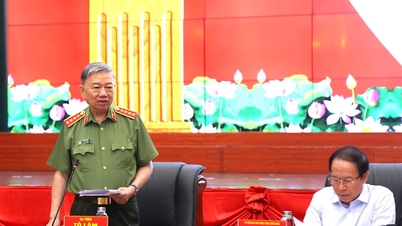
On the afternoon of June 22nd, the National Assembly continued its plenary session discussion on the draft Law on Citizen Identification (amended). After listening to the comments and suggestions, General To Lam, Minister of Public Security, explained and clarified some of the issues raised and of concern to the delegates.
Mr. To Lam assessed that this draft law is an important legal document in the management of population and identity cards, aiming to facilitate people's travel, administrative procedures, civil transactions, and many other conveniences, meeting the requirements of digital transformation in our country.
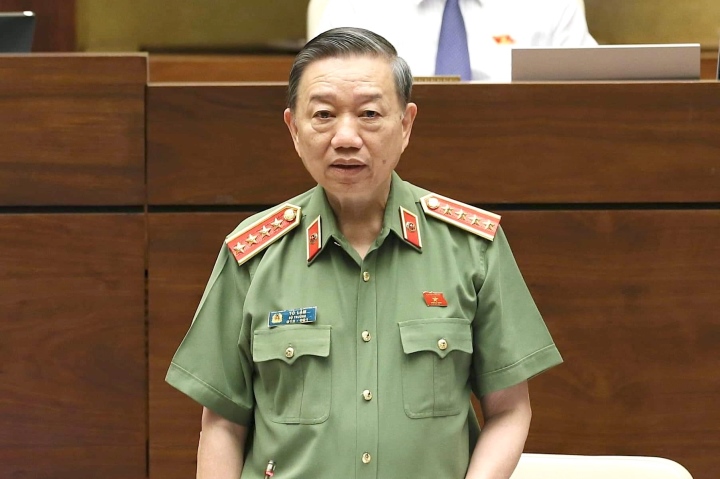
General To Lam delivered a speech.
Regarding the necessity of enacting the law, the Minister of Public Security stated that there was unanimous agreement on enacting the Identity Card Law and highly appreciated the government 's preparation of the legal dossier.
"Regarding the name of the draft law, the majority of delegates agreed on the name 'Law on Citizen Identification' to ensure comprehensiveness and suitability with the scope of regulation and the subjects to which the law applies," Minister To Lam said. In addition, some delegates suggested retaining the current name 'Law on Citizen Identification'.
Regarding information in the national database, the database on identity cards, and the connection, sharing, and exploitation of information, many delegates agreed with this regulation, arguing that it is an essential need in building a digital government and a digital society.
Minister To Lam stated that the Government will incorporate the opinions of the delegates to further revise and refine the draft law, and submit it to the National Assembly at the 6th session.
Earlier, regarding the name of the draft law, delegate Nguyen Hai Dung (Nam Dinh) supported changing the name of the law from the Law on Citizen Identification to the Law on Identity Cards.
According to Mr. Dung, identity cards are issued not only to Vietnamese citizens but also to people of Vietnamese origin whose nationality has not yet been determined. Therefore, the name change ensures that all individuals are included.
Representative Tran Cong Phan (Binh Duong delegation) argued that the drafting agency cited the figure of 31,000 people of Vietnamese origin living in Vietnam whose nationality has not yet been determined. While the Constitution stipulates that a Vietnamese citizen is someone who possesses Vietnamese nationality, the issuance of a citizen identification card signifies their Vietnamese citizenship. These 31,000 people must be managed, but they should have a different type of card to distinguish them, because they are not yet Vietnamese citizens.
This representative argued that while they need to be managed and provided with opportunities, they are not being issued citizen identity cards like Vietnamese citizens. He stated that it is unacceptable to give over 81 million people a single card just for those 31,000 people, treating them all the same.
Speaking in the debate, delegate Le Hoang Anh (Gia Lai province) expressed agreement with delegate Phan's argument. He said that the term "citizen" specifically refers to a person, while the term "identity card" does not specifically refer to a person, because even plants and animals require traceability and identification for each type of plant or animal.
"If anyone has participated in or observed dog and cat breeding groups and associations, they all have identification and identity cards for their pets. Therefore, further consideration is needed," Mr. Anh stated.
Representative Pham Van Hoa (Dong Thap) emphasized that issuing identity cards to the group of people of Vietnamese origin who are stateless and living in Vietnam aims to ensure human rights and facilitate management.
According to him, these people are mostly facing economic hardship, lacking social security benefits due to the absence of permanent residency, and their children are unable to attend school because they lack birth certificates, leaving a burden on society.
"If something happens, we won't know where this person is, and tracking them down will be difficult because there are no records," Mr. Hoa worried.
Given these shortcomings, Mr. Hoa believes that it is essential for authorities to issue identity cards to this group of people, so that they can have citizenship rights and enjoy the same policies as everyone else.
Ha Cuong
Beneficial
Emotion
Creative
Unique
Source






















![[Photo] Prime Minister Pham Minh Chinh attends the Conference on the Implementation of Tasks for 2026 of the Industry and Trade Sector](/_next/image?url=https%3A%2F%2Fvphoto.vietnam.vn%2Fthumb%2F1200x675%2Fvietnam%2Fresource%2FIMAGE%2F2025%2F12%2F19%2F1766159500458_ndo_br_shared31-jpg.webp&w=3840&q=75)


























































Comment (0)