

Team leaders and deputy team leaders may have their position allowances cut.
According to current regulations, each teacher cannot hold more than two concurrent positions and is entitled to a reduction in teaching load based on the position with the highest reduction; at the same time, there is no limit on the number of professional duties and job positions that can be concurrently held, so some teachers have to take on multiple jobs.

The Ministry of Education and Training is seeking feedback on the draft Circular regulating working hours for teachers.
Therefore, Clause 3, Article 4 of the draft Circular stipulates that each teacher shall not concurrently hold more than two positions as prescribed in Articles 8, 9, and 10 of this Circular. For concurrent positions and professional activities as prescribed in Chapter III of this Circular (except for concurrent positions in the trade union, school-level Youth Union secretary, or school-level Youth Union deputy secretary), if remuneration or allowances have already been received, they cannot be converted into teaching hours.
Accordingly, Articles 8, 9, and 10 of this circular stipulate that many individuals are eligible for a reduction in teaching load when concurrently holding other positions or responsibilities. Specifically, heads and deputy heads of subject departments or deputy heads of student management departments (in ethnic boarding schools and ethnic semi-boarding schools) are entitled to a reduction of 3 teaching hours (head) and 1 teaching hour (deputy head) per week.
Currently, teachers who also serve as team leaders are granted a reduction of 3 teaching hours, and deputy team leaders are also granted a reduction of 1 teaching hour per week. In addition, according to Circular 33/2005/TT/BGD-ĐT regulating the position allowance regime applicable to officials and employees holding leadership and management positions in public educational institutions, heads of subject departments at the high school level receive a position allowance with a coefficient of 0.25; heads of subject departments at the junior high and primary school levels receive a position allowance with a coefficient of 0.20; and deputy heads of subject departments at all three levels receive a position allowance with a coefficient of 0.15.
However, according to this draft Circular, the head and deputy head of the professional team can only receive one of the two options. If they receive the converted teaching hours, their teaching hours will be reduced, but they will no longer receive the position allowance; if they receive the position allowance, they must teach the full number of hours according to the quota.
In reality, the responsibilities of subject heads in schools today are very heavy. They are primarily responsible for the activities of their subject groups and for the development of their respective subjects. Therefore, maintaining the position allowance for subject heads and deputy heads should be considered alongside the current reduction in teaching load.
Moreover, when the National Assembly agreed to increase the basic salary to 2,340,000 VND, it stipulated that all allowances would remain unchanged. Therefore, cutting the position allowances of team leaders and deputy team leaders while retaining allowances for other specialized or dual-role positions is not entirely reasonable.
The number of class periods and teaching time for secondary school teachers is currently the highest.
According to current regulations, the teaching load for teachers is specifically defined as follows: Primary school teachers: 23 lessons/week, lower secondary school teachers: 19 lessons/week, upper secondary school teachers: 17 lessons/week; teachers in ethnic boarding schools, ethnic semi-boarding schools, and schools/classes for people with disabilities are entitled to a reduction of 2 lessons/week compared to the teaching load of teachers at the same level.
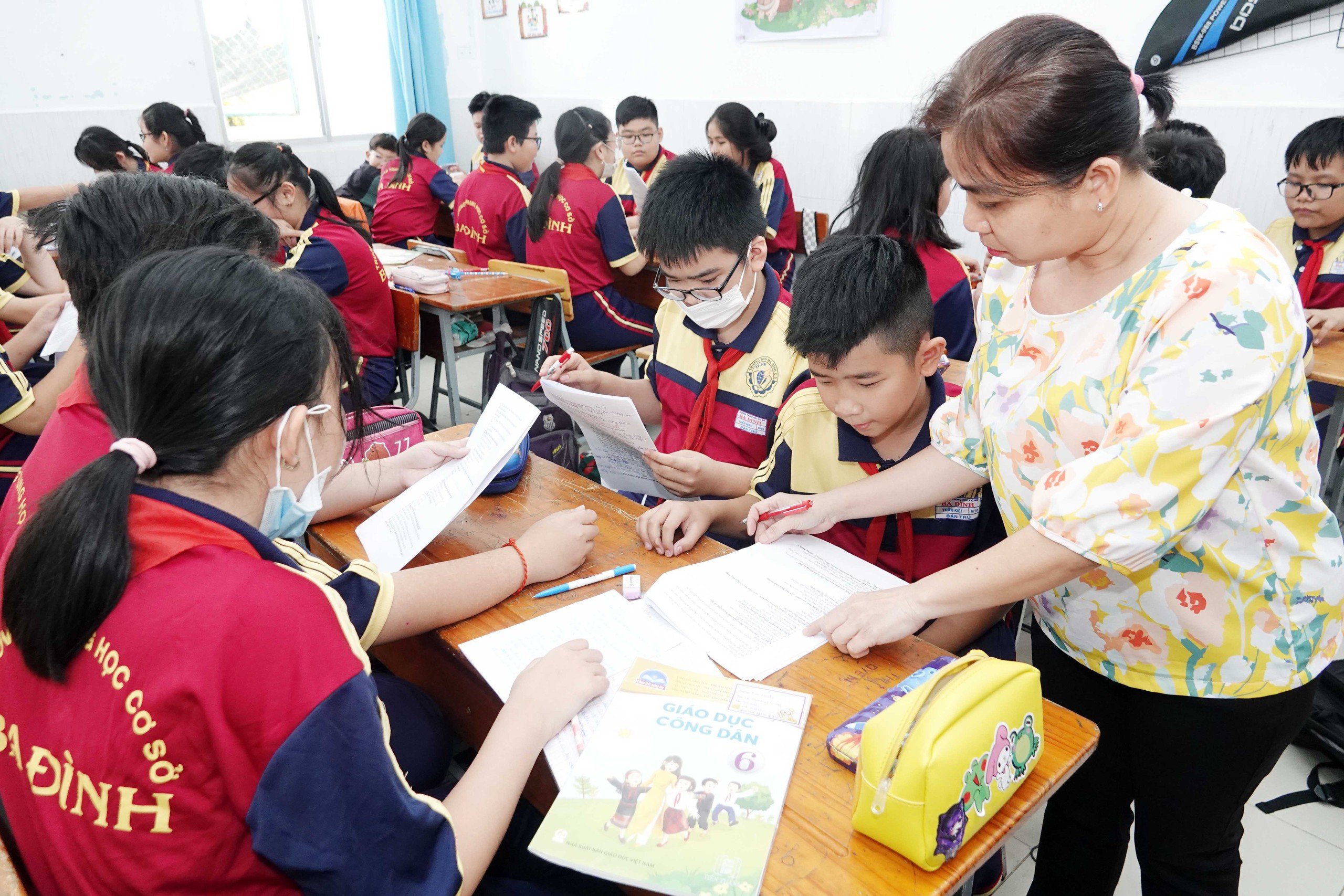
Among all educational levels, secondary school teachers teach the second highest number of lessons (after primary school teachers), but they also spend the most time on the job.
According to the draft Circular, general education teachers currently teaching in schools will essentially continue to teach the same number of lessons as they do now. Among all levels of education, lower secondary school teachers teach the second highest number of lessons (after primary school teachers), but they also spend the most time teaching. Primary school teachers teach 23 lessons, each lasting 35 minutes, totaling 805 minutes. Lower secondary school teachers teach 19 lessons, each lasting 45 minutes. Therefore, the total teaching time per week for lower secondary school teachers is 855 minutes.
Meanwhile, high school teachers teach 17 lessons per week, with each lesson lasting 45 minutes, just like middle school teachers, so that's equivalent to 765 minutes per week.
A long-standing concern for many middle school teachers is the similarity in educational background between middle and high school teachers. For example, those who graduate with a university degree in mathematics can apply to teach at the middle school level, while others can teach at the high school level, as their educational qualifications are the same. Only a small number of middle school teachers who previously had college degrees now have mostly completed university degrees.
Besides teaching, junior high school teachers also handle literacy education, and the dropout rate at this level is higher, as is the number of student violations. However, junior high school teachers have two more teaching hours per week than high school teachers. In particular, most junior high school teachers are teaching two subjects, making lesson planning even more demanding than high school teachers. Therefore, perhaps junior high and high school teachers should have the same number of teaching hours (17 hours/week).
Source: https://thanhnien.vn/che-do-lam-viec-doi-voi-giao-vien-ban-khoan-ve-phu-cap-va-so-tiet-day-185240714062906127.htm

![[Photo] National Assembly Chairman Tran Thanh Man attends the policy seminar to promote Vietnam-Türkiye cooperation.](https://vphoto.vietnam.vn/thumb/1200x675/vietnam/resource/IMAGE/2026/04/16/1776351415367_vna-potal-chu-tich-quoc-hoi-tran-thanh-man-du-toa-dam-chinh-sach-thuc-day-hop-tac-viet-nam-tho-nhi-ky-8705791-jpg.webp)






















![[Image] Bridges and roads connecting the eastern part of Ho Chi Minh City](https://vphoto.vietnam.vn/thumb/1200x675/vietnam/resource/IMAGE/2026/04/16/1776328595108_ndo_br_bh-vt5-jpg.webp)




























![[Infographic] Details of the Hanoi-Quang Ninh High-Speed Railway Project](https://vphoto.vietnam.vn/thumb/402x226/vietnam/resource/IMAGE/2026/04/16/1776338188424_anh-man-hinh-2026-04-16-luc-18-16-10.png)

![[Photo] National Assembly Chairman Tran Thanh Man meets with the Speaker of the Georgian Parliament](https://vphoto.vietnam.vn/thumb/402x226/vietnam/resource/IMAGE/2026/04/16/1776338494029_anh-man-hinh-2026-04-16-luc-18-21-21.png)



















Comment (0)