

Ireland: Experts abandoned the autopsy of a fin whale carcass after hearing gurgling sounds coming from its intestines, revealing the risk of explosion if the animal were opened.
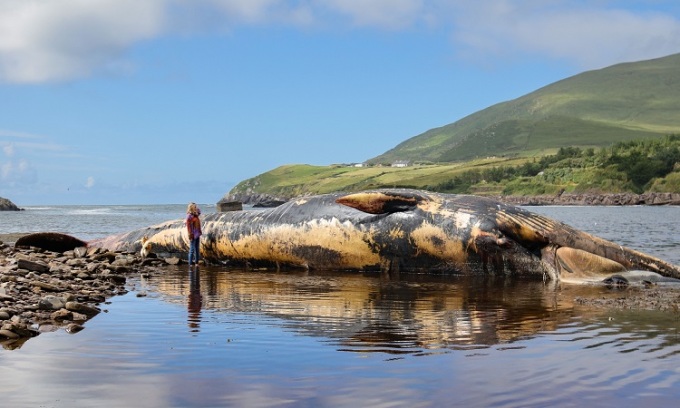
The carcass of a 19-meter-long fin whale was found in Kerry on July 9. Photo: IWDG
A 19-meter-long fin whale ( Balaenoptera physalus ) washed ashore on Baile Uí Chuill Strand in County Kerry, Ireland on July 9th. The cause of death is unclear, but it is likely the giant whale had been dead for about three weeks before washing ashore, based on the degree of decomposition.
A team of experts from the Irish Whale and Dolphin Organisation (IWDG) arrived at the site to collect samples for examination, but were forced to stop due to fears the carcass might explode. "I was collecting fat, jaw plates, and skin," said Stephanie Levesque, an IWDG officer. "I was about to collect muscle samples when I heard a sound, as if it were going to explode right in front of me if I went any deeper."
When whales die, their intestines fill with methane gas, causing the carcass to swell like a balloon, floating on the surface of the sea and washing ashore. At sufficiently high concentrations, when mixed with oxygen in the air, methane gas can cause whales to explode instantly if the pressure increases or when the carcass is dissected, although this is very rare.
In 2013, a marine biologist in the Faroe Islands narrowly escaped death after a sperm whale ( Physeter macrocephalus ) that had washed ashore exploded while the scientist was dissecting it. In 2019, a whale exploded on the surface of the sea off the coast of California.
Sometimes, wildlife authorities intentionally detonate gas-filled carcasses of stranded whales to prevent them from slowly decomposing and emitting foul odors. The most famous example of this was in 1970, when a 14-meter-long sperm whale carcass stranded in Florence, Oregon, was blown to pieces by half a ton of explosives.
Typically, about one or two fin whales beach themselves in Ireland each year. There are approximately 100,000 fin whales worldwide , but the species remains vulnerable to pressures such as climate change, plastic pollution, and overfishing of mollusks, their favorite food, according to the International Union for Conservation of Nature (IUCN). In January 2022, nearly 1,000 fin whales were filmed feeding on a massive mollusk bog in Antarctica.
An Khang (According to Live Science )
Source link

![[Photo] People in Ho Chi Minh City experience the green space at Ly Thai To Park No. 1.](https://vphoto.vietnam.vn/thumb/1200x675/vietnam/resource/IMAGE/2026/03/06/1772783731988_01-9003-png.webp)


![[Image] Me So Bridge - an important connecting point on the Ring Road 4](https://vphoto.vietnam.vn/thumb/1200x675/vietnam/resource/IMAGE/2026/03/06/1772781627165_ndo_br_dji-0917-jpg.webp)
![[Photo] Prime Minister Pham Minh Chinh meets with representatives of female leaders and managers of central agencies and presents the Kovalevskaia Award 2025.](https://vphoto.vietnam.vn/thumb/1200x675/vietnam/resource/IMAGE/2026/03/06/1772789429283_ndo_br_dsc-1149-jpg.webp)
































































































Comment (0)