Fifteen years of rubber cultivation in the border region with Cambodia has been an incredibly arduous and challenging journey. From the initial pioneering steps, vast, lush green rubber forests have now sprung up, creating a song steeped in the love of the land and its people.
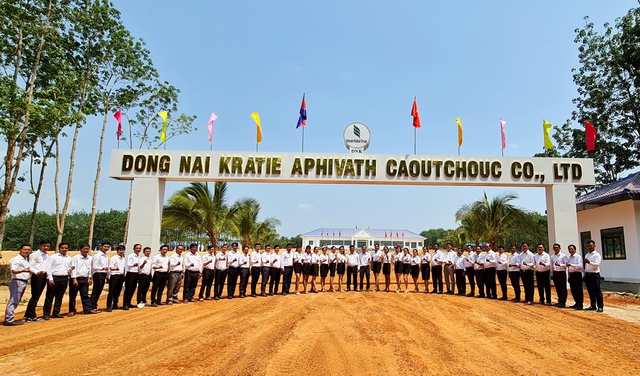
The staff and workers of Dong Nai - Kratie Rubber Joint Stock Company at the project farm headquarters in O'Kreang commune, Sambo district, Kratie province.
Do not be discouraged by difficulties.
Mr. Le Van Lam, General Director of Dong Nai - Kratie Rubber Joint Stock Company, stated that on January 29, 2008, the VRG Board of Directors approved the capital contribution plan to establish Dong Nai - Kratie Rubber Joint Stock Company. Subsequently, the company was granted a certificate of establishment by the Ministry of Commerce of the Kingdom of Cambodia. In accordance with this plan, the company is tasked with planting, caring for, harvesting, processing, and selling natural rubber latex in the Kingdom of Cambodia.
The rubber plantation project of Dong Nai - Kratie Rubber Joint Stock Company is located in the two communes of O'Kreang and Roluos Meanchey, Sambo district, Kratie province, bordering Binh Phuoc province. From Hoa Lu border gate, it's about a 200 km drive by road to the "rubber capital" of approximately 5,000 hectares, currently in the harvesting stage, which the VRG member company has invested in for the past 15 years.
The pioneering force of Dong Nai - Kratie Rubber Joint Stock Company in reclaiming new land in O'Kreang and Roluos Meanchey consists of 15 cadres and employees from the parent company - Dong Nai Rubber Corporation (DNRC, under VRG) who were seconded to form the core of the task.
At that time, living conditions were extremely difficult. Most of the staff did not know the Khmer language, and living facilities were very scarce. Many had to live and work in makeshift shelters built from forest trees. The red dirt roads leading to the project were severely damaged in many sections, making travel extremely difficult, especially during the rainy season. Communication was intermittent; machinery for land clearing and planting was scarce, and when it broke down, it took many days to repair, causing many difficulties in land clearing and preparation. Undeterred by these difficulties and hardships, the leading staff gradually began to determine the area of the orchards over the years.
In 2008, Dong Nai - Kratie Rubber Joint Stock Company planted over 71 hectares of new rubber trees, and with the experience gained, in 2009, it planted over 1,021 hectares; in 2010, over 2,035 hectares; in 2011, over 2,652 hectares; and in 2012, over 590 hectares. Over the five years (2008-2012), the company completed land clearing and planting of over 6,371 hectares; averaging over 1,274 hectares planted per year.
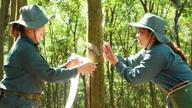
The plantation faced numerous difficulties during its development, including hot, dry weather, soil conditions (sandy and rocky soil), and especially, a large area of over 1,441 hectares suffered from sunburn, specifically: over 78 hectares in 2012, over 151 hectares in 2013, and over 1,211 hectares in 2016. This sunburn caused the rubber plantation area to shrink to approximately 5,000 hectares.
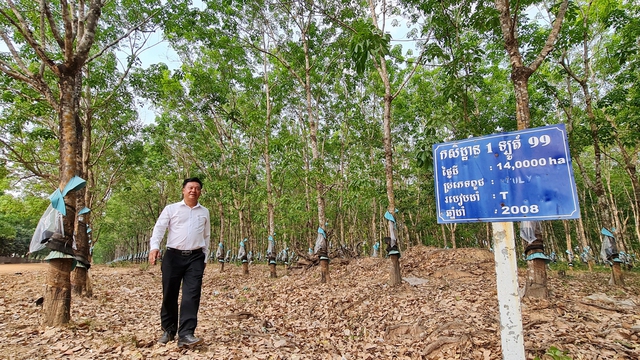
Mr. Le Van Lam, General Director of Dong Nai - Kratie Rubber Joint Stock Company, inspects a rubber plantation during the latex harvesting period.
Pioneering responsibility
"The most significant takeaway after 15 years of arduous challenges is that here, from a remote and sparsely populated area with difficult living conditions and poor transportation, the company, with the enthusiasm of Vietnamese staff and workers and the diligent labor of Cambodian workers; along with the close guidance of VRG and the extremely enthusiastic support of the local government of Cambodia, has completed the plan to plant new trees and establish a well-developed plantation. From 2016 to 2022, the company gradually brought the entire plantation area into rubber tapping," Mr. Le Van Lam shared.
During the development and construction of its rubber plantations, Dong Nai - Kratie Rubber Joint Stock Company has been awarded emulation flags and numerous commendations by the Ministry of Agriculture and Rural Development, the State Capital Management Committee at Enterprises, and VRG. Over 15 years of construction and development, from a barren, sparsely populated area, the company has now established approximately 5,000 hectares of thriving rubber plantations, with an average yield of 1.7 tons of latex per hectare per year (in 2021, latex production reached over 7,000 tons, generating revenue of over 274 billion VND; in 2022, it reached over 8,100 tons, generating revenue of over 275 billion VND). The rubber mill, plantation headquarters, and worker housing areas have been built, along with convenient transportation systems, electricity, telephone, and internet access. Mr. Le Van Lam shared: "The company's success today is the result of a difficult period during which everyone worked together and diligently built it."
In Cambodia, the land of temples and pagodas, Dong Nai - Kratie Rubber Joint Stock Company has actively participated in local social and charitable activities, organizing visits and gift-giving to disadvantaged worker families, and visiting workers and the local community on Khmer national holidays and traditions. At the same time, the company fulfills its tax obligations to the host country in full.
Furthermore, Dong Nai - Kratie Rubber Joint Stock Company also participates in contributing to local charitable funds, donating to the Red Cross in Cambodia; contributing to the construction of welfare facilities and temples serving the local community where the company is located. This has fostered closer relationships between the company and its workers and the local people, strengthening the solidarity between Vietnam and Cambodia. (to be continued)
CONTRIBUTING TO THE GROWTH OF FRIENDSHIP
After 94 years of continuous construction and development, the rubber plantation area managed by VRG has now reached nearly 402,650 hectares (over 288,101 hectares in Vietnam; approximately 90,000 hectares in Cambodia and approximately 27,000 hectares in Laos).
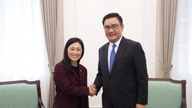
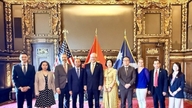

There is a commonality between Vietnam and neighboring Cambodia and Laos: rubber trees are primarily grown in border regions and remote areas with challenging socio- economic conditions. Land reclamation and rubber tree cultivation is a task fraught with difficulties and hardships.
It is a source of pride that the rubber industry, in every era, has had pioneers who continue the industry's tradition of contributing to greening border areas and maintaining border security.
In Cambodia alone, VRG currently has 16 member companies (with a total registered investment capital of nearly 1.8 billion USD) investing across 7 provinces (Kampong Thom, Kratie, Rattanakiri, Odor Meanchey, Preah Vihea, Siem Reap, and Mondolkiri): Chu Se - Kampong Thom Rubber Joint Stock Company, Ba Ria - Kampong Thom Rubber Joint Stock Company, Tan Bien - Kampong Thom Rubber Joint Stock Company, Phuoc Hoa - Kampong Thom Rubber Joint Stock Company, Chu Pah - Kampong Thom Rubber Joint Stock Company, Mekong One-Member Limited Liability Company, Tay Ninh - Siem Reap Rubber Joint Stock Company, Hoang Anh Mang Yang K Rubber Joint Stock Company, Chu Prong - Stung Treng Rubber Joint Stock Company, Krong Buk - Rattanakiri Rubber Joint Stock Company, Mang Yang - Rattanakiri Rubber Joint Stock Company, Dau Tieng Kratie Rubber Joint Stock Company, Dau Tieng Cambodia Rubber Joint Stock Company, Dong Nai - Kratie Rubber Joint Stock Company, Dong Phu - Kratie Rubber Joint Stock Company, and VKETI Limited Liability Company.
Mr. Yim Chhayly, Deputy Prime Minister of the Kingdom of Cambodia and Chairman of the Cambodian Council for Agricultural and Rural Development Restoration, highly appreciated VRG's contributions to Cambodia's socio-economic development. To date, rubber trees serve as a vivid example, further enhancing the friendship, sustainable cooperation, and mutual benefit between Vietnam and Cambodia.
Source link