

In any revolution throughout history, especially the wars of resistance for independence, the defense of national sovereignty , and the building of the country during the period of international integration, the decisive factor for victory has always stemmed from internal unity within the revolutionary forces, national unity, and the ability to gain the sympathy and support of the people of countries around the world.
President Ho Chi Minh, a Vietnamese revolutionary of the 20th century, possessed a profound understanding of national history and numerous revolutions around the world. From the very beginning of his struggle to find a way to save the country, he recognized the importance of national unity. His ideology of "Unity, unity, great unity / Success, success, great success" became the strategic guideline of the Vietnamese revolution.
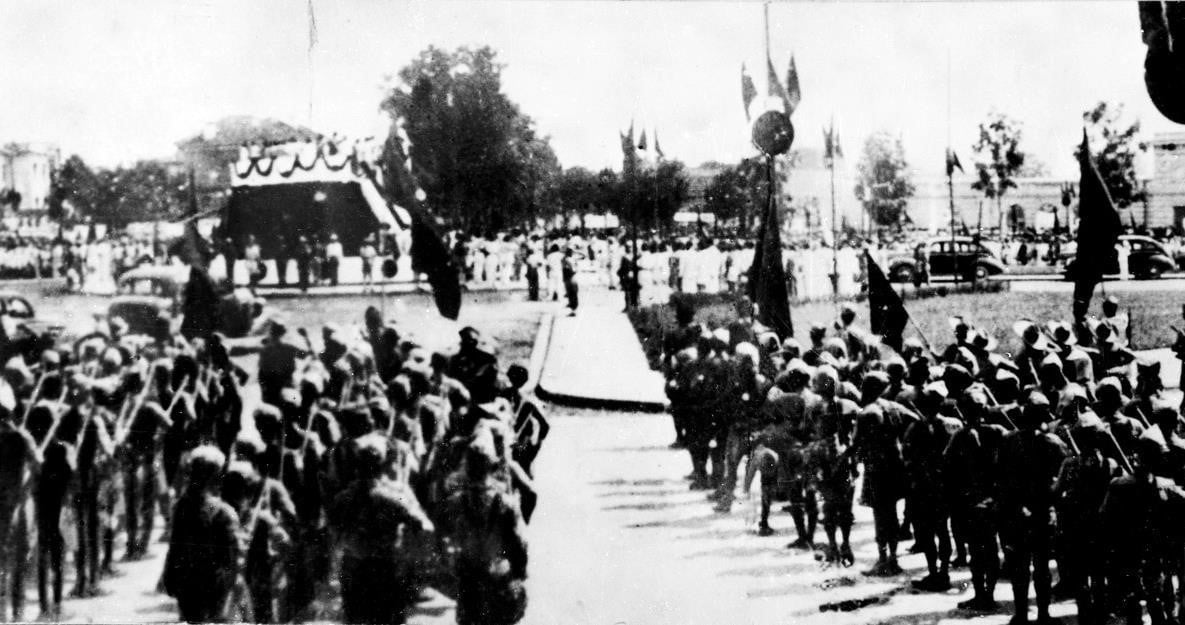 |
| A large crowd gathered at Ba Dinh Square to listen to President Ho Chi Minh read the Declaration of Independence on September 2, 1945. (Source: VNA) |
1. Trusting and relying on the people in Ho Chi Minh's strategy of national unity is a continuation and enhancement of traditional political thinking: "The nation is founded on the people," "The people are the ones who steer the boat, and the people are also the ones who can overturn it," "Even if it's ten times easier, without the people, nothing can be achieved; even if it's a thousand times harder, with the people, everything can be accomplished."
This principle of Ho Chi Minh's dialectical unity aligns with the Marxist principle that "revolution is the work of the masses," but his concept of the masses is broader than that of many revolutionaries of his time. For Ho Chi Minh, loving the people, trusting the people, respecting the people, relying on the people, living, fighting for the people, and serving the people are the supreme principles, permeating his strategic thinking and practical activities. He concisely but profoundly summarized this vital principle: "In the sky, nothing is more precious than the people. In the world, nothing is stronger than the united force of the people," and "a tree must have a firm root for it to endure; the edifice of victory is built on the foundation of the people."
This principle can be summarized into the following main points: The people are the root and foundation of national unity; the people are the subject of national unity; the people are the inexhaustible and invincible source of strength for national unity, determining the victory of the revolution; the people are the solid support of the Party and the revolutionary political system.
This generalization can be found in concise statements such as Ho Chi Minh's Declaration on the People: “Our country is a democratic country / All benefits are for the people / All powers belong to the people / The work of reform and construction is the responsibility of the people / The cause of resistance and national construction is the work of the people / The government from the commune to the central government is elected by the people / Organizations (at the time Ho Chi Minh wrote this, in 1949, the Party was operating secretly, so it is called Organizations) from the central to the commune are organized by the people / In short, power and strength reside in the people”1
For Ho Chi Minh, the principle of consistency and national unity was not a random, spontaneous, or temporary gathering, but a sustainable collection of social forces with direction, organization, and leadership. This is a core principle that distinguishes Ho Chi Minh's strategy of national unity from the ideas of unity and the gathering of forces of some other patriots and revolutionary leaders. Professor Tran Van Giau made a insightful observation: for Ho Chi Minh, national unity was no longer just a sentiment of "people of the same country must love each other," but was built on a solid theoretical foundation.
| Uncle Ho often wrote short, concise, and easy-to-understand poems urging the people to unite in the revolution: “Our people, please remember the word 'unity': Unity of sentiment, unity of strength, unity of heart, unity of alliance!” “A large stone / A heavy stone / One person alone / Cannot lift it. But when many people join forces: “A large stone / A heavy stone / Many people lift it / Can lift it.” And the conclusion is: Knowing unity of strength / Knowing unity of heart / No matter how difficult / It can be done.” |
2. The solid foundation of national unity is the guarantee of the supreme interests of the entire nation and the fundamental rights of the working people. The right to life, the right to liberty, and the right to the pursuit of happiness are sacred human rights that no one can infringe upon.
However, human beings cannot live in isolation but must live with society, in a national community. Therefore, human rights must be based on the rights of the community, the rights of the nation. From the objective reality of enslaved nations around the world, from the traditional patriotism of our ancestors, and creatively absorbing the ideas of human rights and civil rights from typical revolutions around the world, especially the national and class liberation ideas of Marxism-Leninism, Ho Chi Minh developed the rights of the nation: “All nations in the world are born equal, every nation has the right to live, the right to happiness and the right to freedom,” “Vietnam has the right to enjoy freedom and independence... The entire Vietnamese nation is determined to dedicate all its spirit and strength, its life and property to uphold that right to freedom and independence.”2
This is a bright spot, a unique essence in Ho Chi Minh's philosophical and political thinking. Many renowned researchers of the history of thought and philosophy around the world acknowledge this creative contribution of his.
The Japanese philosopher Shingo Shibata, in his work "Vietnam and Ideological Issues," published in Tokyo in 1968, wrote: "Ho Chi Minh's most famous contribution lies in his discovery that human rights are national rights. Thus, all nations have the right to self-determination, and all nations can and should achieve independence and self-determination. This affirmation is linked to his theoretical contributions to the national and colonial question, and this was achieved because Ho Chi Minh fully understood the unique national characteristics of colonial and dependent countries."
Nothing is more precious than independence and freedom; this was the meaning of life and a fundamental content in Ho Chi Minh's revolutionary thought. It was also the strength that won people's hearts and the glue that bound the entire nation together. It was the source of his and the nation's unwavering faith and fighting spirit, the fundamental and long-term task, and also the most urgent and pressing task for the entire Vietnamese nation during the years of suffering, anguish, and resentment under imperialist and colonial rule. However, for Ho Chi Minh, national independence was always linked to the freedom and happiness of the people. He declared: "An independent country without freedom and happiness for its people is meaningless."
Nothing is more precious than independence and freedom – Ho Chi Minh's great revolutionary ideology, while rooted in the past, reflects the aspirations of the present and illuminates the future of the entire nation, and aligns with the just cause of nations around the world. This is the all-powerful key, the focal point of victory for the strategy of "Unity, unity, great unity. Success, success, great success."
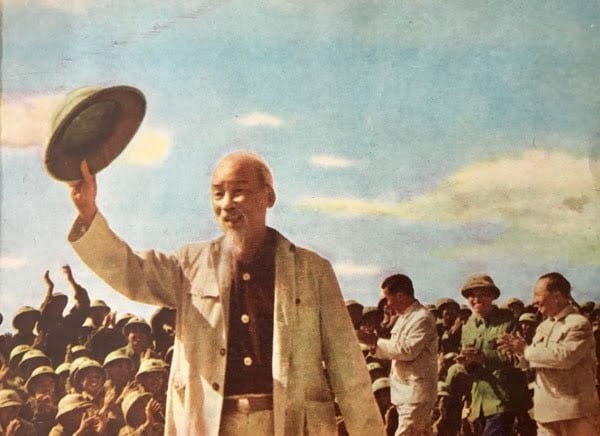 |
| Looking at Vietnam's achievements today, it's clear that many of President Ho Chi Minh's visions and aspirations have come true. (Archival photo) |
3. “Unity, unity, great unity/Success, success, great success” refers to unity within the Party, unity of the entire people, and international unity. Simultaneously with correctly understanding and resolving class-national relations, Ho Chi Minh's strategic principle of great unity also encompasses the close combination of national unity with international unity.
Just as building national unity is important, the primary goal of international solidarity is to serve the struggle for national independence and freedom. Overcoming the limitations of his predecessors, Ho Chi Minh placed Vietnam within the broader context of the world situation and considered the Vietnamese revolution as a part of the world revolution.
From the very beginning of his revolutionary activities, through international forums and newspapers, Ho Chi Minh constantly called for solidarity among oppressed peoples, between colonial peoples and the world workers' movement. In fact, he organized the Union of Colonial Peoples, published the newspaper "The Pariah," and joined the Communist International.
Overcoming narrow national and racial prejudices, Ho Chi Minh found commonalities among colonial peoples and called out, “We share a common suffering: the tyranny of the colonial regime. We fight for a common ideal: the liberation of our compatriots and the independence of our homeland. In our struggle, we are not alone, because we have the support of all our people and because the democratic French, the true French, stand beside us.”3
During this period, the slogan "Workers of all countries, unite!" (from the Paris newspaper, 1923) resonated in Paris – the information center of the contemporary world – signifying a continuation and development, elevating to a new level, of the two strategic slogans of two outstanding predecessors of the proletariat: "Workers of all countries, unite!" (Karl Marx) and "Workers of all countries and oppressed peoples, unite!" (VI Lenin).
From that fundamental perspective, Ho Chi Minh's strategy of national unity established a global people's front in solidarity with Vietnam. Throughout history, especially during critical moments of trial, the banner of independence and freedom has always been raised high, its just nature becoming increasingly clear, in line with the general trend of the revolution and the common aspirations of the vast majority of the world's people.
Therefore, dialectical and highly effective relationships emerged, and the goal of independence and freedom gained increasing support from the people of the world. This support contributed to bringing our people's struggle for independence and freedom to complete victory.
In the current revolutionary period, our Party and State need to continue to affirm that national unity is the strategic guideline of the Vietnamese revolution; it is the source of strength, the main driving force, and the decisive factor ensuring the victory of the cause of building and defending the Fatherland.
Taking the common goal of building a peaceful, independent, unified, territorially intact Vietnam, with a prosperous people, a strong nation, democracy, fairness, and civilization; eliminating feelings of inferiority and prejudice about the past and class divisions; accepting differences that do not contradict the common interests of the nation; upholding national spirit, traditions of humanity, and tolerance… to unite all people in a common front and strengthen social consensus.
Recently, speaking at the Congress of the Vietnam Fatherland Front, General Secretary To Lam emphasized the need for a unified understanding of the position and special importance of the great national unity bloc, and stressed the urgent need, more than ever, to prioritize consolidating and promoting the great national unity bloc under the leadership of the Party. This is one of the key solutions to lead the country into a new era.
1. Ho Chi Minh Complete Works, Vol. 5, 1995, p. 698
2. Declaration of Independence, September 2, 1945
3 Ho Chi Minh, Complete Works, Volume 1, 1995, pp. 23-24
Source: https://baoquocte.vn/tu-tuong-chien-luoc-dai-doan-ket-ho-chi-minh-306478.html
































































Comment (0)