One year, my family went back to our cottage in the English countryside for Christmas. That year, we went all out and bought two Christmas trees to decorate the house.
After Christmas, before returning to Switzerland, I felt so bad about leaving the two pine trees behind that I planted them in the garden, one in front of the house and one in the back.
The problem arose from the pine tree.
More than a year passed, and we rarely returned to England due to busy work schedules and other trips. The pine tree continued to grow rapidly, but neither my husband nor I noticed. Until one day, he, who was in America at the time, called me from India, saying the police had just called him.
They informed us that our neighbors had filed a complaint with the police, requesting government intervention because... the pine tree planted in front of my house has grown quite tall and is likely to obstruct their view (?!).
What? I remember my utterly shocked reaction to what my husband told me. I asked, "So what do the police want from us now? The tree is in our yard!"
It's also worth mentioning that our house in England was in a village situated on a hillside, and our house was atop a small hill, so it was generally a little higher than the other houses in the village. Therefore, even though the pine tree wasn't very tall, it was already at eye level with the house across the street!
My husband said he had to arrange for his business trip to start a day earlier, then immediately fly back to England to deal with this tree, otherwise, the police said they would enter the garden and cut it down.
I said that if they wouldn't allow it, they should just go in and do the sawing themselves. Why should I buy a plane ticket back to England just to do that? He said no, if they did it, they'd send us a bill for the costs, and it would be better to sort it out ourselves if we didn't want to be surprised... again by the bill. After hearing that, I didn't argue any further!
For many years, I often heard the saying: "In the West, they are very free; people respect differences, so everyone is free to do what they want!" This statement is only true if you understand the Western definition of "freedom."
Freedom within the freedom of others
In reality, there are many things that are considered "freedom" in one environment but are not accepted in another. And one thing I'm quite sure of is that "freedom" doesn't mean "doing whatever you want," in both the East and the West.



Westerners, at least in the places where I have lived and worked, truly respect individual differences and identities.
For example, in the office environment where I work, I've encountered quite a few male colleagues with long hair, tied back in a ponytail, and some of them even hold high-level management positions.
Apparently, having a hairstyle that's different from most people around them, or having large tattoos on visible parts of their bodies, or wearing nose piercings... these things don't seem to affect the work of the colleagues I know.
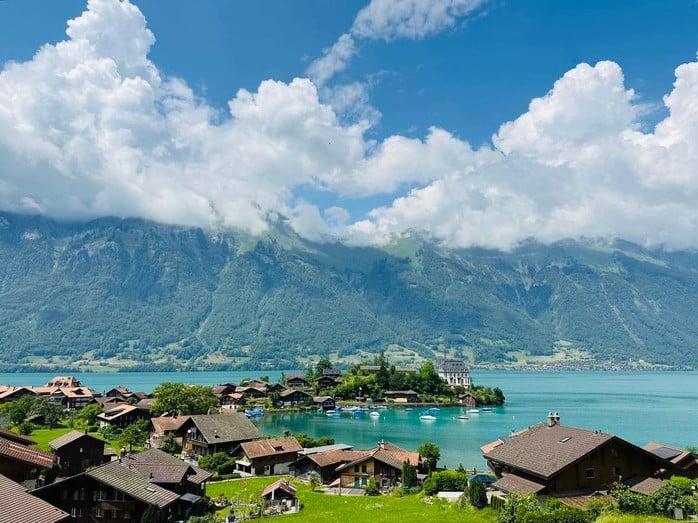
A village in Switzerland with traditional chalet houses has preserved its architecture and landscape for the common good of the community.
However, I once witnessed a colleague of mine, wearing earrings, after parking his car in a parking lot, get out of the car, and realize one wheel seemed to be slightly over the line separating the adjacent parking space. He immediately went back into the car to adjust it until his car was perfectly centered between the two lines before stopping.
This shows that freely expressing oneself is different from doing whatever one likes without considering the impact on others.
The Western philosopher John Locke (1632-1704) stated: "Freedom is the ability of a person to do whatever he desires without hindrance." However, in Western countries, laws are extremely strict to ensure that each person finds their freedom within the freedom of others; this is the boundary between social control and individual independence.
Freedom does not mean that a person can do whatever they want without facing consequences. One person's freedom cannot harm another's freedom. People are free within limits so as not to infringe upon the freedom of anyone else.
Training to develop awareness
Some people who have been to Europe have told me that the people there have excellent manners; they always avoid causing trouble for others. The reality is that they have been trained to have that manner, and that training comes at a cost, sometimes a very high cost.
Whenever I fly back home to Switzerland after a trip, my husband might pick me up, or I might call a car myself through a ride-hailing app.
If I call a taxi, I always have to go to the designated pickup area before I start booking, which means I might have to wait quite a while.



If I call a ride in advance and don't show up when the car arrives, they won't wait for me and I'll be charged a very high fee. If this happens a few times, my account on the app will be blocked, and I won't be able to use that app anymore.
So why didn't that car stop and wait for me a little while? Because in Switzerland, they get a very heavy fine for parking in no-parking zones.
When I returned to Vietnam, I was probably the only one who went to the designated pick-up area to book a ride, and my driver often had to wait behind a long line of cars where the customers were still waiting for their luggage! Clearly, when a sense of community isn't fostered, the more freedom one has, the more disadvantageous it becomes.
A year ago, I was planning to renovate our country house in England so we could spend more of the summer there. But my husband said he didn't want to tear down the front part of the house, because it's the most important part that creates the overall beauty compared to other houses in this village, the characteristic beauty of 18th-century rural houses that have been preserved to this day, and we can't demolish it...
Eventually, we no longer had a Christmas tree in our front yard, but I was free to decorate the tree in the backyard with any colorful lights I wanted...
In fact, laws are not enacted to restrict individual freedoms, but to ensure that these freedoms are exercised. The more strictly a country's laws are enforced, the safer its citizens feel. This is the highest form of freedom.
Source