

Russia is ready to normalize relations with the United States, but Russia “cannot dance alone, and will not do so.” This statement by Kremlin spokesman Dmytri Peskov on November 18 hints at the possibility of easing tensions between the two leading world powers, after a long period in which their relationship has fallen to its lowest point in history.
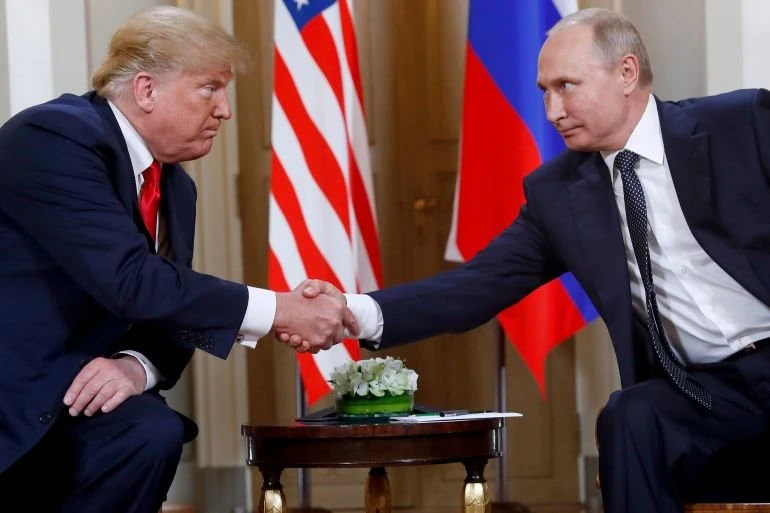 |
The personal relationship between Donald Trump and Russian President Vladimir Putin is considered to be quite good.
It is also important to emphasize that Moscow may extend a hand to Washington, but only after US President-elect Donald Trump has officially taken over the White House, meaning after his inauguration on January 20, 2025, and not after the Kremlin changes its stance toward the administration of President Joe Biden (who is in office until then). Immediately after Donald Trump's election victory earlier this month, Russian Foreign Minister Sergei Lavrov promptly stated: Russia "has never refused contact with anyone," and "dialogue is always better than isolation." Although many analysts and Donald Trump himself have spoken about his good personal relationship with Russian President Vladimir Putin, international observers are generally not very optimistic about the speed and prospects of rapprochement between the two superpowers. First, as Moscow cautiously noted before the US election: Donald Trump is just an individual, and it is difficult for him to quickly change an entire system. The Russian Foreign Ministry also noted that during his first term as president, Trump imposed relatively harsh sanctions on Russia. Therefore, currently, with his "America First!" motto, it will not be easy for the new US President to accept the challenge to the United States' dominant position. This is due to Russia's influence, as well as the rising international powers in which they play a core role, such as OPEC+ or BRICS+, and more broadly, the voice of the entire Southern Hemisphere, in demanding a change to the unipolar world order currently dominated by the US), especially in the economic sphere. Furthermore, in fact, during his remaining two months in office, President Joe Biden and the Democratic administration have been attempting to set as many traps as possible. For example, on the Ukraine front alone, the current White House has repeatedly lifted the ban on the direct presence of US military contractors on the ground, hastily approved the last remaining precious military aid packages for Kyiv, and agreed to allow the Ukrainian army to use long-range weapons against targets deep within Russian territory. These actions, in short, put both the Kremlin and Donald Trump in a difficult position, further pushing tensions between Russia and the US close to "red lines." If Moscow truly "retaliates in a way..." "Proportionately," the "de-escalation" and "de-escalation" will be extremely difficult. However, because these moves were actually anticipated (by both observers and the strategic "brains" around Russian President Putin and US President-elect Donald Trump), the doors to dialogue are still beginning to open. Economically, having adapted to Western isolation and having withstood approximately 20,000 sanctions (according to Russian Deputy Foreign Minister Alexander Pankin), while rapidly building new "ecosystems," Moscow will probably not be too concerned if Washington reverts to isolationist forms of trade protectionism. On the military and geopolitical front, the possibility of retaliating with tactical nuclear weapons, thereby expanding the conflict, is also not a priority. Currently, the Russian military holds many advantages in its "special military operations," so it doesn't need to change its stance. That's a favorable situation in any way. Both President Putin and his future counterpart, Donald Trump, probably see through these issues. So why can't they reach out to each other?![[Photo] Young people in Da Nang radiate the spirit of spring in traditional ao dai dresses.](/_next/image?url=https%3A%2F%2Fvphoto.vietnam.vn%2Fthumb%2F1200x675%2Fvietnam%2Fresource%2FIMAGE%2F2026%2F02%2F05%2F1770283565383_ndo_br_d7fd33c1bcc2329c6bd3-3439-jpg.webp&w=3840&q=75)


![[Video] Building a professional, humane, and modern press in the capital city.](/_next/image?url=https%3A%2F%2Fvphoto.vietnam.vn%2Fthumb%2F402x226%2Fvietnam%2Fresource%2FIMAGE%2F2026%2F02%2F05%2F1770304275801_xay-dung-nen-bao-chi-thu-do-chuyen-nghiep-nhan-van-va-hien-dai-7301-png.webp&w=3840&q=75)




Comment (0)