

Italy: The gases inside Mount Etna combine with the symmetrical shape of its vent to create unique rings of steam rising into the sky.
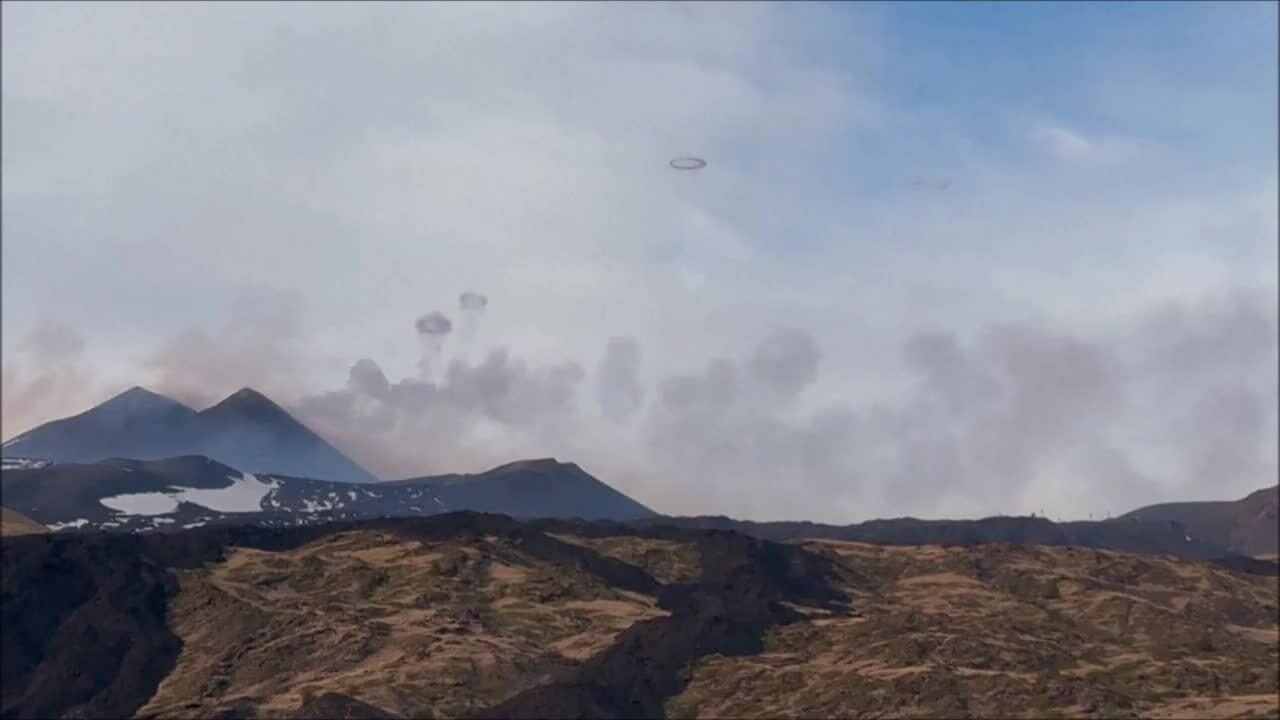
Mount Etna erupts in rings of steam. Video : Independent
Mount Etna, on the eastern coast of Sicily, Italy, is Europe's largest and most active volcano, and also the world's most active stratovolcano. On April 6th, the volcano attracted attention when it erupted, spewing white, ring-like plumes of smoke into the sky. Reports indicate that a new vent has opened, causing the white vapor to shoot up.
"No volcano on Earth produces as many rings of steam as Etna. We've known about this phenomenon for quite some time. But now it's breaking all previous records," said Boris Behncke, a volcanologist at the National Institute of Geophysics and Volcanology in Catania, Italy.
These circles are harmless and don't necessarily mean an eruption is imminent. They are actually called "volcanic rings," formed from volcanic gases and condensed water vapor, not smoke.
"They are colorless on their own, but when they reach the point of condensation, they turn white – that's what we're seeing. The reason the water vapor rises, condenses quickly, and forms these circles is the temperature difference," explains Ana Casas Ramos, a volcanologist at the Australian National University. Ramos says the escaping water vapor is very hot, and when it reaches the appropriate level in the atmosphere, it encounters cold air and condenses.
Volcanic vortices form in a similar way to a dolphin blowing out a ring of bubbles underwater or a smoker creating a ring of smoke; the gases slow down and curl up as they are pushed out, according to research by expert Simona Scollo from the National Institute of Geophysics and Volcanology of Catania and her colleagues last year. The formation of volcanic vortices is mainly due to the gases inside the volcano, but the shape of the crater is also a contributing factor.
"The research results show that volcanic vortices are formed by a combination of rapidly escaping gas from bubbles at the top of the magma duct and the balanced shape of the vent," the authors wrote in the study published in Scientific Reports .
Thu Thao (According to IFL Science )
Source link
![[Photo] Conference on the transfer and reception of Party organizations and Party members between the Party Committee of the Government and the Party Committees of the Central Party Agencies](https://vphoto.vietnam.vn/thumb/1200x675/vietnam/resource/IMAGE/2026/04/01/1775036784472_ndo_br_bnd-2620-jpg.webp)

![[Photo] Conference announcing the Politburo's Decision on organizational and personnel matters](https://vphoto.vietnam.vn/thumb/1200x675/vietnam/resource/IMAGE/2026/04/01/1775017881825_bnd-2410-1472-jpg.webp)





















































![[Photo] Prime Minister Pham Minh Chinh receives the Ambassador of the Russian Federation to Vietnam](https://vphoto.vietnam.vn/thumb/402x226/vietnam/resource/IMAGE/2026/04/01/1775046774818_anh-man-hinh-2026-04-01-luc-19-32-33.png)






















Comment (0)