At the beginning of the 19th century, Danish literature shifted completely towards Romanticism because the naval battle of 1801 during the war with England ignited nationalistic spirit, and a young philosopher introduced German Romanticism to Denmark.
Formation and maturation stages
The Middle Ages: From the 8th to the 10th centuries, the Nordic peoples in general, known as Vikings (meaning kings, seafaring warriors), migrated from the Scandinavian peninsula to the southern coast, roaming the seas, sometimes with hundreds of ships. They were pirates, traders, explorers , land conquerors, and even landed in the Americas. These adventures are reflected in the epic sagas of oral literature.
After the introduction of Christianity (9th-10th centuries), it wasn't until the 12th century that the historian Saxo Grammaticus recorded these stories in Latin in his Gesta Danorum, highlighting the courage, honesty, and simplicity of the Vikings.
Influenced by Christianity, a Latin-language literature developed, primarily serving religion (hymns, genealogies of saints) and the king (laws, chronicles). By the 16th-17th centuries, the Protestant Reformation introduced Christianity to Northern Europe, and religious literature flourished (hymns, folk songs), as did historical writing. Secular poetry, however, was impoverished.
In the 18th century, Denmark played the most important role in Northern Europe due to its wealth, fertile land, proximity to the European mainland, and a similar social system (feudal serfdom, which was almost nonexistent in Sweden and Norway), flourishing commerce and industry, and active citizens. Copenhagen was the largest capital (at that time the joint capital of Denmark and Norway after their merger).
During this period, the writer and playwright L. Holberg (1684-1754) was a typical representative of the Enlightenment movement in Northern Europe, the founder of Danish literature, and the founder of Danish comedy (influenced by French literature).
In the latter half of the 18th century, German literary influence became more prominent, especially due to the presence of the German poet Klopstock, who was favored by the court. As a result, Danish literature returned to its origins and the myths of the Nordic Germatic period. A typical example of that era was the great lyric poet J. Ewald (1743-1781), who wrote two plays.
Following a religious crisis, his poetry became more profound. In his opera *The Fisherman*, there is a melody used as the song of the Danish royal family. Towards the end of the century, a pre-Romantic tendency began to emerge (patriotism, fascination with nature).



At the beginning of the 19th century, Danish literature shifted completely towards Romanticism. The naval battle of 1801 during the war with England ignited nationalistic fervor, and a young philosopher introduced German Romanticism to Denmark. Literature returned to its roots, to ancient Norse mythology, to find themes for writing and to innovate its forms (imagery, rhythm of folk poetry).
The first Romantic generation: The pioneering author was A. Oehlenschlaeger (1779-1850) with his collection of poems, *The Golden Horns*, using the lyrical-epic "romancero" poetic form. His tragedies drew their themes from Norse mythology. His most famous work is the play *Aladdin's Lamp*, based on an Arabian fairy tale. During a visit to Sweden, he was hailed as "the king of the poets of the North".
Reverend N. Grundtvig (1783-1872) was the greatest religious poet of his time. He sought to combine Nordic tradition with Christianity, national spirit, and folklore. His hymns are still used today. He initiated the establishment of "popular schools" which were very influential in Northern Europe.
Reverend SS Blicher (1742-1848) held reformist ideas based on the Enlightenment philosophy. He wrote poetry and prose. His short stories depict the past and present of his hometown, Jutland.
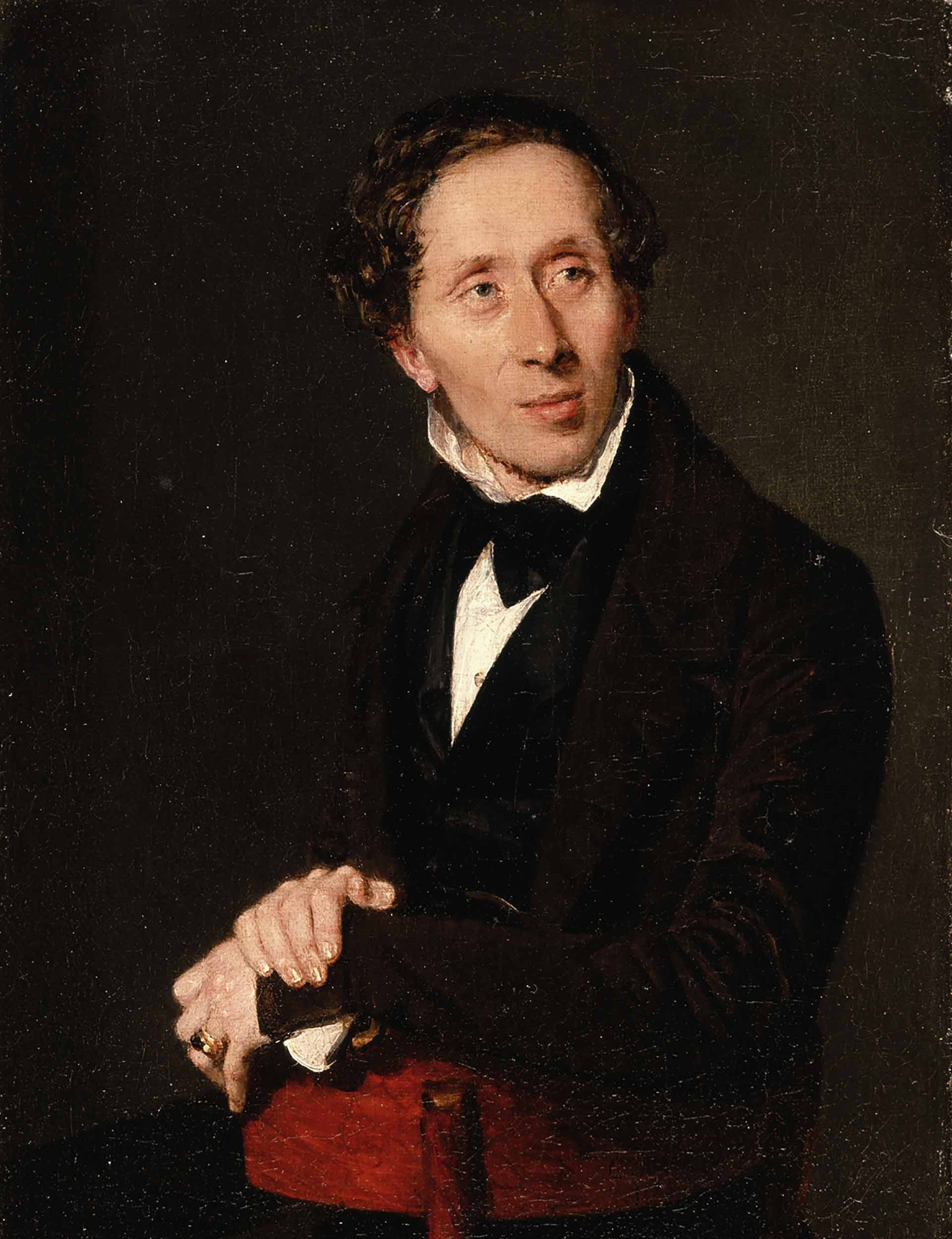 |
| The writer Hans Christian Andersen. |
The second Romantic generation: Following the impulsiveness of the first generation came the more tranquil period of the second. Bourgeois literature reached maturity, with certain distinctive features: an awareness of the intimate, dreamy sentiment, and politeness. The name of L. Heiberg, the playwright and critic, emerged.
Not only during that period, but even to this day, no Danish writer is as famous domestically or internationally as Hans Christian Andersen (1805-1875).
As of 1987, he was one of the world's most published authors. He embodies the most nationalistic aspects of the Danish people. His most famous work is the collection of children's stories, comprising over 164 stories.



He borrows plot elements from myths, fairy tales, folk stories, and history, while adding fictional elements based on everyday life. His stories have two dimensions: an immediately captivating aspect due to the dramatic plot, and a deeper, more profound aspect due to their delicate, poetic nature, revealing a compassionate, sensitive, and sometimes naive heart that still manages to win people's hearts.
His style blends poetry with reality, irony with sentiment, always featuring delightful and unexpected associations, and is fundamentally optimistic. This is an introduction to the English translation of *Andersen's Tales*, published in 1999 in the author's homeland – considered the most faithful adaptation of the original.
Professor E. Bredsdroff complained that translations of Andersen's works around the world often suffer from two shortcomings: firstly, they treat Andersen as an author for children, so the anthologies only select stories for children. Many stories with profound philosophical meanings that only adults can understand are omitted. Secondly, the translations sometimes fail to capture Andersen's style.
These two observations also apply to the Vietnamese translations, many of which were translated from the French version. I had the opportunity to compare three Vietnamese versions with the 1999 English edition (printed in Odense) and found that it is true that there is a lack of stories for adults, and the translations are primarily focused on Vietnamese adaptation, thus failing to capture Andersen's style. Worse still, sometimes the translators only aimed to make the story understandable, omitting difficult words, and in some places translating the meaning in reverse.
Source