


TOD (Transit-Oriented Development) – a model that uses public transportation system development as the basis for urban planning – will be the future of the real estate market.
TOD (Transit-Oriented Development) – a model that uses public transportation system development as the basis for urban planning – will be the future of the real estate market.
Infrastructure breakthroughs that increase the value and liquidity of TOD projects will boost the real estate market.
According to CBRE, Transit-Oriented Development (TOD), a model of urban development based on public transportation systems, has become a global trend. With rapid urbanization, numerous environmental challenges have emerged, leading countries to focus on Transit-Oriented Development (TOD) to reduce traffic congestion and ensure sustainable development.
The TOD model is not simply about investing in transportation systems, but also involves urban planning, aiming to optimize land use and build high-density urban areas around transportation hubs. Metro Vancouver, British Columbia, is an example where large-scale, integrated TOD projects, when combined sufficiently, create a "self-contained city"—a city within a city.
 |
| The TOD (Transit-Oriented Development) model is becoming a new trend in the real estate market. (Illustrative image) |
Stockholm, Sweden, is considered a successful example of the TOD (Transit-Oriented Development) model, having maximized its principles. Sustainable urban development revolves around public transport systems, with a high degree of integration between housing, commerce, and green spaces. The city has become one of the world's leading sustainable living areas, with reduced energy and water consumption, increased recycling rates, and improved quality of life.
Japan is also one of the leading countries in developing TOD (Transit-Oriented Development), emphasizing reducing reliance on private vehicles to alleviate congestion and protect the environment. Closer to Vietnam is Singapore, an example of an effective TOD model. This island nation has integrated urban transport development with spatial design and planning, creating a cluster of satellite urban areas surrounding a central core, with a railway network connecting these urban areas to industrial zones and the city center.
With its future potential, the TOD (Transit-Oriented Development) model has opened up many opportunities for businesses to invest in and build projects and urban areas. Among these, the trend of investing in real estate development based on infrastructure is not new, but it will be a driving force for Vietnamese real estate businesses. This is because breakthroughs in infrastructure are the springboard to increase the value and liquidity of TOD projects thanks to the developed transportation infrastructure network.
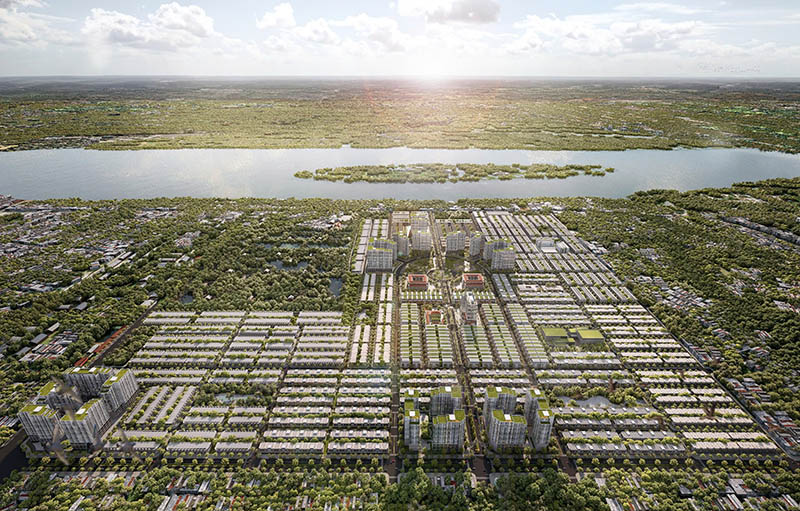 |
| The TOD model encourages Vietnamese real estate businesses to make breakthroughs in investing in large-scale projects and urban areas. |
The TOD (Transit-Oriented Development) model has encouraged real estate businesses to acquire land along roadsides and develop large-scale projects. Mr. Le Hoang Chau, Chairman of the Ho Chi Minh City Real Estate Association (HoREA), believes that effectively utilizing land along newly opened roads or at metro stations creates a transparent business environment in auctions, attracts investors, and allows the city to recoup its infrastructure investment, thereby reinvesting in other projects. This will lead to a market receiving more new supply from projects with clear legal status.
Mr. Chau believes that breakthroughs in infrastructure, which increase the value and liquidity of TOD projects, will be a driving force for the real estate market in the new growth phase. Observing the market, it can be seen that more and more large projects are being developed according to the TOD model. Major investors in Hanoi and Ho Chi Minh City, who previously promoted technology and green real estate, are now shifting their marketing to TOD as major transportation routes and metro lines continuously come into operation.
Along with the two major markets, projects in cities with strong infrastructure development are also viewing TOD (Transit-Oriented Development) as a growth driver for real estate. Can Tho City is a prime example of a city that has been given favorable conditions to apply the TOD model. Recently, the KITA Airport City urban area, developed by KITA Group using the TOD model, has centered around Can Tho International Airport and its transportation network connecting to localities in the Mekong Delta region, promising to create a modern residential community and a vibrant airport city in the near future.
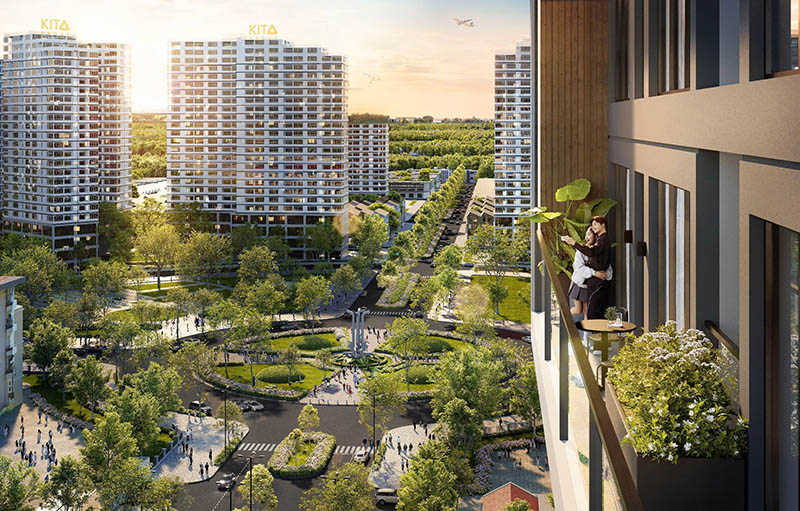 |
| KITA Airport City, developed by KITA Group, has successfully implemented the TOD (Transit-Oriented Development) model. |
According to KITA Group, the developer of KITA Airport City, the idea of developing this project using the TOD (Transit-Oriented Development) model is in line with the general trend in developed countries.
Located 3 km from Can Tho International Airport, the meticulously planned urban area covers over 150 hectares and includes various functional zones such as residential, commercial, cultural, entertainment, administrative, medical, and educational areas.
With Can Tho International Airport, a major transportation hub with a capacity of approximately 5 million passengers per year, as its foundation, and coupled with the strong development of Can Tho's transportation infrastructure in recent times, KITA Airport City is envisioned as a residential center, from which a connected and expanding transportation and urban system will be formed, benefiting Can Tho, the Mekong Delta, and Ho Chi Minh City.
Evaluating the TOD (Transit-Oriented Development) model, experts believe that it is both a solution for implementing modern urban planning and improving the quality of life for residents. Coupled with the metro system, a series of interconnected projects will enhance the area's stature, and the value of nearby real estate will establish a new price level. Existing projects along the route have also increased by 20-50% compared to their initial selling prices, with the potential for rapid price appreciation and benefits in transportation and commerce continuing to attract savvy investors.
Source: https://baodautu.vn/batdongsan/mo-hinh-tod-luc-day-cho-bat-dong-san-tang-toc-d232414.html








































































































Comment (0)