

If re-elected, Biden would seek to increase government spending to subsidize production and social welfare, but would remain skeptical of globalization.
Joe Biden's opponents focused on his age as a weakness during his 2020 presidential campaign. But paradoxically, upon becoming the occupant of the White House, the 81-year-old leader may have led the most dynamic American government in nearly half a century, according to The Economist.
Accordingly, he launched spending packages to reduce poverty and encourage industry in an attempt to reshape the world's largest economy . Naturally, there was much debate about the value these policies delivered. For example, the sharp increase in federal spending exacerbated the budgetary situation. Or the subsidies for companies investing in the U.S. angered allies.
But it's undeniable that many of these policies have had an effect. Just look at the boom in factory construction; investment in manufacturing has more than doubled under Biden, soaring to record highs.
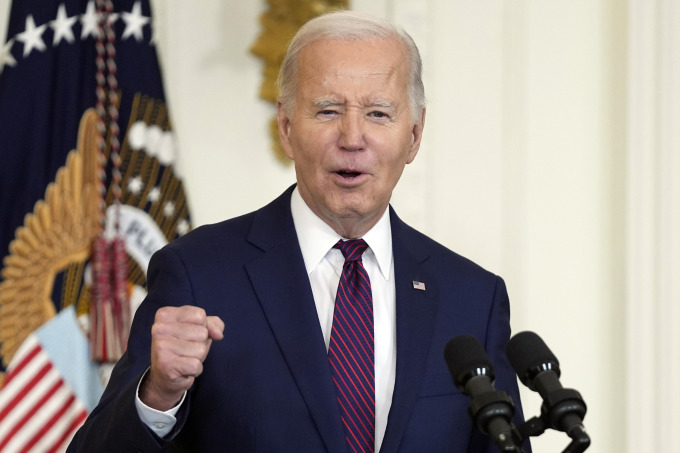
US President Joe Biden speaks at the White House on January 19. Photo: AP
Like any president, Biden's agenda has so far been limited by Congress . His $3.5 trillion "Build Back Better" bill is multifaceted, but its greatest success so far has been in the investment area, encompassing three sections of legislation focused on infrastructure, semiconductors, and green technology.
Accordingly, three laws were signed into law related to these issues, forming a $2 trillion effort to reshape the American economy. This was considered an effective presidential term, according to The Economist.
In this year's re-election campaign, Biden's motto is "We can get the job done," which sounds more like a contractor's pledge than political rhetoric. However, current and former advisors to the president argue that "Bidenomics" is akin to an American economic revolution. Where will this revolution lead if Biden continues to run for a second term?
There are two possible scenarios. First, if the Republican Party retains control of the House or Senate, or both, advisers say Biden's focus will be on protecting his legislative achievements. Republicans won't be able to overturn Biden's investment packages, but they can obstruct them.
For example, a nearly $200 billion funding package for research and development of cutting-edge technologies requires congressional approval before spending. To date, only $19 billion has been allocated to three federal research agencies, almost 30% less than planned, according to Matt Hourihan of the Federation of American Scientists.
Therefore, if Congress refuses to cooperate, the actual money spent will be further constrained. The investment that has been initiated over the past few years could then be reduced. Manufacturers will struggle to survive due to high input costs.
But Biden will have some leverage. Many of the large tax cuts passed during Donald Trump's administration are set to expire at the end of 2025. If Republicans want to extend them to avoid a surge in tax rates, they will likely have to negotiate with Biden, in exchange for supporting some of the president's priorities, including industrial subsidies, regardless of the budgetary impact.
But what happens if the Democrats control both houses? Biden could implement unfulfilled plans on his "Build Back Better" agenda, including free preschools, increased child and senior benefits, and other social welfare programs.
Treasury Secretary Janet Yellen described the agenda as "modern supply-side economics." She argued that investing in education would make workers more productive, while healthcare would free people, especially women, to work, leading to a larger workforce.
But it would also be very expensive, leading to at least $100 billion in additional spending each year, equivalent to adding half a percentage point to the federal deficit, which is expected to reach 7.5% of GDP in 2023. Implementation wouldn't be easy either. For example, funding for childcare would fuel demand, exacerbating staffing shortages.
Biden's desire to strengthen unions also presents an opportunity for consolidation. Last year, he became the first president to participate in protests, joining a strike by auto workers near Detroit. But beyond symbolic actions and words, his efforts to push through the Advocacy Act to promote collective bargaining and limit corporate interference in union decisions have been unsuccessful. Re-election and Democratic control of Congress would open up opportunities for him.
For his supporters, Biden's ambitious spending hikes, from childcare to semiconductor subsidies, would make America more equitable and boost industry. But for his opponents, it's the prospect of a government reverting to an outdated model focused on manufacturing and unions, which could strain relations with allies.
Furthermore, there are doubts about the direction of foreign economic policy. For example, the big question is whether the US and Europe can reach an agreement on critical minerals and cooperate to secure inputs for battery production and reduce dependence on China. To date, Biden remains skeptical about globalization. He recently paused approvals for liquefied natural gas exports and will almost certainly maintain a tough stance on China.
First and foremost, in order to continue managing the world's largest economy, Biden must convince the American people. As he prepared for the general election, he emphasized that people were beginning to feel better about the state of the economy. This will be a crucial issue for them in the November election.
"We've passed a lot of really good laws. It will take time for them to start taking effect, but now they're having an impact in turning the economy around," he said on January 25 at an event in Superior, Wisconsin.
However, overall, American voters still have a vague view of Biden's ability to manage the economy. A December Wall Street Journal poll showed that "Bidenomics" was approved by less than 30% of voters and more than half disapproved.
Historical experience also works against him, from an economic perspective. The research journal *The Conversation* points out that when Americans are confident about the economy, they tend to support the incumbent president. Conversely, they will vote for someone else if they are pessimistic.
Over the past 45 years, from January 1978 to December 2023, consumer confidence has risen rapidly, as it did under Republican Ronald Reagan in the 1980s and again under Democratic Bill Clinton in the 1990s. Simultaneously, the incumbent president's approval rating also increased.
Conversely, confidence hit its lowest point in 2008 after the financial crisis, when George W. Bush was in the White House. Approval ratings declined when Barack Obama was elected president that year. For Biden, a Gallup poll released in December 2023 showed 22% of consumers satisfied and 77% dissatisfied with the state of the nation.
According to The Conversation, the US economy is growing better than expected, but GDP figures can feel vague and detached from reality for the average person. So far, economic indicators have shown an increase in the run-up to the November election, but this has not had a positive impact on Biden. "While the US economy is doing well, voters don't necessarily feel that in their pockets," the magazine noted.
Phiên An ( according to Economist, ABC, and The Conversation )
Source link




































































































Comment (0)