Consistently implementing the ethnic policy of "Equality, solidarity, mutual assistance, and shared development," the Party and State always consider education and training as a top national priority; it is a fundamental condition for ensuring the achievement of socio- economic goals, national construction and defense in general, and in ethnic minority and mountainous regions in particular.
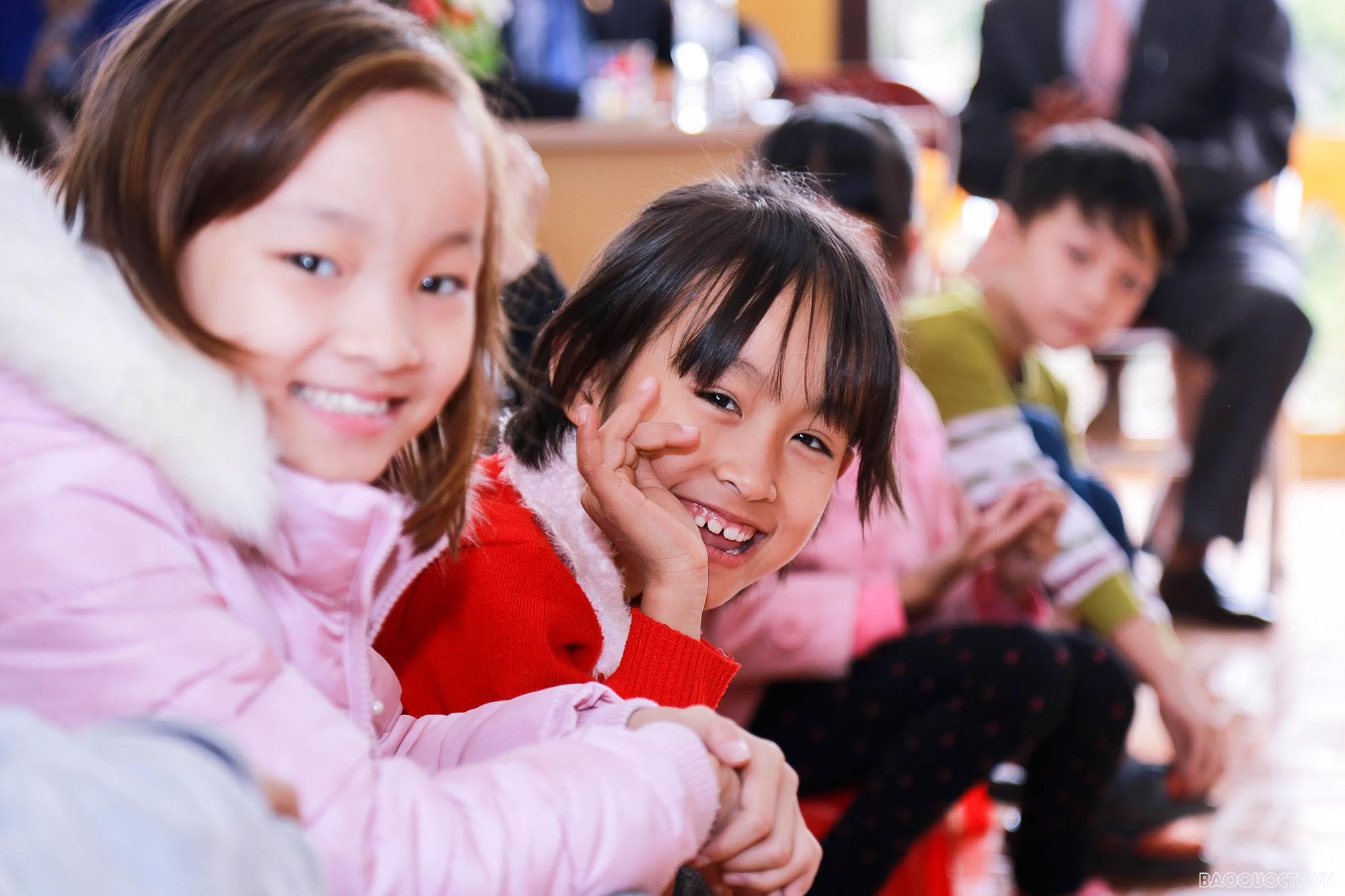 |
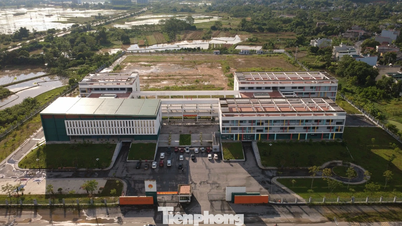
| The school attendance rate for students from ethnic minority and mountainous regions is steadily increasing. (Photo: Nguyen Hong) |
Institutionalizing the guidelines and policies of the Party and the State.
Since the Doi Moi (Renovation) period, the Party and the State have always paid attention to and cared for the cause of education and training, creating conditions for education and training to lead the way and lay a solid foundation to effectively serve the socio-economic development in ethnic minority and mountainous regions.
Conclusion No. 65/KL-TW dated October 30, 2019, of the XII Politburo clearly states: “Improve the quality of education and training in ethnic minority and mountainous areas. Maintain and promote the achievements of eradicating illiteracy, universalizing preschool education for 5-year-old children, and universalizing primary and lower secondary education. Improve the quality and expand the system of ethnic boarding and semi-boarding schools; support food and accommodation for students in particularly difficult areas. Innovate the admission method towards a system of selective admission, pre-university programs, and vocational training for ethnic minorities; establish mechanisms to care for the lives of teachers and education management staff working in ethnic minority and mountainous areas.”
The 13th National Congress of the Party continued to emphasize "Paying due attention to the development of education in mountainous areas, highlands, islands, and areas inhabited by ethnic minorities... Having specific investment policies for disadvantaged areas and areas inhabited by ethnic minorities."
Through each Party Congress, building upon the theoretical and practical achievements, the Party's documents on education and training have increasingly focused on regional characteristics in proposing policies, closely adhering to the realities of educational development to formulate appropriate and effective decisions that are feasible in implementation. To date, the system of legal documents has become increasingly comprehensive, creating a legal basis to promote the development of education and training in ethnic minority and mountainous regions.
Specifically, Article 61 of the 2013 Constitution stipulates that "The State prioritizes the development of education in mountainous areas, islands, areas inhabited by ethnic minorities, and areas with particularly difficult socio-economic conditions."
The 2005 Education Law and the 2009 Law amending and supplementing certain articles of the Education Law contain several provisions stipulating policies to support and invest in the development of education in ethnic minority and mountainous regions, and areas with particularly difficult socio-economic conditions.
The government has issued 42 legal documents on education for ethnic minorities and mountainous areas, or related to education for ethnic minorities and mountainous areas, such as: Government Decree No. 116/2016/ND-CP dated July 18, 2016, "Regulations on policies to support students and schools in particularly difficult communes and villages"; Decision No. 159/2002/QD-TTg dated November 15, 2002, on "Implementing the Program for the Solidification of Preschool and Primary Schools"; Prime Minister's Decision No. 1719/QD-TTg approving the National Target Program for socio-economic development in ethnic minority and mountainous areas for the period 2021-2030, which includes the implementation of Project 5 on the development of education and training to improve the quality of human resources...
Gradually affirming the quality of education and training.
With the aforementioned policies and guidelines, education and training in ethnic minority areas have achieved significant results from preschool to high school, meeting the learning needs of children from ethnic minority communities and strengthening the ranks of ethnic minority officials and civil servants.
The education system, from preschool to high school, has been strengthened and developed. According to the results of the 2019 Survey of 53 Ethnic Minorities, the whole country has nearly 21,600 schools and 26,500 school branches in ethnic minority areas. The percentage of solidly built schools and school branches is gradually increasing at all levels of education, from preschool to high school.

![[INFOGRAPHICS] Focus of Development in Ethnic Minority Regions 2026-2030](https://vphoto.vietnam.vn/thumb/192x108/vietnam/resource/IMAGE/2026/06/21/1782048151300_1782047943.webp)

The political system at all levels has focused on directing the construction of preschools, the first level in the national education system, laying the foundation for the physical, emotional, social, and aesthetic development of children in ethnic minority areas, with a total of 6,400 schools and nearly 10,900 school branches. The lower secondary level has 4,100 schools and 646 school branches. The upper secondary school system has 884 schools and 64 school branches.
The system of ethnic minority boarding schools comprises 314 schools and semi-boarding schools comprises 1,097 schools, with over 93% of schools having solid structures. Notably, 15 ethnic minority boarding schools in border communes have achieved 100% solid school and classroom construction, contributing to increased schooling opportunities for children and improving the quality of education in ethnic minority areas.
The number and quality of teachers from ethnic minority groups have increased. According to the General Statistics Office, there are approximately 525,000 teachers currently teaching in schools and school branches in ethnic minority areas, with more than a quarter being ethnic minority teachers and nearly a fifth being female ethnic minority teachers.
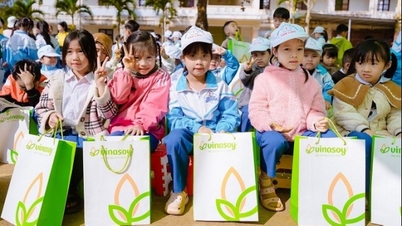
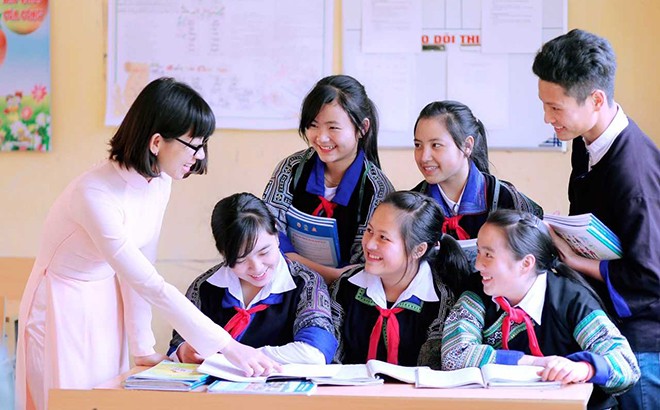 |
| To ensure that students in ethnic minority and mountainous regions can attend school with sparkling happiness. (Source: chinhphu.vn) |
Teachers and education administrators enjoy many preferential policies, including: preferential allowances, attraction allowances, seniority allowances exceeding the standard rate, relocation allowances, study allowances, and professional development allowances. Programs teaching ethnic languages to ethnic minority students are beginning to receive attention in order to preserve and protect the spoken and written languages of ethnic minorities.
In 23 provinces and cities with large ethnic minority populations, teaching and learning of eight ethnic minority languages is being implemented, including: Hmong, Cham, Khmer, Gia Rai, Bana, Ede, Mnong, and Thai. The Ministry of Education and Training has compiled several textbooks for teaching ethnic minority scripts such as Khmer, Hmong, Mnong, Bana, Ede, Cham, and Hoa...
The student enrollment rate is increasing, and the quality of education is gradually improving. The literacy rate of ethnic minorities aged 15 and above in the common script is 80.9%. Ethnic minorities with high literacy rates in the common script include the Ngai (96.5%), San Diu (95.7), Muong (95.5%), Tay (94.9%), Tho (94.9%), Hoa (91.0%), and Nung (90.0%).
In addition, policies for students from areas with particularly difficult socio-economic conditions are being implemented effectively.
According to statistics from the Committee for Ethnic Minorities, there are currently 5 preparatory university training schools nationwide that have facilitated the selection of children from ethnic minority groups to study at universities, colleges, and vocational schools.
The schools have performed well in training high-quality human resources for ethnic minority areas; over 50% of their students pass entrance exams to universities and colleges; 5% attend government-sponsored programs; 13% attend pre-university programs; 20% attend vocational schools and training centers; the remaining few participate in local work and production; 51 out of 53 ethnic minority groups have students who have been sponsored to attend university; ethnic minority students in particularly difficult areas receive support for food, accommodation, and tuition fees, so the proportion of ethnic minority cadres, civil servants, and public employees is increasing, better meeting the human resource needs for socio-economic development in the localities.
Thanks to the effective implementation of the Party and State's policies on education, training, attracting, recruiting, and employing ethnic minority cadres, the number and quality of ethnic minority cadres have steadily increased, with nearly 70,000 ethnic minority personnel, accounting for 11.68% of the national total.
According to the monitoring report of the National Assembly's Ethnic Affairs Committee at ministries, sectors, and 36 localities, the number of ethnic minority officials and civil servants who received professional training was 17,598 (out of 374,263 nationwide), accounting for 4.7%; political theory training: 14,381 (out of 476,225 nationwide), accounting for 3%; state management training: 7,368 (out of 77,927 nationwide), accounting for 9.45%; professional skills training: 35,457 (out of 415,867 nationwide), accounting for 8.52%; other training and professional development: 36,648 (out of 219,940 nationwide), accounting for 16.67%. "Overseas training: 99 people (nationwide 2,989 people), accounting for 3.3%", has contributed to promoting political, economic and social development, maintaining security and order in ethnic minority areas nationwide, and creating a foundation for achieving equality among ethnic groups.
| Ethnic minority and mountainous regions occupy three-quarters of the country's natural area, characterized by vast territories, fragmented terrain, steep slopes, harsh climates, and difficult transportation. Ethnic minorities account for 14.6% of the country's population, with dispersed populations and challenging living conditions. These natural, economic, and social challenges significantly impact the development of education and training. |
Investing educational resources in a way that is appropriate to the local context.

To improve the quality of education and training in ethnic minority areas, in the coming period, all levels and sectors need to focus on the following solutions:
Firstly , increase investment in education and training development; ensure synchronized coordination between policy and policy implementation, and between the education and training activities of relevant ministries and sectors.
Secondly , we need to improve policies for training ethnic minority teachers with both pedagogical and knowledge-based skills for each region and ethnic group. We must develop a system of incentives and employment for teachers and education administrators that is appropriate to practical needs, ensuring their job security and commitment to their local communities. Simultaneously, we need to strengthen the training of teachers teaching ethnic minority languages; innovate professional development activities, focusing on cluster, group, and team-based professional development, both in-person and online.
Thirdly , reform education policies at all levels, expand the teaching and learning of ethnic minority languages in general schools; innovate and improve the effectiveness of scholarship policies for ethnic minority children to study at universities, colleges, and vocational schools; expand preparatory university programs for ethnic minorities; and develop appropriate support policies for ethnic minority students at each educational level, prioritizing those in particularly disadvantaged areas.
Fourth , diversify and rapidly develop training, professional development, and vocational education in ethnic minority areas; prioritize on-the-job training; introduce vocational training programs into ethnic boarding schools; develop vocational school models linked to businesses that are suitable to the socio-economic development requirements of the locality, with priority given to training children of ethnic minorities and mountainous regions. Increase the scale of school enrollment in remote areas and ethnic minority regions, as well as research and develop models of ethnic boarding schools and semi-boarding schools suitable to the socio-economic development conditions of provinces in ethnic minority and mountainous regions.
Fifthly , continue to review and replan the network of educational and training facilities, implement the consolidation and standardization of school facilities at all levels, especially prioritizing investment in building new schools for communes without preschools; focus on investing in facilities for scattered school locations; prioritize the allocation of recurrent expenditure, investment funds and support programs and projects for provinces that frequently suffer heavy damage from natural disasters.
Source: https://baoquocte.vn/doi-moi-nang-cao-chat-luong-giao-duc-vung-dan-toc-thieu-so-293855.html