

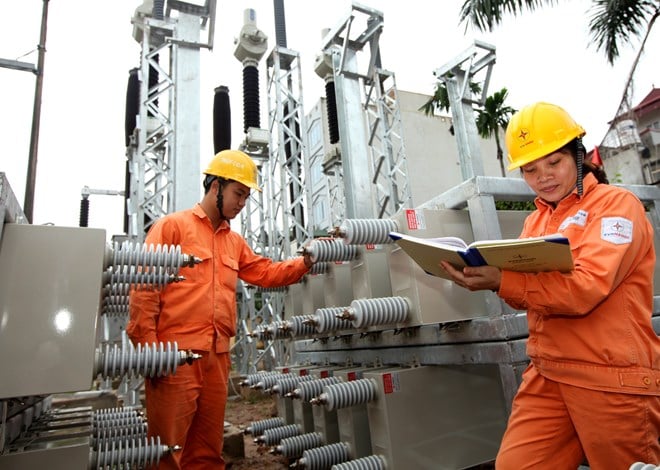
Clarifying EVN's losses in 2023
This is one of the points highlighted by the Supervisory Delegation in its report recently submitted to the National Assembly Standing Committee on "The implementation of policies and laws on energy development in the period 2016-2021".
According to the monitoring team, the retail electricity price was last adjusted on May 4, 2023, after more than four years, while input fuel prices have increased many times.
Since the end of 2021, the price of imported coal has increased and by mid-2022 had exceeded $160 per ton. Although domestic coal sold to the power sector is subject to price controls preventing price increases, to ensure the quantity and quality for each type of power plant, it must be mixed with imported coal and its price is subject to a proportional increase based on the proportion of imported coal.
Coal-fired power accounted for 39% of the national electricity production in 2022. The purchase price of wind and solar power was also higher than the average retail price. Gas-fired power prices also increased somewhat, although they remained lower than international prices. Therefore, while the Vietnam Electricity Group (EVN) had to purchase inputs at market prices, its output remained stable and did not increase since 2019, resulting in significant losses for EVN exceeding 26 trillion VND in 2022.
In 2023, fuel prices decreased compared to previous periods; however, EVN still incurred losses of nearly 29,000 billion VND in the first eight months of 2023. The National Assembly Standing Committee's energy monitoring delegation believes that it is necessary to continue strengthening supervision, auditing, inspection, investigation, and concluding and resolving outstanding cases.
Specifically, in 2023, the cause of the losses incurred by state-owned energy corporations and companies in the recent past (including EVN, which lost nearly 29,000 billion VND) was clarified.
Research, propose, or decide, within their authority, on solutions to definitively address and prevent financial risks and imbalances.
Simultaneously, strengthen the responsibility and coordination of activities among ministries managing the sector, localities, and investors to address shortcomings in the implementation of policies and laws on energy development, focusing on land clearance and conversion of forest land for transmission and distribution grid projects.
Adjust retail electricity prices to reflect actual fluctuations.
The supervisory delegation also recommended timely adjustments to retail electricity prices in accordance with actual fluctuations in input parameters, raw material and fuel prices, exchange rates, and the electricity market, ensuring macroeconomic stability and social welfare.
At the same time, it helps to offset costs and achieve reasonable profits to preserve the business capital of enterprises, ensuring transparent electricity pricing for inspection and control.
The law should be enacted soon to regulate retail electricity prices in the spirit of "removing all barriers to ensure transparent energy prices determined by the market," eliminating cross-subsidization of electricity prices between customer groups and regions, shortening the time between electricity price adjustments; and managing retail electricity prices flexibly, closely following market developments.
Regarding EVN's loss of nearly 29,000 billion VND in the first eight months of 2023, Mr. Nguyen Xuan Nam, Deputy General Director of EVN, stated that the corporation has been assigned many tasks and objectives by the Party, Government , and State, beyond just economic goals. The most fundamental task is to ensure sufficient electricity supply for the country and for economic development.
EVN is also striving to provide electricity to remote, mountainous, and island areas. When investing in this activity, the selling price of electricity could reach 7,000 VND/kWh; however, currently EVN sells it at a price of only 1,900 VND/kWh.
"This is an example of the current situation that EVN is facing. Because serving the lives of the people is the top priority, fulfilling the tasks assigned by the Party and the State, EVN accepts selling at a much lower price than buying at a lower price," Mr. Nam said.
EVN leaders further informed that 2022 was a very difficult year for the corporation due to geopolitical instability around the world. When the Russia-Ukraine war broke out, the prices of input materials for electricity production such as coal, gas, oil, etc., increased dramatically.
At one point, coal prices increased fivefold, reaching $400 per ton. Oil prices also doubled. This led to higher electricity production costs, pushing up electricity purchase prices and causing financial difficulties for EVN. By 2023, prices had cooled down but remained high.
"Although electricity prices have been increased by 3%, it only solves part of the problem," Mr. Nam said.
Source
























































































Comment (0)