

Determined that education was the only way to escape poverty, Kieu Trinh graduated with honors from university in Taiwan and won a full scholarship to pursue a doctorate in Germany.
Dinh Kieu Trinh is currently a member of the doctoral research program at the German Cancer Research Center, Germany's largest cancer research institute, located in Heidelberg. In 2021, Trinh won a four-year full scholarship worth 4 billion VND from this institute, allowing her to study concurrently at Heidelberg University. This is Germany's oldest university, ranked 47th in the world , according to THE 2024 rankings.
Outside of school hours, she and her colleagues Research on the immune function of Yes-Associate Protein (YAP) in tumor microenvironment components, particularly in cancer cells, fibroblasts, and endothelial cells.
"I didn't think I'd come this far. I used to dislike Biology," said Trinh, 29.
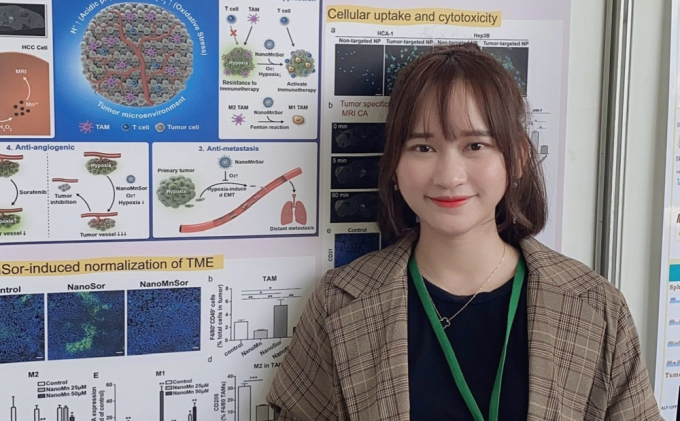
Trinh attended a scientific conference in Taiwan in 2020. Photo: Provided by the subject.
During high school, Trinh focused only on the science subjects (Mathematics, Physics, Chemistry) to get into her dream economics major. Having already mastered Math and Chemistry, Trinh took the biology exam in the science group (Biology) at the University of Science, Ho Chi Minh City, as a backup. Ultimately, she failed the science group but got accepted into the science group.
Trinh was accepted into university but was worried because she lacked knowledge of Biology. She recounted that her first year was "very boring" because she only studied theory; her grades in Math, Physics, and Chemistry were always high, while her Biology grades were only 5 or 6.
"I was thinking of retaking the entrance exam for Economics, but then I realized I needed to study, and I was too lazy, so I gave up," Trinh shared.
In her second year of practical training, Trinh became curious, found it interesting, and asked to join the department's laboratory to help out. At first, she helped the seniors wash bottles and observed them conducting experiments. Gradually, she developed a greater interest in research, so she strived to study well and work diligently in the laboratory.
Born into a large family, Trinh witnessed her parents' hard work farming and repairing bicycles to earn money for their children's education. Wanting to escape poverty and repay her parents' kindness, she vowed that the only way was through education. Thinking that a degree in Biology in Vietnam would be difficult to find a high-paying job in, Trinh sought scholarships to study abroad. In 2014, Trinh won a full scholarship for Biomedical Engineering at National Tsing Hua University (Taiwan).
Trinh said that studying for a master's degree required balancing her schoolwork with laboratory work. To avoid being overwhelmed, she reviewed her lessons immediately after each class. During exam periods, she often stayed up studying until 2-3 am. Thanks to her diligence, Trinh achieved a score of 96/100 on her graduation thesis.
During her two years of master's studies, Trinh published five scientific papers on liver cancer treatments in Q1 journals, including one as a co-lead author. The paper, published in the ACS Applied Materials & Interfaces journal, had an impact factor (IF) of 10.3 and discussed a nanoparticle called NanoMnSor that targets tumors, simultaneously transporting sorafenib and oxygen-producing MnO2-. Treatment with NanoMnSor resulted in reduced angiogenesis, decreased tumor size and metastasis, and improved survival in a mouse cancer model.
NanoMnSor also reprograms immunity within the tumor microenvironment, such as increasing the number of cytotoxic T cells (CD8+ T cells), resulting in increased efficacy of anti-PD-1 immunotherapy.
With her research achievements, conference experience, and near-perfect GPA of 4.24/4.3, Trinh successfully passed the application screening for a scholarship at the German Cancer Research Institute. After three rounds of interviews with the institute and an entrance exam at Heidelberg University, she became the sole candidate to join the research group of Dr. Michael Dill, a senior physician in gastroenterology, infectious diseases, and toxicology at Heidelberg University Hospital.
Even so, when Trinh went to Germany, she was still shocked by the completely different research direction. She also faced the most difficulty in getting used to the cutting-edge research techniques in the laboratory.
In Taiwan, she only cultured cells on the surface of the plate, in a two-dimensional (2D) space, while in Germany, the technique was more advanced with 3D cultivation, preserving the inherent structural and functional characteristics.
"Raising 3D animals is much more difficult, so I had to learn everything myself, and if I made a mistake, I had to start over," Trinh said.
Trinh was the first doctoral student under her supervisor at the institute, so initially, she felt pressured by his expectations. After about six months, she became accustomed to the research environment and adapted to the culture there.
Trinh said that in Germany, graduate students have to present their research to a committee every six months to a year. Trinh's research topic was about the function of a protein in fibroblast cells affecting the tumor environment. At the second presentation, the report was evaluated by the thesis advisory committee as "very logical, with professional diagrams and charts."
In their comments, Dr. Michael Dill and three other professors on the panel wrote: "The presentation was clear. The research process showed significant progress, great potential, and many more promising results. There was a willingness to embrace new ideas and learn."
Trinh plans to go to the US to pursue postdoctoral studies, trying her luck at prestigious universities like Harvard. She also wants to become a professor, pursuing a career in teaching and research in the future.
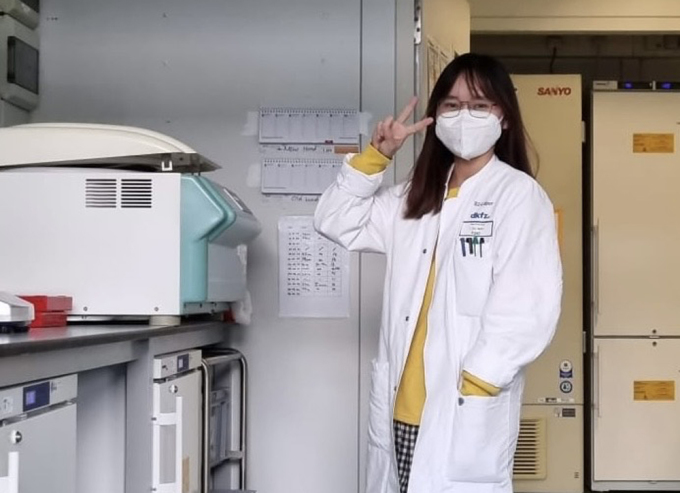
Trinh works at the laboratory of the German Cancer Research Institute. Photo: Provided by the subject.
Trinh said that Biology came to her by chance, and on her journey of discovery, she was fortunate to meet dedicated teachers and mentors. After achieving success in her career, Trinh returned to help Vietnamese students find scholarships to study abroad.
"There are many paths to having better life experiences, but for me, the path of learning is the shortest. Strive to gain experience in the lab, publish articles in scientific journals, and attend many conferences to increase your advantage in applying for scholarships," Trinh said.
Dawn
Source link
































































































Comment (0)