

From a terrorist attack that was… broadcast live on television.
Ecuador's national police chief, César Zapata, said officers regained control of the TC television station in the coastal city of Guayaquil, arresting 13 people and seizing weapons, including grenades, on Tuesday afternoon. Zapata said the attackers appeared to be members of Los Tiguerones, a drug cartel that has emerged from the Esmeraldas province on the border with Colombia.

Screenshot showing masked men pointing guns at the heads of Ecuador's TC television station employees last Tuesday (January 9) - Photo: CNN
During the 15-minute live-streamed attack, masked terrorists, brandishing submachine guns, aggressively kicked the station staff huddled on the floor. Then everyone screamed when they heard what sounded like gunshots in the background.
“Tell the viewers we have bombs,” one of the terrorists yelled at the station staff, holding something that looked like a grenade. Another gunman held what appeared to be a stick of dynamite in front of the television cameras.
"Don't shoot!" a woman screams in a video shared on social media. In another video, terrified station staff plead with the country's new president to order police to leave as gunmen point their weapons at them.
The television signal was then cut off. The raid by special police forces, as César Zapata stated, rescued the hostages and arrested 13 suspects. According to information from TC television, fortunately no one was killed and only two station employees were injured.
TC television has resumed normal operations. But out on the streets, on the notoriously dangerous roads of the port city of Guayaquil, violence has not subsided. In retaliation by gangs, at least eight people have died and two others have been injured in the violence in Guayaquil as of Tuesday afternoon (January 9), according to Mayor Aquiles Álvarez, who held a press conference with the police chief.
The situation escalated to widespread violence.
Violence didn't just erupt in Guayaquil. Explosions, car fires, looting, and gunfights were reported throughout Ecuador. The population was panicked and terrified. Shops, schools, government offices, and buildings were closed. Workers were given time off, and the streets of Quito and Guayaquil were gridlocked as people just wanted to get home quickly to avoid endangering their lives.
After Ecuadorian authorities announced on Sunday that Adolfo Macias, also known as Fito, the leader of the country's second-largest gang, Los Choneros, had escaped from a prison where he was serving a 34-year sentence, violence erupted at at least six other prisons across Ecuador, with at least 150 guards and other staff members taken hostage by inmates.
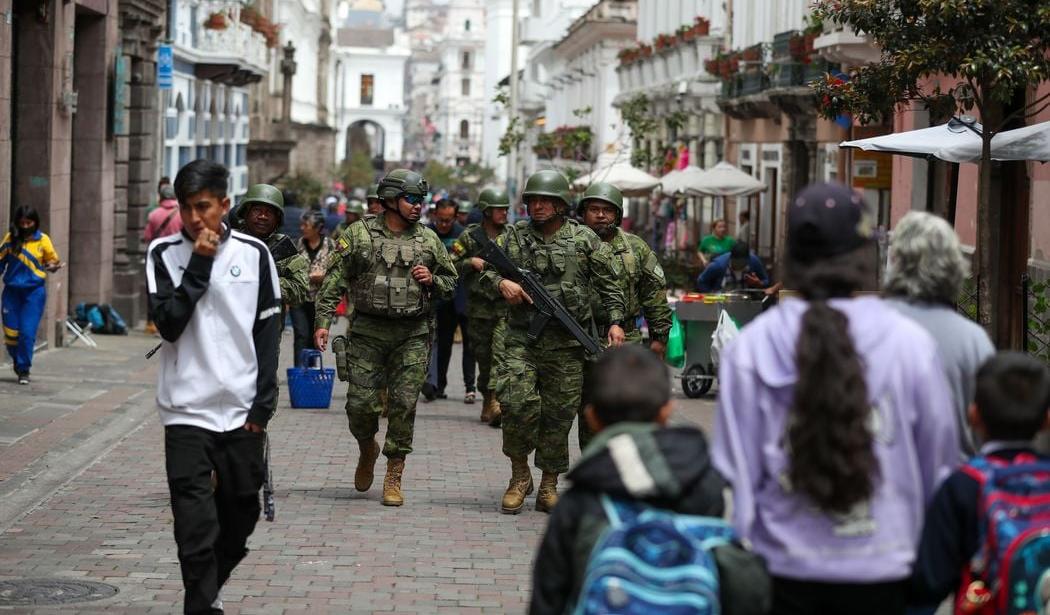
By Tuesday, violence had spilled into the streets, with seven police officers kidnapped in gang attacks across the country and five explosions confirmed in several cities, although there were no reports of injuries.
In the capital Quito, an explosion occurred outside the home of the Chief Justice of the Supreme Court, while explosions also occurred in the Andean province of Cuenca. In the city of Guayaquil, videos posted on social media showed university students hiding in classrooms as gang members opened fire on campus.
“Talk or war,” a gangster says in the video. “We’ll start killing police, jailers, and civil servants.” Another video shared by gang members on Tuesday via WhatsApp shows dozens of jailers kneeling on the floor with hooded men pointing knives and guns at them.
Another gang member declared war on the authorities. “You’ve turned the prison into a battlefield,” the hooded gunman shouted. “You’re the ones who started this bloody war.”
Why is security in Ecuador so terrible?
Amid the violence, Ecuador's new president, Daniel Noboa, declared on Tuesday that the country was in armed conflict and ordered police and the military to "neutralize" two dozen mafia gangs that he described as "terrorist organizations."
Noboa's statement also means the Ecuadorian government will extend the nationwide curfew to 60 days and allow the military to patrol the streets and oversee prisons.
The Ecuadorian government reported that deaths due to violence nationwide rose to 8,008 in 2023, nearly double the more than 4,500 recorded in 2022. Meanwhile, according to the Spanish newspaper El Pais, as of October last year, gang violence in Ecuador had resulted in 6,348 murders, a rate of 34.8 per 100,000 inhabitants, the third highest in Latin America.
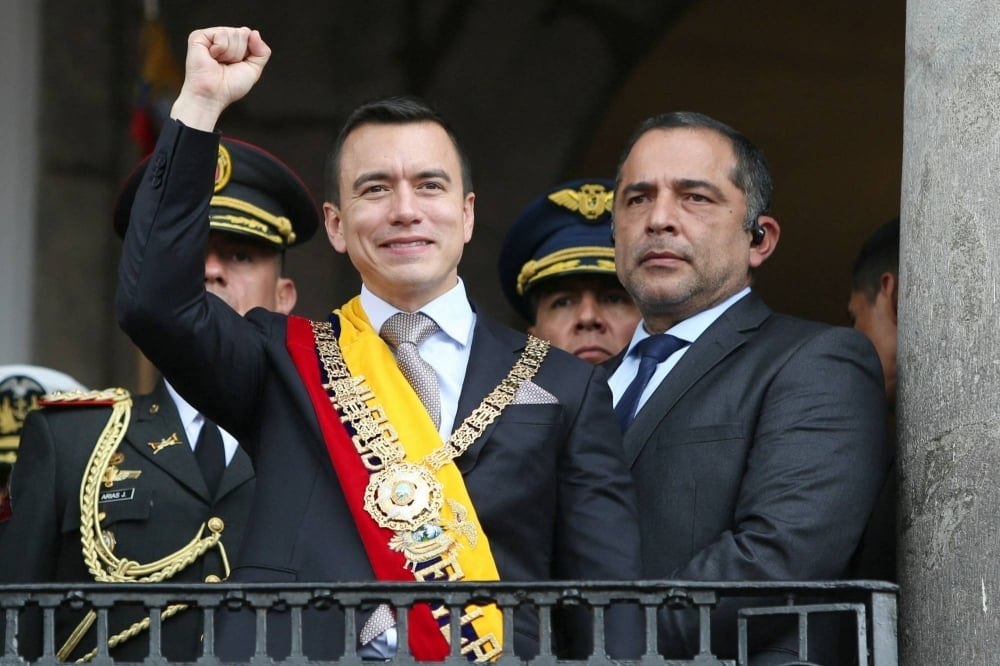
Ecuador's new president, Daniel Noboa, is determined to restore order to the country. - Photo: GI
It's not just ordinary citizens who are becoming victims. Last year's Ecuadorian presidential election was marred by the assassination in August of Fernando Villavicencio, a candidate known for his anti-corruption stance and strong crime-fighting views. And wealthy businesspeople aren't safe either. They've been targeted in nearly 200 kidnapping and extortion cases in Ecuador in the first half of 2023 alone.
Security in Ecuador is deteriorating, transforming the once peaceful nation into one of the most feared places in Latin America. The Ecuadorian government blames this situation on the growing expansion of cocaine trafficking gangs, who have partnered with notorious Mexican and Colombian cartels to act as "logistics" for drug routes from South America to North America and Europe. Ecuador's seaports, particularly Guayaquil, have thus become unprecedentedly busy gateways for cocaine trafficking.
This lucrative business was divided among more than 20 criminal gangs across Ecuador, armed to a level comparable to the police and extremely brutal. Where there's business, there's competition. These gangs, in addition to establishing their own local territories, also sought to expand their influence and frequently engaged in shootouts and assassinations against each other.
Once in prison, criminals create their own world and rules. They exploit the poor management and corruption of many guards to control the prison. Prison violence is increasingly common, resulting in hundreds of deaths in inmate gang wars.
After taking office in November, President Noboa launched a program called "Phoenix Plan" to strengthen security and order, including a new intelligence unit, more weapons for the police, the construction of new, more heavily guarded prisons, and increased security at seaports and airports.
According to observers, weapons and prisons only address half the problem. The human factor is the decisive element leading to widespread violence in Ecuador, and that is the key issue that needs to be resolved.
President Noboa himself understands this well. The 36-year-old president is launching a strong crackdown to clean up the government apparatus. Most recently and notably, this includes the arrest of 29 suspects on December 15th, including the President of the Ecuadorian Judicial Council, Wilman Teran, along with many prison officials, lawyers, police officers, and judges, on suspicion of involvement in a drug trafficking ring.
Ecuador's Justice Minister, Diana Salazar, declared this campaign the first step in an effort to eradicate what she called "political drugs" in Ecuador. In response to this government determination, however, gangs reacted violently and brutally, such as their storming of the TC television station last Tuesday.
Nguyen Khanh
Source
![[Photo] General Secretary and President To Lam presides over a meeting with the Central Organizing Committee.](https://vphoto.vietnam.vn/thumb/1200x675/vietnam/resource/IMAGE/2026/06/03/1780482764658_a1-bnd-4741-3342-jpg.webp)

![[Photo] Secretary of the National Assembly Party Committee, Chairman of the National Assembly presides over the meeting of the Standing Committee and Executive Committee of the National Assembly Party Committee.](https://vphoto.vietnam.vn/thumb/1200x675/vietnam/resource/IMAGE/2026/06/03/1780480353201_ndo_br_bnd-2585-jpg.webp)
![[Photo] First session of the 14th Congress of the Vietnam Trade Union](https://vphoto.vietnam.vn/thumb/1200x675/vietnam/resource/IMAGE/2026/06/03/1780465947883_ndo_br_img-3852-jpg.webp)
















































![[Video] Sunset at Lap An Lagoon – Where the sun sets over the fishing nets](https://vphoto.vietnam.vn/thumb/1200x675/vietnam/resource/IMAGE/2026/05/31/1780192137701_beach-landscape-sea-water-nature-grass-745871-pxhere-com.jpeg)





































Comment (0)