

One of the must-see landmarks when talking about Hanoi is the One Pillar Pagoda. This ancient pagoda, built with impressive architecture, is a popular tourist attraction for many visitors when they have the opportunity to visit the capital city of Hanoi.
One Pillar Pagoda, also known as Mật Pagoda, Diên Hựu Pagoda, or Liên Hoa Đài, is a uniquely designed temple built during the reign of King Lý Thái Tông in 1049.
Legend has it that King Ly Thai Tong dreamt of the Bodhisattva Avalokiteshvara meditating on a radiant lotus throne, and that she reached out and led him onto the throne. Upon waking, the king immediately ordered the construction of the One Pillar Pagoda according to what he had seen in his dream.
The temple was built with a unique single-pillar structure. Its architectural form resembles a lotus flower rising from the Linh Chieu lake. It is a creative combination of various art forms, from sculpture and carving to painting. The water's surface is also a beautiful feature, a mirror reflecting and illuminating the temple above.
The One Pillar Pagoda is built in a square shape. Each side of the pagoda measures 3 meters. At the base is a 4-meter-high, 1.2-meter-diameter stone pillar made of two interconnected blocks. Eight wide wooden wings on top of the pillar resemble a blooming lotus flower. Above the pagoda's roof is a flaming moon, flanked by dragon heads. The pagoda has four roofs with four curved eaves and embossed dragon heads.
To offer prayers on the temple floor, visitors must climb 13 steps. Inside the temple is a statue of the Goddess of Mercy (Quan Am) seated on a lotus pedestal, painted in red and gold. Having witnessed many historical changes throughout various dynasties, the temple has undergone numerous renovations and repairs. Today, its architecture has also changed from its original form. The One Pillar Pagoda was recognized by the Asian Record Organization as having the most unique architecture in 2012.
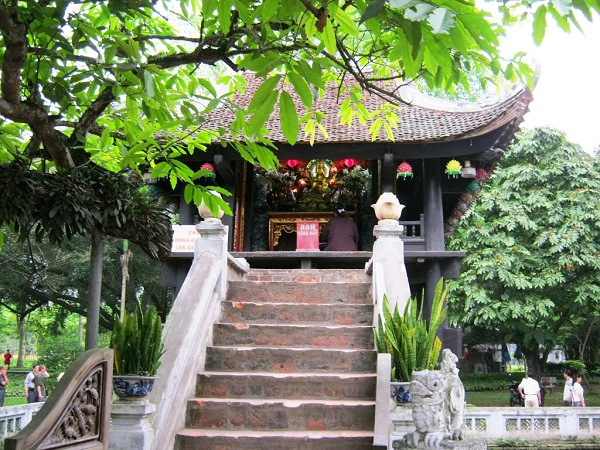
The front view of One Pillar Pagoda
The One Pillar Pagoda is located in the heart of Ba Dinh district, next to the Ba Dinh Square complex and the Ho Chi Minh Mausoleum. Visitors wishing to visit and worship at the pagoda can travel by various means of transportation such as motorbike, taxi, bus, etc.
Visitors can combine a visit to the pagoda with a visit to the Ho Chi Minh Mausoleum, the Presidential Palace, and the Thang Long Imperial Citadel, all located in the same area. A suggested itinerary is: Visit the Ho Chi Minh Mausoleum, then the Presidential Palace, past the Ho Chi Minh Museum, and ending at the One Pillar Pagoda.
according to nghisitre.quochoi.vn
Source















































































Comment (0)