

The fate of the universe remains an unanswered question, after new data showed that dark energy, which powers the expansion of the universe, has been gradually weakening over the past four or five billion years.
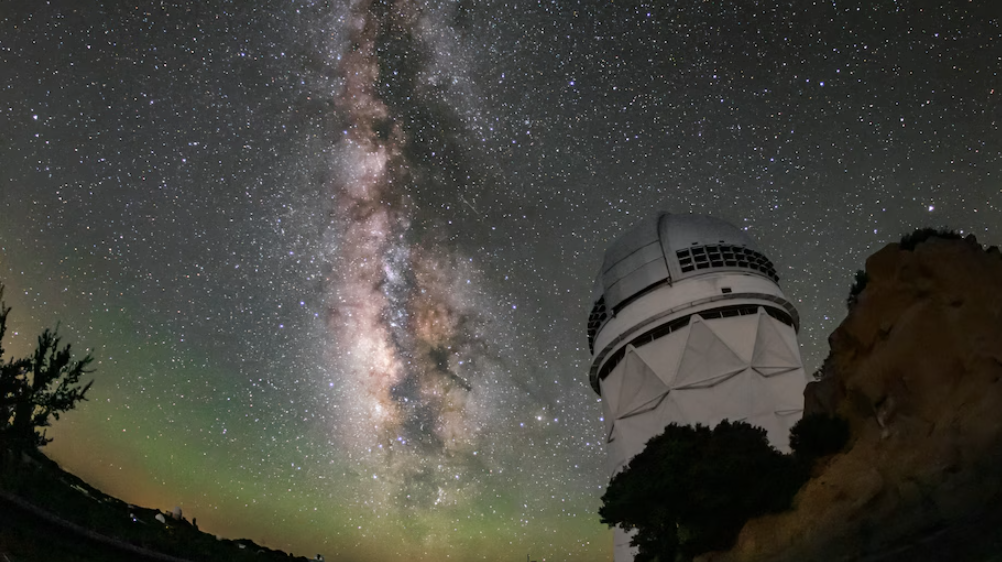
The Nicholas U. Mayall Telescope at the National Observatory on Mount Kitt near Tucson (Arizona, USA)
Prior to 1998, scientists believed that the rate of expansion of the universe following the Big Bang would gradually slow down due to the effects of gravity.
However, in 1998, two independent research teams from the US and Australia, while studying supernovae, discovered that the expansion of the universe was actually accelerating, rather than slowing down as previously thought.
Based on this discovery, astronomers believe that a mysterious force must be behind the phenomenon, and they have named it "dark energy".
Unless something changes, researchers predict that billions or trillions of years from now, the universe could become a cold, dark, and lifeless space.
However, The Washington Post reported on March 19, citing new data released that same day by scientists participating in the DESI (Dark Energy Spectrometer) survey, that the expansion trend of the universe has actually been weakening over the past 4 to 5 billion years.
According to the DESI team's analysis, dark energy may not be a "cosmological constant" as previously thought, but rather evolves over time.
If the "progressive dark energy" hypothesis holds true in future research, the future of the universe will be something truly unpredictable.
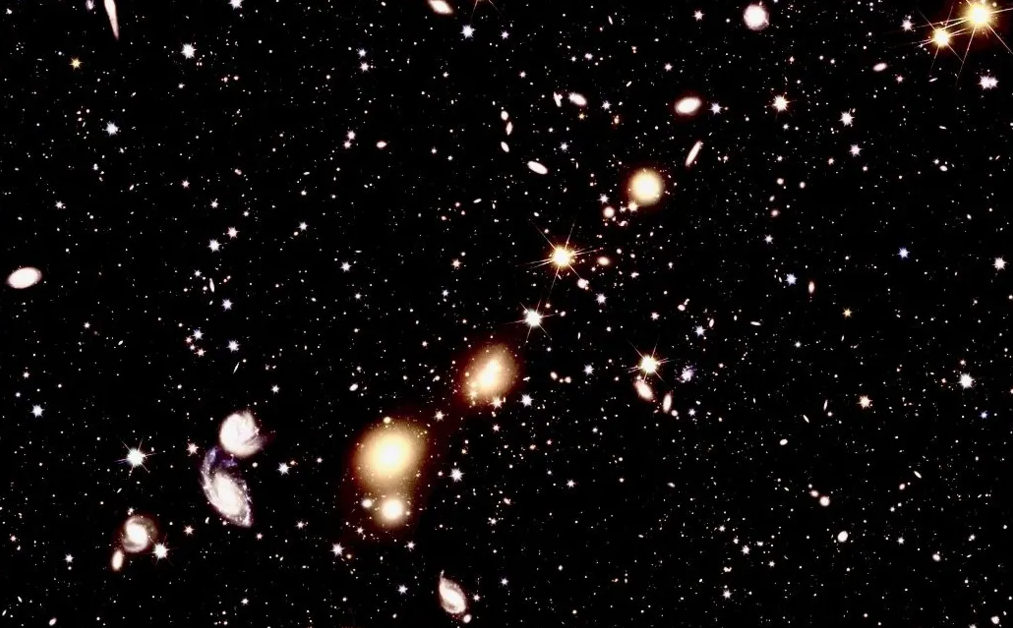
The universe may have stopped expanding because dark energy is weakening.
Perhaps the universe will move towards a stage of maturity and stability, rather than being rushed and unchangeable.
Or perhaps the expansion process will accelerate again, as if being acted upon by some mysterious force.
Or perhaps things will reverse, and the universe will shrink.
"These results once again raise the possibility that the universe may not continue expanding forever. One possibility under current analysis is that the universe may stop expanding and contract," The Washington Post quoted Mustapha Ishak, cosmologist at the University of Texas, as cosmologist and co-chair of the data analysis group.
"We cannot predict how dark energy will behave in the future," said Willem Elbers, a cosmologist at Durham University (UK) and co-chair of the DESI team.
Supercomputer predicts the end of humanity when the Earth runs out of oxygen.
Source: https://thanhnien.vn/vu-tru-doi-mat-tuong-lai-kho-doan-vi-nang-luong-toi-bat-ngo-suy-yeu-185250320110312326.htm
![[Photo] Closing Ceremony of the 10th Session of the 15th National Assembly](/_next/image?url=https%3A%2F%2Fvphoto.vietnam.vn%2Fthumb%2F1200x675%2Fvietnam%2Fresource%2FIMAGE%2F2025%2F12%2F11%2F1765448959967_image-1437-jpg.webp&w=3840&q=75)


![[Photo] Prime Minister Pham Minh Chinh holds a phone call with the CEO of Russia's Rosatom Corporation.](/_next/image?url=https%3A%2F%2Fvphoto.vietnam.vn%2Fthumb%2F1200x675%2Fvietnam%2Fresource%2FIMAGE%2F2025%2F12%2F11%2F1765464552365_dsc-5295-jpg.webp&w=3840&q=75)











































![[OFFICIAL] MISA GROUP ANNOUNCES ITS PIONEERING BRAND POSITIONING IN BUILDING AGENTIC AI FOR BUSINESSES, HOUSEHOLDS, AND THE GOVERNMENT](https://vphoto.vietnam.vn/thumb/402x226/vietnam/resource/IMAGE/2025/12/11/1765444754256_agentic-ai_postfb-scaled.png)















































Comment (0)