

The use of artificial intelligence (AI) in wildfire detection and early warning is developing globally as climate change dramatically increases the risk of wildfires in countries around the world .
Recently, California firefighters have been using AI to detect and control wildfires early. The program, called ALERTCalifornia, aims to detect fires earlier and minimize false alarms using AI technology. Developed by engineers at the University of California San Diego, the platform utilizes 1,036 existing cameras installed by government agencies and power companies across the state.
[caption id="attachment_428056" align="aligncenter" width="768"]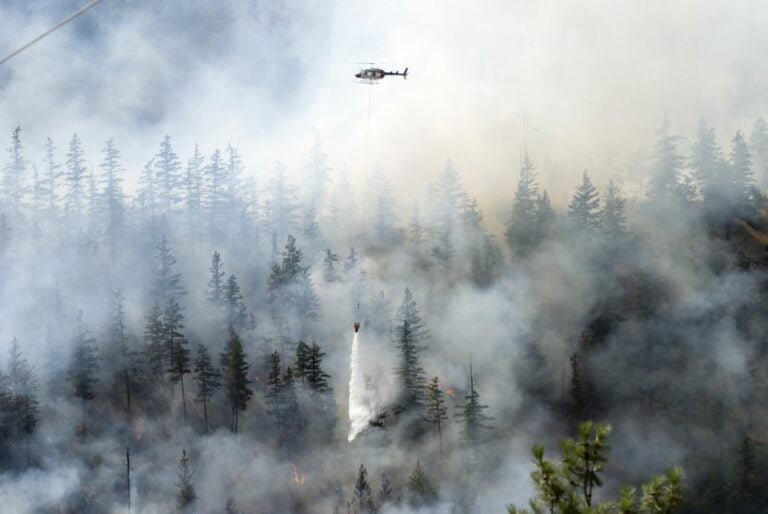 Climate change is increasing wildfires globally. [Image: iStock]
Suzann Leininger, an artificial intelligence expert at the California Fire Department, said: "Our job is to keep fires within an area of about 0.4 hectares. Therefore, with the help of AI cameras, we can more easily reach the fire and control it more quickly."
According to Professor Neal Driscol, a geologist and physicist at the University of California San Diego, 5-6 years ago, checking for fires required sending aircraft or even a whole squad. Now, simply filming with a camera is enough to detect fires. These cameras can show how far the smoke travels, how dark the environment is, and so on. This helps us assess the extent of the fire and quickly extinguish it without calling 911.
The technology website Alert California revealed how this AI works. According to them, they use LiDAR scans taken from aircraft and drones to create “three-dimensional, equally accurate information about the scanned surfaces.”
Combining this with the physical characteristics of tree species, one can learn more about forest biomass and the carbon content of the state of California. The California Fire Department said the machine learning model leveraged petabytes of data from cameras to differentiate between smoke and other airborne particles.
At the World Economic Forum (WEF) annual meeting in January 2023, a report titled "The Next Frontier in Fighting Wildfires: FireAId Pilot and Scaling" was published. According to this report, the FireAId initiative, which uses artificial intelligence to effectively manage wildfires, has been successfully tested since its launch by the WEF in January 2022.
The project is being implemented in Türkiye's South Aegean and Western Mediterranean regions. According to reports, this area was chosen because one-quarter of the country's wildfires occurred there between 2010 and 2021, accounting for 75% of the total area burned during that period. From July to August 2021, Türkiye experienced some of its worst wildfires, burning a total of 139,503 hectares.
Here, scientists used static and meteorological data to map areas where wildfires could start, predict intensity, and plan the necessary logistics for an effective response.
According to Weforum, thanks to successful application in Türkiye, the accuracy rate in predicting forest fires 24 hours in advance has reached 80%. This information helps authorities prepare and respond proactively. The success of the pilot program demonstrates how effective AI is in assisting management agencies and saving lives, protecting property, protecting the environment, and significantly reducing damage caused by forest fires.
[caption id="attachment_428070" align="aligncenter" width="768"] Wildfire monitors at the University of California (USA) track a fire in July 2023 in Topanga Canyon near Los Angeles. Photo: New York Times
Climate change has increased the severity and frequency of wildfires in recent years, causing unprecedented biodiversity loss, carbon dioxide emissions, and financial damage worldwide.
WEF statistics show that the average annual cost of wildfires globally is approximately $50 billion, while in 2021 global wildfires released around 6,450 megatons of CO2 into the atmosphere.
Meanwhile, the World Meteorological Organization forecasts that the rate of extreme wildfires globally will increase by 30% by 2050 and double by the end of this century.
AI-powered wildfire detection systems utilize various sensors such as cameras, satellites, and drones to detect fires in real time, enabling early response and timely action. These systems have proven effective, cost-efficient, and accurate in detecting fires, minimizing the impact of wildfires on the environment and local communities.
Minh Thai


![[Image] Central Party Office summarizes work in 2025](/_next/image?url=https%3A%2F%2Fvphoto.vietnam.vn%2Fthumb%2F1200x675%2Fvietnam%2Fresource%2FIMAGE%2F2025%2F12%2F18%2F1766065572073_vptw-hoi-nghi-tong-ket-89-1204-jpg.webp&w=3840&q=75)















![[Video] Launch of two books on history and heritage preservation](https://vphoto.vietnam.vn/thumb/402x226/vietnam/resource/IMAGE/2025/12/18/1766072185865_2663241292917005256-4230-jpg.webp)










































































Comment (0)