

When people think of Phu Quoc, they often think of beach bathing, but there's a very different landscape hidden deep within Phu Quoc National Park that sparks the curiosity of visitors.
Phu Quoc National Park covers a total area of 31,422 hectares, located in six communes: Cua Duong, Cua Can, Ganh Dau, Bai Thom, Ham Ninh, and part of Duong To commune. The park has three forest ecosystems: evergreen broadleaf forest, Melaleuca forest, and coastal mangrove forest. According to the Phu Quoc National Park website, it is home to approximately 1,400 plant species and nearly 500 animal species.
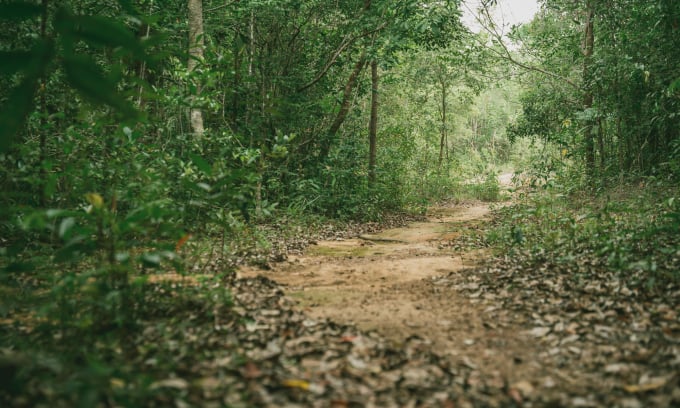
Trekking routes in Phu Quoc National Park.
Nguyen Anh Tien, a tour guide in Phu Quoc, said that trekking through the forest in Phu Quoc National Park is a new experience that has emerged in the last two years and is not yet widely known to tourists. Each month, he receives about 5-7 tours, with each tour ranging from 2 to 12 guests.
On May 23rd, Le Minh Tan (29 years old, Ho Chi Minh City) completed a trek of approximately 9 km, with different routes going and returning, including three rest stops. "The trek was relatively easy, not too steep, suitable for beginners," Tan said after spending about three hours traveling there and about an hour and a half returning.
Because it doesn't require too much physical exertion, he has time to focus on observing, experiencing, and eating various wild fruits such as sim fruit, the fruit and leaves of the bứa tree (a type of mangosteen), guava, and mushrooms. Depending on the season, different types of wild fruits and leaves will be available.
Besides mosses, herbaceous plants, fruit trees, ancient trees, or edible plants, the guides also introduce rare plants listed in the Red Book, or unfamiliar plants they've never heard of before. Some medicinal plants and herbs can be found along the trek, such as reishi mushrooms, cloud mushrooms, and ant nest plant (Aquilaria sinensis).
If lucky, visitors may also encounter wildlife such as monkeys, weasels, monitor lizards, and other monitor lizards. Some insects and reptiles are easier to spot, such as snakes, centipedes, and lizards.
According to Mr. Tien, one of the situations that easily frightens many people when trekking in the forest is encountering snakes. In this case, tourists need to remain calm, not try to chase them away, to avoid injuring or attacking the snake. Experienced guides will proactively handle the situation.
The final point of the trek is Thầy Tu Waterfall, approximately 5 meters high. Surrounding the waterfall are arched rock formations that provide shelter from rain and sun, and can also be used as cooking areas or places to rest during lunchtime. Near the waterfall, there is a sinkhole where visitors can take photos for social media.
Water from the waterfall flows into a relatively large lake just below, the water is clear and cool. Visitors can swim, fish, or take photos. There are also many large, flat rocks here for camping and stargazing at night.
"During the trek, it started raining, and I thought I was out of luck. But when we reached the waterfall, the water level rose, making it even more impressive," Tấn said.
According to Mr. Tien, the best time to trek this route is during the dry season, from September to February of the following year, when there is less rain, but the waterfalls and streams still have plenty of water and the vegetation is lush. Currently, it is the rainy season in Phu Quoc, but because the terrain is not too complicated, tourists can still experience trekking, only avoiding going during storms or heavy rain.
Mr. Tien suggested that tourists should bring insect repellent creams and sprays, long-sleeved clothing, hats, sunglasses, sunscreen, swimwear, sports shoes, and waterproof bags for their phones.
Food is prepared in advance by the guides. Along the trek, visitors can pick some mushrooms and wild vegetables to eat with grilled meat at the rest stop. The National Park has strict regulations regarding the use of fire and hunting/gathering, so visitors must follow the guide's instructions.
Tourists are also reminded not to litter, not to touch the animals and plants in the forest without permission, and not to cut down or take anything out of the forest. The guides for Mr. Tan's group all carried bags and collected all the trash along the trek.
"Looking at these images of lush green trees, it's hard to believe this is a forest in Phu Quoc," Mr. Tan said, having previously assumed that Phu Quoc's forests were "sparse." If visitors are already familiar with the blue of Phu Quoc's sea, Mr. Tan suggests they should come and admire the green of the forest for a truly enjoyable experience.
Quynh Mai
Photo : Nguyen Anh Tien
Source link
![[Image] First Congress of the Vietnam Science and Technology Trade Union](/_next/image?url=https%3A%2F%2Fvphoto.vietnam.vn%2Fthumb%2F1200x675%2Fvietnam%2Fresource%2FIMAGE%2F2025%2F12%2F24%2F1766552551054_ndo_tr_img-1801-jpg.webp&w=3840&q=75)










































































Comment (0)