

Held by the Ottoman Empire until 1917, the area was then transferred from British and Egyptian military rule to Israeli control and is now home to over 2 million Palestinians. Here are some key milestones in the area's history over the past 75 years:
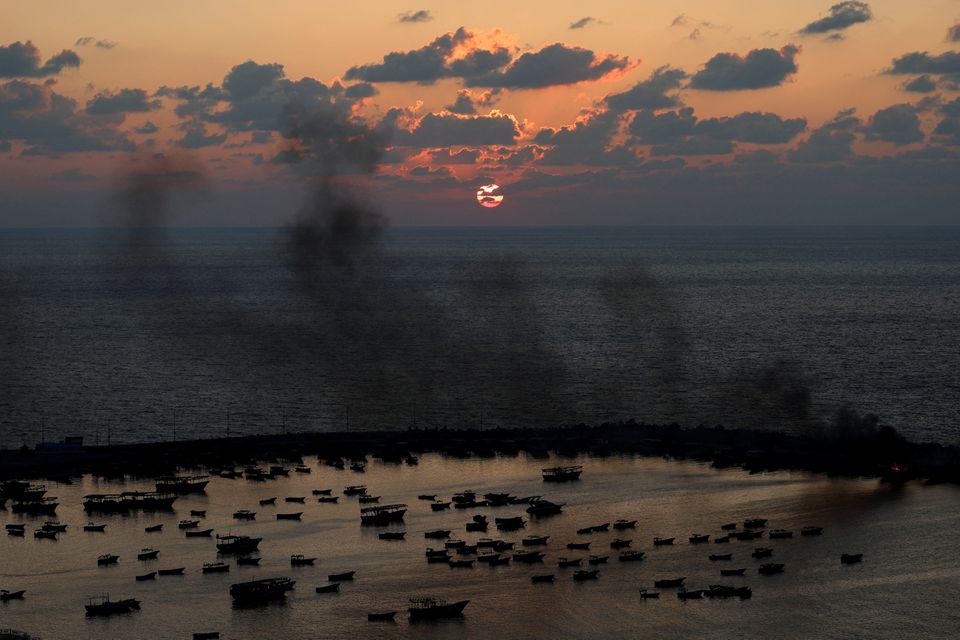
Smoke rises from the port area of Gaza. Photo: Reuters
1948: End of British rule
When British colonial rule in Palestine ended in the late 1940s, violence escalated between Jews and Arabs, culminating in the war between the newly formed State of Israel and its Arab neighbors in May 1948.
The Egyptian army seized this narrow 40-kilometer-long strip of coastline, running from Sinai to south of Ashkelon. Subsequently, tens of thousands of Palestinians sought refuge in Gaza. This influx of refugees tripled Gaza's population to approximately 200,000.
1950-1960: Military rule in Egypt
Egypt held the Gaza Strip for two decades, allowing Palestinians to work and study in Egypt. During this time, armed Palestinians carried out attacks against Israel.
Subsequently, the United Nations established a refugee agency called UNRWA, which currently provides services to 1.6 million Palestinian refugees in Gaza, as well as to Palestinians in Jordan, Lebanon, Syria, and the West Bank.
1967: War and Israeli military occupation
Israel seized control of the Gaza Strip during the 1967 Middle East War. An Israeli census that year indicated a population of 394,000 in Gaza, with at least 60% of them being refugees.
When the Egyptians left, many workers in Gaza began working in agriculture , construction, and services within Israel. The Israeli military continued to administer the territory and protect the settlements Israel built in the following decades. These factors became a source of growing Palestinian resentment.
1987: The first Palestinian uprising.
Twenty years after the 1967 war, Palestinians launched their first uprising. It began in December 1987 following a traffic accident when an Israeli truck crashed into a vehicle carrying Palestinian workers at the Jabalya refugee camp in Gaza, killing four people. This was followed by stone-throwing protests, strikes, and shutdowns.
The Egyptian-based Muslim Brotherhood exploited public anger to establish an armed Palestinian faction, Hamas, with its power base in Gaza. Hamas advocates for attacks on Israel and the restoration of Islamic rule.
1993: The Oslo Accords and the semi-autonomy of the Palestinians
Israel and the Palestinians signed a historic peace agreement in 1993 that led to the establishment of the Palestinian Authority. Under the interim agreement, Palestinians were initially granted limited control over Gaza and Jericho in the West Bank.
The Oslo Accords granted the newly established Palestinian Authority some autonomy and were envisioned to become a state within five years. But that never happened. Israel accused the Palestinians of abandoning the security agreements, and the Palestinians were angered by Israel's continued settlement construction.
The Hamas and Islamic Jihad movements carried out bombings in an attempt to derail the peace process, prompting Israel to impose more restrictions on Palestinian movement out of Gaza.
2000: The second Palestinian uprising
In 2000, relations between Israel and Palestine reached a new low after the second Palestinian uprising. This triggered a period of Palestinian suicide bombings and gun attacks, as well as Israeli airstrikes, destruction, and strict control of the area.
Gaza International Airport, a symbol of Palestinian hopes for economic independence, opened in 1998 but was considered a security threat by Israel, which destroyed its radar antenna and runway months after the September 11, 2001 attacks in the United States.
Another victim is Gaza's fishing industry, the livelihood of tens of thousands of people. Gaza's fishing grounds have been narrowed by Israel, a restriction they deem necessary to prevent arms smuggling.
2005: Israel evacuates settlements in Gaza.
In August 2005, Israel evacuated all its troops and settlers from Gaza, which at the time had been completely isolated from the outside world by Israeli barricades.
Palestinians demolished abandoned buildings and infrastructure for scrap metal. The dismantling of settlements led to greater freedom of movement within Gaza and a booming "tunnel economy." Armed groups, smugglers, and numerous businesspeople quickly dug tunnels into Egypt to smuggle goods back into Gaza.
2006: Isolated under Hamas
In 2006, Hamas won a surprise victory in the Palestinian parliamentary elections and subsequently gained full control of Gaza. Much of the international community cut aid to Palestinians in Hamas-controlled areas because they considered Hamas a terrorist organization.
Israel has prevented tens of thousands of Palestinian workers from entering the country, cutting off a vital source of income. Israeli airstrikes have crippled Gaza's only power plant, causing widespread power outages. Citing security concerns, Israel and Egypt have also imposed stricter restrictions on the movement of people and goods through Gaza's border crossings.
Hamas planned to refocus Gaza's economy toward the border with Egypt, away from Israel. However, viewing Hamas as a threat, Abdel Fattah al-Sisi, who was elected President of Egypt in 2014, closed the border with Gaza and blew up most of the tunnels. Once again, Gaza's economy was isolated.
Conflict cycle
The Gaza economy is constantly affected by the cycle of conflict, attacks, and retaliation between Israel and Palestinian militant groups.
Prior to 2023, some of the worst fighting occurred in 2014, when Hamas and other armed groups launched rockets at central Israeli cities. Israel launched devastating airstrikes and artillery bombardments of residential areas in Gaza. More than 2,100 Palestinians were killed. 73 Israelis were killed.
2023: The surprise attack
While Israel believes it is effectively containing Hamas, the group's fighters are being trained in secret.
On October 7th, Hamas militants launched a surprise attack on Israel, devastating towns, shooting hundreds of people, and taking dozens hostage. Israel retaliated, attacking Gaza with airstrikes in the worst conflict in 75 years, with approximately 2,000 people killed on both sides.
Quoc Thien (according to Reuters)
Source


































































































Comment (0)