

Prime Minister Pham Minh Chinh instructed the Ministry of Finance to finalize the draft plan for developing a carbon market as soon as possible and submit it to the Government for approval in July.
On the afternoon of July 14th, the Prime Minister chaired a meeting of the National Steering Committee for implementing Vietnam's commitment to net-zero emissions by 2050. The head of government requested the Ministry of Natural Resources and Environment to develop a decree on carbon credit management and submit it to the Government in the second quarter of 2024.
The Ministry of Natural Resources and Environment is also tasked with coordinating with the Ministry of Agriculture and Rural Development to learn from the experiences of other countries and advise the Prime Minister on issuing a directive on managing forest carbon credits in Vietnam. Four other ministries are tasked with promptly issuing regulations on responding to climate change and reducing greenhouse gas emissions. Businesses with greenhouse gas emissions will be inventoried.
CO2 credits (carbon credits) are tradable certificates representing the right to emit one ton of CO2, or an equivalent ton of other greenhouse gases. The trading mechanism is such that a company producing 12 tons of emissions while the permitted limit is 10 tons can purchase 2 tons of credits from a company that emits less than the limit. This is verified by a third party. The ultimate goal of carbon credits is to reduce greenhouse gas emissions into the atmosphere.
The global market for trading carbon credits is quite active. In Vietnam, the government aims to establish and operate a pilot carbon credit exchange by 2025. Three years later, the exchange will be officially operational.
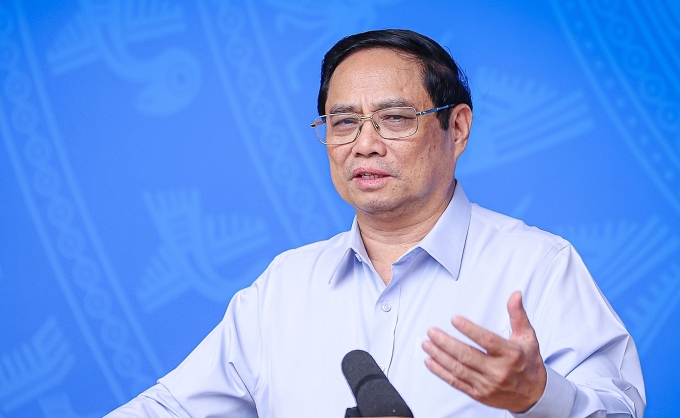
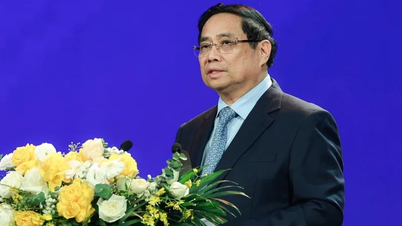
Prime Minister Pham Minh Chinh. Photo: Nhat Bac
At the end of 2022, Huong Hoa district, Quang Tri province, began selling carbon credits for the first five forests in Vietnam to receive FSC international certification for CO2 absorption and storage. Huong Hoa district has 2,150 hectares of forest, capable of absorbing 7,000 tons of CO2 per year. The local authorities are currently negotiating with a Dutch company to sell carbon credits at a price of $10 per ton of CO2.
However, not many localities are able to sell carbon credits. Many foreign businesses and organizations want to buy carbon credits in Vietnam but face obstacles due to the lack of a clear legal framework.
When entering Vietnam, businesses need a coordinating agency from the Government to provide guidance because the carbon market encompasses many sectors such as forestry, energy, livestock, veterinary medicine, etc. Vietnam still lacks a carbon rights registration system or a list of carbon-related facilities and projects for businesses to access.
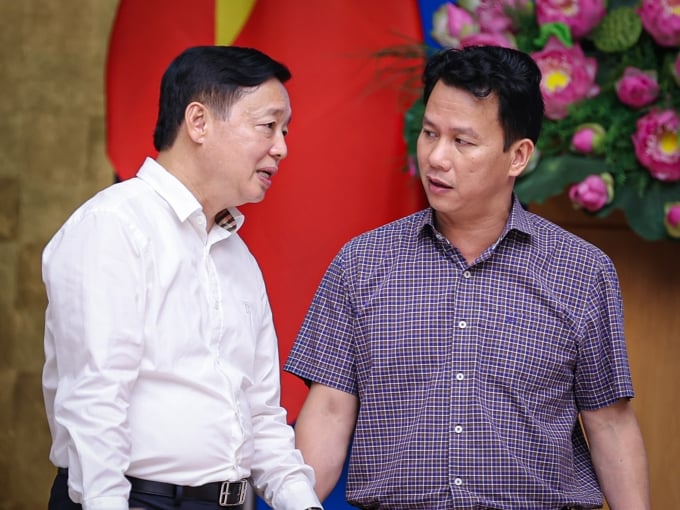
Deputy Prime Minister Tran Hong Ha (far left) and Minister of Natural Resources and Environment Dang Quoc Khanh discuss at the afternoon session on July 14. Photo: Nhat Bac
At today's meeting, Prime Minister Pham Minh Chinh affirmed that green development, energy transition, and emission reduction are inevitable and irreversible trends. Vietnam cannot stand aside and needs to see this as an opportunity to develop and restructure the economy towards a green and sustainable direction. "Green development must be sustainable, inclusive, comprehensive, and leave no one behind," the government leader said.
He instructed the Ministry of Industry and Trade to promptly submit a pilot mechanism for direct electricity purchase and sale between renewable energy power generation units and large consumers; and to establish a mechanism to encourage the development of rooftop solar power. This policy aims to accelerate equitable energy transition projects and fulfill Vietnam's commitments at COP26.

![[Photo] Prime Minister Pham Minh Chinh receives Lao Minister of Education and Sports Thongsalith Mangnormek](/_next/image?url=https%3A%2F%2Fvphoto.vietnam.vn%2Fthumb%2F1200x675%2Fvietnam%2Fresource%2FIMAGE%2F2025%2F12%2F16%2F1765876834721_dsc-7519-jpg.webp&w=3840&q=75)
![[Photo] Prime Minister Pham Minh Chinh receives the Governor of Tochigi Province (Japan)](/_next/image?url=https%3A%2F%2Fvphoto.vietnam.vn%2Fthumb%2F1200x675%2Fvietnam%2Fresource%2FIMAGE%2F2025%2F12%2F16%2F1765892133176_dsc-8082-6425-jpg.webp&w=3840&q=75)

![[Live] 2025 Community Action Awards Gala](/_next/image?url=https%3A%2F%2Fvphoto.vietnam.vn%2Fthumb%2F1200x675%2Fvietnam%2Fresource%2FIMAGE%2F2025%2F12%2F16%2F1765899631650_ndo_tr_z7334013144784-9f9fe10a6d63584c85aff40f2957c250-jpg.webp&w=3840&q=75)
![[Image] Leaked images ahead of the 2025 Community Action Awards gala.](/_next/image?url=https%3A%2F%2Fvphoto.vietnam.vn%2Fthumb%2F1200x675%2Fvietnam%2Fresource%2FIMAGE%2F2025%2F12%2F16%2F1765882828720_ndo_br_thiet-ke-chua-co-ten-45-png.webp&w=3840&q=75)













































![[Photo] Prime Minister Pham Minh Chinh attends the Vietnam Economic Forum 2025](https://vphoto.vietnam.vn/thumb/402x226/vietnam/resource/IMAGE/2025/12/16/1765893035503_ndo_br_dsc-8043-jpg.webp)





















Comment (0)